Opening Hours
Daily: 10 A.M.–5 P.M.
Closed on Tuesdays
1151 Oxford Road
San Marino, CA 91108
Daily: 10 A.M.–5 P.M.
Closed on Tuesdays
1151 Oxford Road
San Marino, CA 91108

Visual Materials
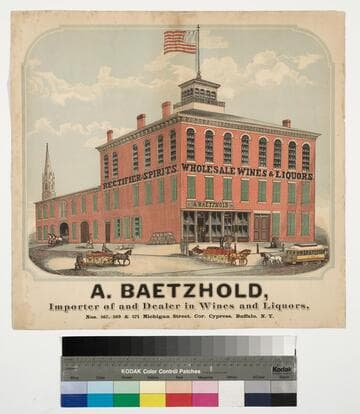
Image of an eye-level view of the storefront of the three-story brick building of the distillery and office of August Baetzhold in Buffalo, New York, showing horse-drawn carts moving barrels of spirits, a horse-drawn omnibus full of passengers, and pedestrians on the street outside; "A. Baetzhold" and "Rectifier of Spirits. Wholesale Wines & Liquors." painted on the building; a church steeple is visible in the background.
priJLC_BEV_001024
Visual Materials
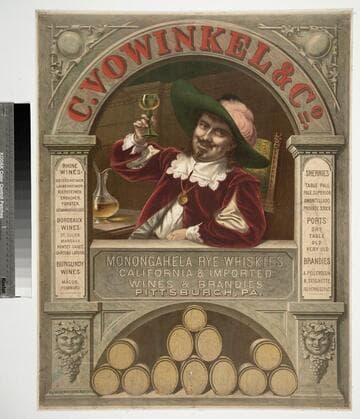
Image of a man seated in a brocade chair at an arched window raising a wine glass with a wine decanter visible on a table at left; the man is wearing a historical costume with a velvet jacket with slashed sleeves, square lace-trimmed collar, gold necklace, and large hat with feather; stonework surrounding the window has carved Bacchus heads and grape clusters; wooden barrels at center under a smaller stone arch; stone plaque panel on left reads, "Rhine wines: Deidesheimer, Laubenheimer, Niersteiner, Erbacher, Forster, Assmannshaeuser. Bordeaux wines: St. Julien, Margaux, Pontet Canet, Chateau Latour. Burgundy wines: Macon, Pommard." and stone plaque panel on right reads, "Sherries: Table Pale, Pale, Superior, Amontillado, Private Stock. Ports: Dry, Table, Old, Very Old. Brandies: A. Pellevoisin, A. Seignette, Jas. Hennessy & Co."
priJLC_BEV_001867
Image not available
Visual Materials
The Jay T. Last collection of beverage prints and ephemera contains approximately 2,650 printed items advertising beverage products and related businesses in the United States from the 1840s to the 1940s, with the bulk of the items spanning from 1850 to 1915. The collection consists largely of lithographed ephemeral items produced for American businesses affiliated with the manufacture, distribution, and sale of beverages such as coffee, tea, juice, milk, carbonated beverages, and alcoholic drinks including beer, wine, whiskey, and other liquors. The collection includes approximately 40 large-size items comprised mainly of lithographed advertising prints and product labels for tea, coffee, and spirits. Small-size items number approximately 2,600 and contain a variety of promotional materials including trade cards, calendars, die-cut scraps, booklets, and printed billheads and letterheads with manuscript text. The collection deals with beverage production, merchandising, advertising, and consumption -- including depictions of families and other groups drinking together -- and the images provide a resource for studying the history of American beer, liquor, coffee, tea, and carbonated beverage industries along with the evolution of their advertising in the 19th and early 20th centuries. Materials in the collection produced for manufacturers and distributors of alcoholic beverages also provide a perspective on their advertising strategies in the face of a growing temperance movement in the United States leading up to Prohibition. As graphic materials, the prints offer evidence of developing techniques and trends in printmaking, and of the artists, engravers, lithographers, printers, and publishers involved in the creative process.
Visual Materials
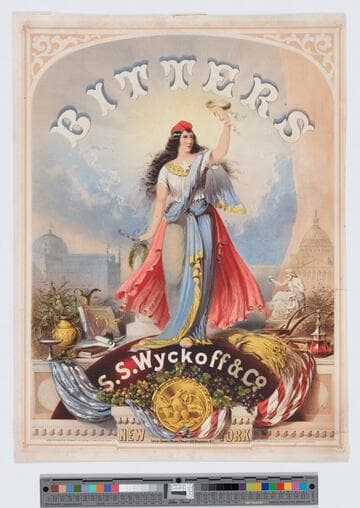
Image of an advertisement for bitters sold by S. S. Wyckoff & Co. of New York, New York; allegorical woman figure wearing a liberty cap and holding laurel wreaths in each hand at center surrounded by books, ewers, sculpture, sheaves of grain, grapes, and a draped American flag; United States Capitol building in background; United States seal with eagle at bottom center.
priJLC_MED_002616
Image not available
Manuscripts
The manuscript defines and explains the process of fermentation, with instructions for the fermentation and distillation of wines and liquors and recipes for making brandy, cinnamon water, and "a good water for expelling wind." The author and nationality of this brief account of distilling and fermenting is unknown; according to the dealer from whom it was purchased, the mansucript was found in the attic of an estate on Cape Cod, Massachusetts.
mssHM 66750
Image not available
Visual Materials
The Jay T. Last collection of beverage prints and ephemera contains approximately 2,650 printed items advertising beverage products and related businesses in the United States from the 1840s to the 1940s, with the bulk of the items spanning from 1850 to 1915. The collection consists largely of lithographed ephemeral items produced for American businesses affiliated with the manufacture, distribution, and sale of beverages such as coffee, tea, juice, milk, carbonated beverages, and alcoholic drinks including beer, wine, whiskey, and other liquors. The collection includes approximately 40 large-size items comprised mainly of lithographed advertising prints and product labels for tea, coffee, and spirits. Small-size items number approximately 2,600 and contain a variety of promotional materials including trade cards, calendars, die-cut scraps, booklets, and printed billheads and letterheads with manuscript text. The collection deals with beverage production, merchandising, advertising, and consumption -- including depictions of families and other groups drinking together -- and the images provide a resource for studying the history of American beer, liquor, coffee, tea, and carbonated beverage industries along with the evolution of their advertising in the 19th and early 20th centuries. Materials in the collection produced for manufacturers and distributors of alcoholic beverages also provide a perspective on their advertising strategies in the face of a growing temperance movement in the United States leading up to Prohibition. As graphic materials, the prints offer evidence of developing techniques and trends in printmaking, and of the artists, engravers, lithographers, printers, and publishers involved in the creative process.
priJLC_BEV_004723
priJLC_BEV