Paintings
Sam with Sam Chifney, Jr., Up
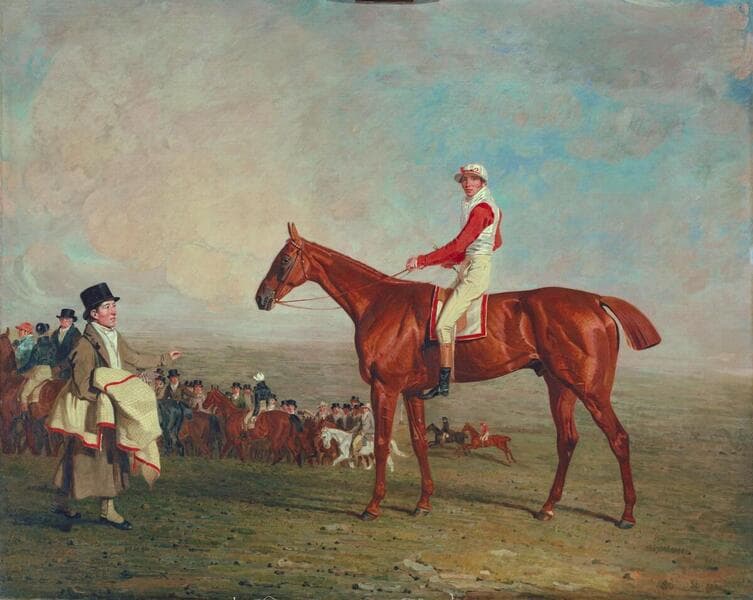
Sam Chifney, Jr., was born in 1786, the younger of two sons of the famous jockey Sam Chifney, Sr., and his wife, a daughter of the Newmarket horse trainer Frank Smallman. Relentlessly instructed in his father's idiosyncratic riding techniques, the boy began to distinguish himself as a jockey in his early teens. In 1802 he joined Perren's stables at Newmarket where his patrons included Thomas Thornhill (1780-1844) of Riddlesworth Hall, Norfolk, who became a good friend. In 1812 Chifney married his boss's daughter and, buoyed by success, left Perren's stables to work independently. Among many classic races, he won the Oaks Stakes at Epsom in 1807, 1811, 1816, 1819, and 1825. He won the Derby at Epsom in 1818 and 1819, riding Thomas Thornhill's horses on both occasions. In this portrait, Chifney appears in Thornhill's white-bodied jacket with red sleeves, astride the racehorse that Thornhill named for him: Sam, a chestnut colt foaled in 1815 by Scud out of Hyale. Chifney rode his namesake to victory in the Derby Stakes, May 28, 1818. The horse went on to win two minor races at Newmarket on October 26, 1818, and April 15, 1819, and placed second or third in five other races, but his career was short-lived. Sold to a Mr. Charlton in 1819, he was retired to the stud at Ludlow, where he sired at least four racehorses. Chifney's career proved more enduring. He won his last classic race, the One Thousand Guineas Stakes, in 1843 at the age of fifty-seven on Thornhill's Extempore. Through audacious betting coups, Chifney netted huge profits for himself and his patrons. In gratitude, a group led by the Duke of Cleveland built Chifney a grand neo-classical house in Newmarket, where he indulged his growing taste for lavish expenditure and indolence. Rather than starve off the ten to twenty pounds added each winter to his five-foot, six-inch frame, Chifney increasingly declined profitable riding opportunities. Financial hardship in the early 1830s forced him to sell his opulent home, but on his death in 1844, Thomas Thornhill (who had remained a loyal friend) left Chifney his Newmarket house and stables for life. In November 1851 Chifney moved to Hove on the Sussex seaside, where he died on August 29, 1854. The words "Of Newmarket" provided the only epitaph on his headstone.
In 1812 Ben Marshall left his urban London studio and re-established his painting practice in the vicinity of Newmarket race course, where he immersed himself in the sporting life that provided the principal subject matter of his art. As he reportedly told his pupil Abraham Cooper, "the second animal in creation is a fine horse, and at Newmarket I can study him in the greatest grandeur, beauty and variety." Marshall is said to have been in the habit of setting up his easel in the stable of his friend, the jockey Sam Chifney, Jr., where the lighting was good and he had direct access to horses. In the present painting, as in many of Marshall's works, the horse claims center stage and is depicted in hyper-realistic anatomical detail that immediately arrests the eye. This emphasis on the animal's underlying muscles and skeleton probably reflects Marshall's conscious emulation of George Stubbs (1724-1806), whose dissection work, documented in The Anatomy of the Horse (1766), introduced a new level of sophistication to equine portraiture. In the majority of Stubbs's paintings, however, anatomy is allied to the artist's instinctive naturalism and psychological insight. Marshall, by contrast, pursued anatomy as an end in itself, privileging his abstract knowledge of equine structure over his subjective impressions of a particular animal. Here, the racehorse Sam is presented in the diagrammatic fashion characteristic of Marshall's paintings, with emphasis placed on the network of muscles, bones, and tendons beneath his flesh, and the range of colors created by the play of light and shadow on his shiny red coat.
In 1812 Ben Marshall left his urban London studio and re-established his painting practice in the vicinity of Newmarket race course, where he immersed himself in the sporting life that provided the principal subject matter of his art. As he reportedly told his pupil Abraham Cooper, "the second animal in creation is a fine horse, and at Newmarket I can study him in the greatest grandeur, beauty and variety." Marshall is said to have been in the habit of setting up his easel in the stable of his friend, the jockey Sam Chifney, Jr., where the lighting was good and he had direct access to horses. In the present painting, as in many of Marshall's works, the horse claims center stage and is depicted in hyper-realistic anatomical detail that immediately arrests the eye. This emphasis on the animal's underlying muscles and skeleton probably reflects Marshall's conscious emulation of George Stubbs (1724-1806), whose dissection work, documented in The Anatomy of the Horse (1766), introduced a new level of sophistication to equine portraiture. In the majority of Stubbs's paintings, however, anatomy is allied to the artist's instinctive naturalism and psychological insight. Marshall, by contrast, pursued anatomy as an end in itself, privileging his abstract knowledge of equine structure over his subjective impressions of a particular animal. Here, the racehorse Sam is presented in the diagrammatic fashion characteristic of Marshall's paintings, with emphasis placed on the network of muscles, bones, and tendons beneath his flesh, and the range of colors created by the play of light and shadow on his shiny red coat.