Skip to content

OPEN TODAY: 10 A.M.–5 P.M.

Tickets

Visual Materials

Copy of a Plan returned by His Maj'tys Com'rs. for settling the Boundarys between the Provinces of New Hampshire and Massachusetts Bay, along with the said Com'rs. Judgement of 2. Sept. 1737


You might also be interested in

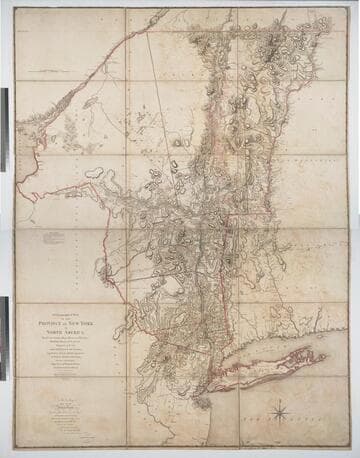
  • Chorographical Map of the Province of New York in North America, Divided into Counties, Manors, Patents and Townships; Exhibiting likewise all the private Grants of Land made and located in that Province; Compiled from Actual Surveys deposited in the Patent Office at New York

    Chorographical Map of the Province of New York in North America, Divided into Counties, Manors, Patents and Townships; Exhibiting likewise all the private Grants of Land made and located in that Province; Compiled from Actual Surveys deposited in the Patent Office at New York

    Visual Materials

    An enormous wall map, measuring 6 feet by almost 5 feet, canvas backed. Kashnor notes, "Shows the military grants made in Oct. 1763, around Lake George and Lake Champlain. A magnificent map of the Province of New York on the eve of Independence, taking in that part which was afterward erected into the State of Vermont, in fact the map is the title-roll to the early land holders in Vermont." Compass Rose. . Prime meridian: London. Relief: hachures. Graphic Scale: Miles. Projection: Cylindrical. Printing Process: Copper engraving. Verso Text: MS note: 105 #120.

    105:120 M

  • Image not available

    Colonial boundary disputes collection

    Manuscripts

    A collection of nine documents concerning the "New Hampshire Grants" assembled by John Adams for his report on the boundary disputes commissioned by the Massachusetts General Court on March 1774. Included are copies of the act of the Privy Council settling the dispute between Samuel Waldo and David Dunbar (approximately 1735) and the Instruction of George II to Benning Wentworth (approximately 1740); also present is a letter to the editor of The New Hampshire Gazette responding to "the political piece in your Gazette of 5th Current upon the subject of the aggrieved and injured settlers of the towns granted by your Governor to the west of the Connecticut river." Some items are in John Adams's hand, including copies of documents endorsed as "Charles Phelps's State of his Case" and "New York Claim."

    mssHM 8970-8978

  • Image not available

    Map of the Coast of New England, from Staten Island to the Island of Cape Breton as it was actually surveyed by Capt. Cyprian Southack

    Visual Materials

    Kashnor notes, "A very good copy of a very rare map. The map of Boston may have been taken from the Bonner Map of 1722, but it is probable that Southack made a new survey. It is the third printed plan of Boston." Kashnor dates as ca. 1740. McCorkle identifies this as a later edition of the 1735 original map. Submaps: Town of Boston in New England; Chart of the Atlantic Ocean showing the situation of Nova Scotia with respect to the British Isles.. Prime meridian: London. Relief: pictorial. Graphic Scale: Miles. Projection: Mercator. Watermark: Fleur-di-lis. Printing Process: Copper engraving. Other Features: Sub-maps. References: McCorkle 735.1. Verso Text: MS notes: 532 East end of Georges Bank from Cape St. Mary to SSW distance 115 miles..

    105:532 M

  • Map of the most Inhabited part of New England, containing the Provinces of Massachusets [sic] Bay and New Hampshire, with the Colonies of Conecticut [sic] and Rhode Island, Divided into Counties and Townships:

    Map of the most Inhabited part of New England, containing the Provinces of Massachusets [sic] Bay and New Hampshire, with the Colonies of Conecticut [sic] and Rhode Island, Divided into Counties and Townships:

    Visual Materials

    Maine is shown as the Eastern Part of Massachusets. This map derived from Thomas Jeffery's map of 1765. Prime meridian: Ferro. Relief: pictorial. Graphic Scale: Miles, leagues. Projection: Cylindrical. Watermark: Crowned fleur-di-lis JWhatman. Printing Process: Copper engraving. References: McCorkle 771.4.

    105:108 M

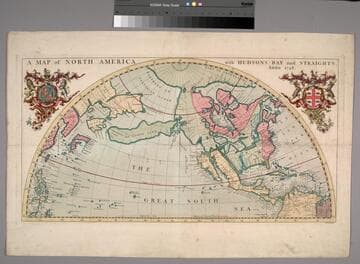
  • A Map of North America with Hudson's Bay and Straits, Anno 1748

    A Map of North America with Hudson's Bay and Straits, Anno 1748

    Visual Materials

    Kashnor notes, "THE ONLY COPY KNOWN, and privately issued by the Hudson's Bay Company. The main cause of this issue was the controversy concerning the alleged neglect of the Company to further the exploration for a North-West Passage. Arthur Dobbs was the leader of this opposition, and he hoped by proving the neglect, to see the company loose its privileges under the charter. Middleton, formerly a servant of the Company, had been sent to find the Passage, but had returned beaten, with the firm conviction that even if the passage did exist, it was impractical. This was in 1741-42. Dobbs, still unshaken, formed a company, which, with the thought of rights of exclusive trade, sent out the Dobbs Galley and the California in 1746. In October 1747, the two vessels returned to the Thames, the expedition a failure. In the following year the opposition to the company resulted in the Parliamentary Inquiry into the rights and working of the Company's charter. This map was part of the Company's case. There is no doubt that Seale, the engraver, executed the work according to the idea of the Company's officers, rather than following the true lines of geographical knowledge, which was available even in Middleton's map. Either the Company was very ignorant, or ready to connive at producing a fraudulent map. Around the Bay there is no outlet of any kind, and Sir Thomas Lancaster's Sound is located on the western side of the continent. The obvious intention of the map was to prove that the Passage went by way of the St. Lawrence, through the Great Lakes to Machilmakinac, where a junction was formed with the Long River of La Hontan, which gained by a portage across an isthmus, another portage from Tahnglak of La Hontan reached the Western Sea. In the Pacific the northern land seen by Vasco de Gama is shown touching the North-West coast, and there is shown De Fonte's track going in the direction of Alaska. It is a brilliant piece of geographical imagination, and yet the coastlines and locations of the Bay are correct. It seems likely that the map, as evidence, was too circumstantial, but it is in keeping with the whole of the inquiry of 1748-49, when the main object was to steer clear of questions regarding the charter, and it is possible that evidence of Joseph la France upset the evidence, and, naturally, the best way was to destroy all copies of the map. In any case, there is no other copy known to be in existence. It is, without doubt, the rarest of engraved maps of America, and unique." Kashnor is incorrect regarding the uniqueness of this map. The archives of the Hudson’s Bay Company at Beaver House, London, possess nine copies; there is another at the company’s Winnipeg headquarters. There is also a copy in the British Museum, presented by the company in 1957. See "The Beaver", Winter 1962, (Huntington F1060.1A1B4) for a full article about this map by Glyndwr Williams. Coat or arms of Hudson's Bay Company and Royal Arms of England.. Prime meridian: London. Relief: no. Projection: Azimuthal. Printing Process: Copper engraving. Other Features: Art Work. Verso Text: MS note: 443.

    105:443

  • Image not available

    Plan of the City of New York, in North America: Surveyed in the Years 1766 & 1767

    Visual Materials

    Kashnor notes, "Ratzer's famous plan with the rare view. It is number 41 in Phelps Stokes Iconography. It is the best map of New York at the period, and Stokes states that 'even today much used in searching titles.' Of all the views of New York issued during the eighteenth century this is the finest, and its execution most excellent. There is little doubt that the original view was drawn by Captain Thomas Davies, of the Artillery." "For His Excellency Sir Henry Moore, Bart: Captain General and Governour in Chief, In and Over His Majesty's Province of New York and the Terrtiories depending theron in America, Chancellor and Vice Admiral of the same, This Map of the City of New York and its Environs, Surveyed and Laid Down: Is most Humbly Dedicated, by His Excellency's Most Obed. & Humble Servant, B. Ratzer Lieut. in His Majesty's 60th or Royal American Regt." Vignette: A South West View of the City of New York, Taken from the Governour;s Island at *. Relief: hachures. Graphic Scale: Miles, yards, feet. Projection: Plane. Printing Process: Copper engraving. Verso Text: MS note: 585.

    105:585 M