Purchased for the Huntington from Donald A. Heald Rare Books and Fine Art by the Library Collectors' Council, January 2020.
Restrictions
Open for use by qualified researchers and by appointment. Please contact Reader Services at the Huntington Library for more information.
Rights
The Huntington Library does not require that researchers request permission to quote from or publish images of this material, nor does it charge fees for such activities. The responsibility for identifying the copyright holder, if there is one, and obtaining necessary permissions rests with the researcher.
Manuscript map showing southern limits of Halifax, with the South Battery, the fort and number of mounted guns. Georges Island is depicted in detail with a proposed plan of fortifications. The island was named after King George II shortly after Halifax was settled by the British in 1749 and has been known as "George's Island" and more currently "Georges Island".
Manuscript map showing the coastline and harbors from Jebucto (i.e. Chebucto) Head to Bedford Basin and Fort Sacville with bearing points, soundings and the channels. Halifax Harbour is depicted in great detail. Probably drawn by Charles Rivez from an original.
Manuscript map copy by Samuel Holland showing the coasts around Halifax, to Lunenburg Harbour, and from Minas Basin to Forts Cumberland and Lawrence on the Bay of Fundy. Also shows the road from Fort Sackvile to Pisiguit Fort and the old Acadian villages around Bedford Bay.
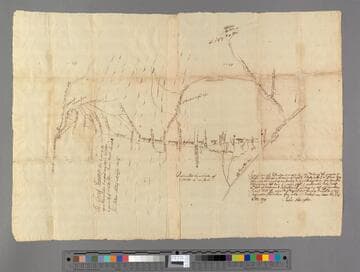
A manuscript map related to the boundary dispute between New York and New Jersey. Shows land between the upper Delaware River and the Upper Susquehanna River.
Manuscript plan showing outside, cross-section and top-view layout of the flour store house at Fort George. Located along the Hudson River at the junction with the Fish Creek River, the fort was later renamed Fort Hardy, which is located in modern day Schuylerville, Saratoga County, New York. Kashnor attributes the map to James Gabriel Montresor, the British engineer, who drew several maps of Fort George in late June 1759.

![Plan of the South Fort at Halifax and the Fort of St. George's Island with three elevations. [cartographic material]](/_next/image?url=https%3A%2F%2Frail.huntington.org%2FIIIF3%2FImage%2F22APN4MOI7DQ%2Ffull%2F%5E360%2C%2F0%2Fdefault.jpg&w=750&q=75)
![A map of the harbour of Halifax [cartographic material]](/_next/image?url=https%3A%2F%2Frail.huntington.org%2FIIIF3%2FImage%2F22APN4MOG0IB%2Ffull%2F%5E360%2C%2F0%2Fdefault.jpg&w=750&q=75)
![Map of that part of Nova Scotia contained between Lunenburgh and the Bay Vert by Halifax and Pisiguit, including Cobiguit and Tatmagouch [cartographic material]](/_next/image?url=https%3A%2F%2Frail.huntington.org%2FIIIF3%2FImage%2F22APN4MO7R2D%2Ffull%2F%5E360%2C%2F0%2Fdefault.jpg&w=750&q=75)
![Elevation of the store-house built at Fort-George: [cartographic material] which contains 2500 barrels of flower](/_next/image?url=https%3A%2F%2Frail.huntington.org%2FIIIF3%2FImage%2F22APN4MONA5I%2Ffull%2F%5E360%2C%2F0%2Fdefault.jpg&w=750&q=75)