Opening Hours
Daily: 10 A.M.–5 P.M.
Closed on Tuesdays
1151 Oxford Road
San Marino, CA 91108
Daily: 10 A.M.–5 P.M.
Closed on Tuesdays
1151 Oxford Road
San Marino, CA 91108

Image not available
Manuscripts
One of the letters is a 16-page detailed account of Mitchell's voyage around Cape Horn and arrival in San Francisco in April 1849. The other letters are about Mitchell's experiences living in San Francisco and Sacramento including witnessing several hangings; his letters also give details regarding his attempts at mining for gold.
mssHM 63944-63950
Image not available
Manuscripts
Four of these five manuscripts were written by Israel Mitchell. These include a speech about agriculture, a manuscript on religion, science and astronomy and two items about slavery. Of the latter two items, the first is a poem written circa 1860 against the institution of slavery, which mentions the abolitionist John Brown. The other is a handwritten copy of a speech Mitchell gave before the Oregon legislature in 1857 regarding both slavery and the Oregon constitution; Mitchell is arguing that Oregon should enter the United States as a free state. He also talks about abolitionists and the United States constitution. The fifth item is a group of notes on Mitchell family genealogy (with mention of Mitchell's grand-uncle Daniel Boone).
mssHM 70712-70716
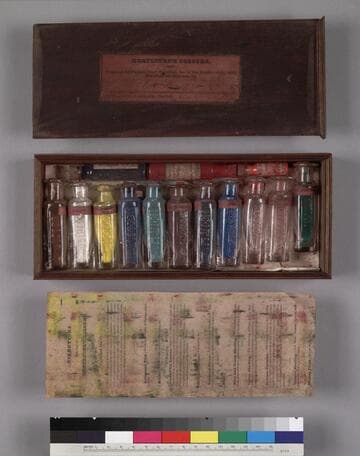
Visual Materials
One boxed set of paint pigments entitled Honfleure's Colours: Prepared for Flower, Fruit Painting, &c. in the English Style, with Directions for their use by L. Honfleure, ca. 1880. The set is comprised of 11 large and 3 small glass jars of dry paint pigments, in a variety of colors, and housed in a wooden box with a sliding lid. Laid into the box is a sheet of printed directions for mixing the pigments and how to use each of the colors. The three small glass jars may not be part of the Honfleure set; they appear to have been manufactured by another company.
ephKAEE

Manuscripts
This journal kept by Cadwallader Colden II during the American Revolution. It includes the following periods: early 1776 to his arrest and confinement in Kingston jail; August 1776, paroled at his home; December 1776, appearance before the Continental Congress; March 1777, ordered to take the oath of allegiance to the State of New York, charged with committing overt acts of loyalism, sent to fleet prison; September 1777, paroled to Hurley, New York; July 1778, exiled to New York City. While he was living in New York City, he pleaded with state leaders, including Governor George Clinton, for his release, which did not come until 1784.
mssHM 607
Image not available
Manuscripts
The collection primarily contains letters and documents relating to Hugh Campbell, 3rd Earl of Loudoun; his son, John Campbell, 4th Earl of Loudoun; other Campbell family members; and various political and military associates. John Campbells military activities during the 1745 to 1746 Jacobite uprising in Scotland and the Seven Years War in North America in 1756 and 1757 are especially documented. Materials in the collection include correspondence, memorials, and petitions; muster rolls, returns, orders, and other military records; appointments; estate records including accounts, bills, receipts, and inventories; and land and government documents.
LO 2318
Image not available
Manuscripts
The collection primarily contains letters and documents relating to Hugh Campbell, 3rd Earl of Loudoun; his son, John Campbell, 4th Earl of Loudoun; other Campbell family members; and various political and military associates. John Campbells military activities during the 1745 to 1746 Jacobite uprising in Scotland and the Seven Years War in North America in 1756 and 1757 are especially documented. Materials in the collection include correspondence, memorials, and petitions; muster rolls, returns, orders, and other military records; appointments; estate records including accounts, bills, receipts, and inventories; and land and government documents.
LO 4644