- Date
- n.d.
- Accession number
- 000.45
- Dimensions
- 6 1/2 x 4 7/8 in. (16.5 x 12.4 cm.)
sheet: 11 9/16 x 7 15/16 in. (29.4 x 20.2 cm.)
- Medium
- pencil counterproof
- Description
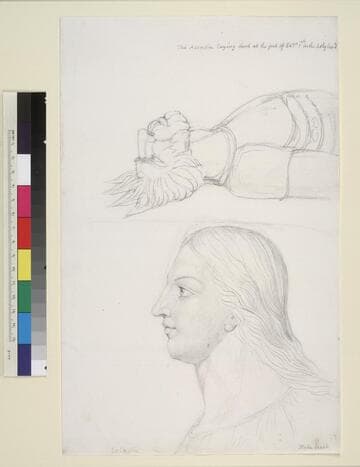
- A counterproof from Blake's original of ca. 1819.
The right-left relationships and the flatness of the lines indicate that this is counterproof of the "Caractacus" from the Blake-Varley sketchbook of ca. 1819. [1] There is also a tracing of the portrait, probably by Linnell, in the collection of G. Ingli James, Cardiff (reproduced James 1979). Henry Fuseli painted a generally similar head of Caractacus in three-quarter view, with prominent eyes, brow ridges, and mustache, in 1972. [2] Blake's visionary head may have been influenced by a recollection of his friend's work.
Caractacus (flourished ca. 50 A.D.) led the Britons in their struggle against Roman domination. In this full-frontal portrait of a powerful, block-like face, Blake represents the indomitable character for which the warrior king was famous. Blake could have learned about Caractacus from such popular works as Rapin de Thoyras, The History of England, where he is presented as a heroic fighter or British freedom, or from Charles Allen's New and Improved History of England (1798), for which Blake engraved four plates. There are also plates about Caractacus by William Mason (1759) and William Monney (1816). Thus, Blake may have considered Caractacus as a precursor to his own struggles against "the silly Greek & Latin slaves of the Sword." [3]
Notes
1. Keynes collection, Fitzwilliam Museum; Butlin 1981, No. 692.36. Reproduced in Keynes 1927, Pl. 46; Blake-Varley Sketchbook 1969, 2:36; Keynes 1970, Pl. 64.
2. See Gert Schiff, Johann Heinrich Fussli (Zurich: Verlag Berichthaus, 1973), 1:633, No. 1760 (reproduced in volume 2). This oil painting is the only extant fragment from a larger composition showing Caractacus as a prison in front of Emperor Claudius.
3. "Preface" to Blake's Milton (ca. 1804-1808); Blake 1982, 95. For the relevant passages in Rapin, see the translation by N. Tindal, 2d ed. (London: Knapton, 1732-33), 1:13-15.
- Credit
- The Huntington Library, Art Museum, and Botanical Gardens
- Department
- European Art