Decorative arts
Desk
1 of 3
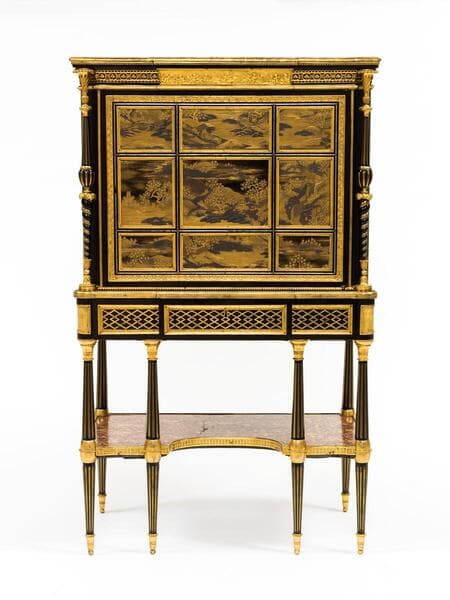
The secretaire is not stamped with a maker's name but it can be firmly attributed to Adam Weisweiler. Weisweiler emigrated to Paris from the Rhineland in about 1776. He specialized in finely made pieces and seems to have worked almost exclusively for the fashionable dealer Dominique Daguerre, who supplied the royal family and the aristocracy with furniture. (Label Text)
The secretaire is not stamped with a maker's name but it can be firmly attributed to Weisweiler, as the gilt-bronze mounts and the overall design of the piece resemble closely a number of objects that carry his name.
Weisweiler emigrated to Paris from the Rhineland in about 1776. He specialized in luxurious and finely made furniture and seems to have worked almost exclusively for Dominique Daguerre, a dealer who owned a fashionable shop called "A la Couronne d'Or" on the rue Saint-Honoré. It was certainly Daguerre who supplied Weisweiler with the Japanese lacquer panels; the fashion for mounting furniture with lacquer had begun in the 1730s and it remained popular throughout the rest of the century. Through Daguerre, Weisweiler supplied the royal family and the aristocracy with furniture. Surviving the upheavals of the French revolution, he maintained an active workshop until he retired in about 1809. (Handlist Text)
The secretaire is not stamped with a maker's name but it can be firmly attributed to Weisweiler, as the gilt-bronze mounts and the overall design of the piece resemble closely a number of objects that carry his name.
Weisweiler emigrated to Paris from the Rhineland in about 1776. He specialized in luxurious and finely made furniture and seems to have worked almost exclusively for Dominique Daguerre, a dealer who owned a fashionable shop called "A la Couronne d'Or" on the rue Saint-Honoré. It was certainly Daguerre who supplied Weisweiler with the Japanese lacquer panels; the fashion for mounting furniture with lacquer had begun in the 1730s and it remained popular throughout the rest of the century. Through Daguerre, Weisweiler supplied the royal family and the aristocracy with furniture. Surviving the upheavals of the French revolution, he maintained an active workshop until he retired in about 1809. (Handlist Text)