Decorative arts
Desk
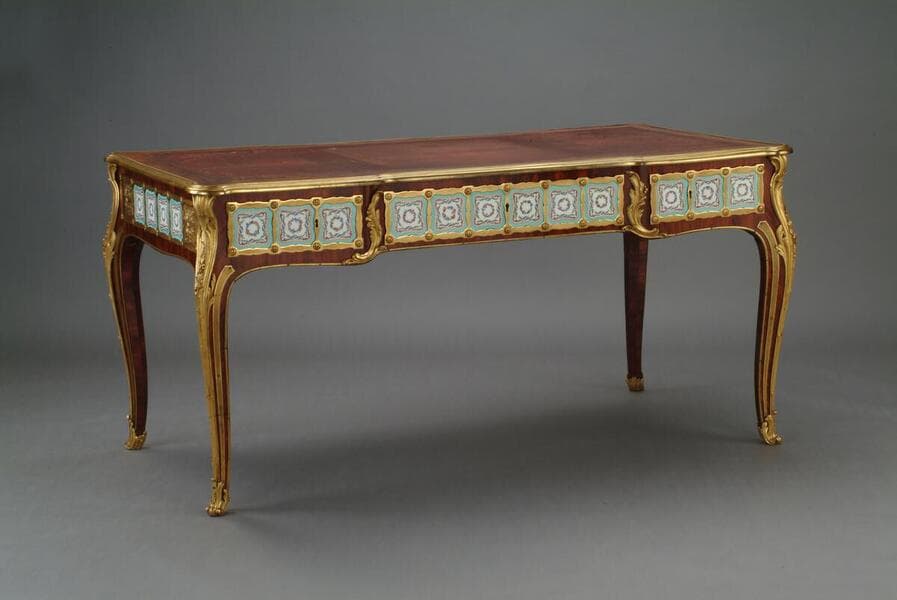
This table originally formed part of an ensemble consisting of a writing desk, a filing cabinet surmounted by a clock (by Julien Le Roy, 1686-1759), and an inkstand. All three pieces survive, albeit in different locations. The suite was purchased from Simon-Philippe Poirier (c. 1720-1785), a marchand mercier specializing in porcelain-mounted furniture, in 1763 or 1764. It stayed together until at least 1818, when the probate inventory of the Flemish-born banker Guillaume-François Vandenyver in Paris recorded the set, or one identical. Thereafter, the inkwell was reported in the collection the Duke of Sutherland and today forms part of that of J. P. Morgan at the Wadsworth Atheneum (fig. 00), whereas the desk, its filing cabinet, and clock were last described and illustrated together in the catalogue of Alfred de Rothschild's collection in 1884 (along with the Molitor secrétaire, cat. 33). Lord Rothschild bequeathed the desk to Lady Carnarvon, whose collection was sold in May 1925, when the desk was purchased by the London dealers Lewis and Simmons. It was then acquired by Duveen, who sold it on to Henry E. Huntington. The clock and filing cabinet (serre-papier) are now in the Musée du Louvre, Paris (fig. 00).
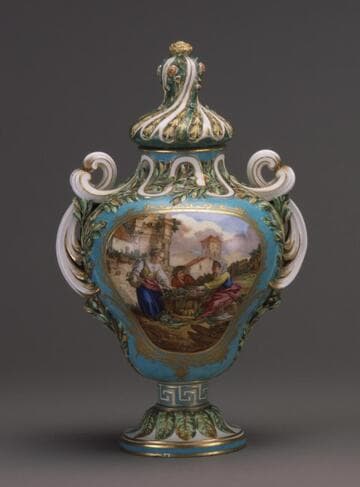
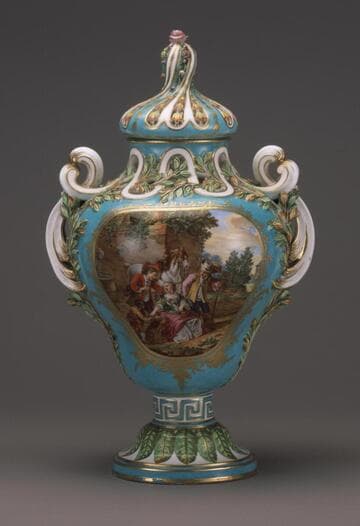
The collecting of porcelain-mounted objects is evidence, as the nineteenth-century collection of Alfred de Rothschild and early twenty-century collections such as those of Samuel H. Kress and Huntington attest, of the prevalence of a decorative theme. The Huntington set is mounted with soft-paste Sèvres porcelain plaques identical in design and set within the pale turquoise-blue ground called petit verd. One of the plaques on the desk bears the date letter for 1763, and the uppermost plaque on the clock also bears the date letter for 1763 and the mark of the painter Jean-Baptiste Tandart. The six different models of furniture mounted with porcelain plaques at The Huntington exemplify the diversity of furniture types decorated in this manner and usually made for women.
In the 1760s and 1770s, Joseph Baumhauer produced a number of porcelain-mounted pieces for the marchands merciers Poirier and Daguerre (c. 1740-1796), including the example discussed here, four similar writing desks, now in the collections at Waddesdon Manor, Buckinghamshire, England, Boughton House, Northamptonshire, England, the Philadelphia Museum of Art, and the Museu Calouste Gulbenkian, Lisbon (this latter desk also stamped EHB), and one formerly in the collection of baron Henri de Rothschild and subsequently in that of Jean Rossignol. All six pieces are characterized by their construction, in particular the contours and decoration of their drawer fronts, the design of the bronze frames to the plaques, and the disposition of plaques with serpentine outlines within a rectilinear formation. The wide brass frames disguise the particular shape of these plaques, each of which rests in a recessed panel of conforming shape, suggesting that the Sèvres plaques were not designed for such an arrangement. It is noteworthy that this is the only desk in the group to be fitted with thirty-two plaques; each of the others has twenty-four.