Decorative arts
Lidded Vase
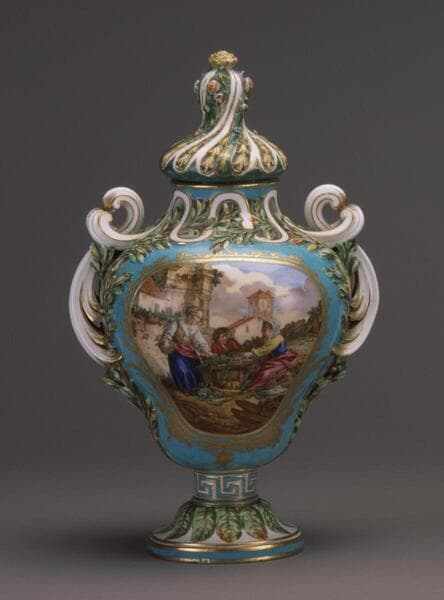
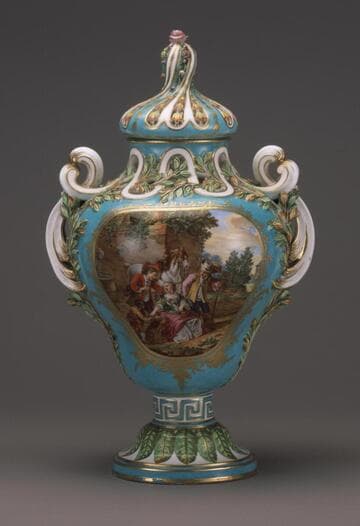
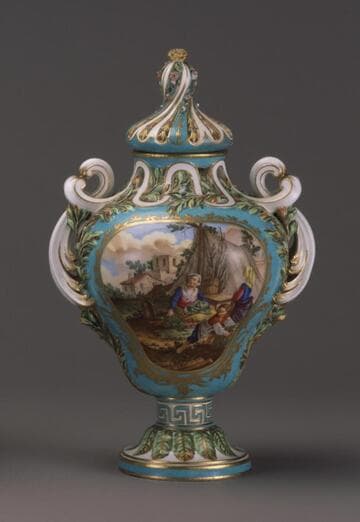
Vases of this shape were first introduced at Sèvres in 1761 and seem to have been produced until about 1768. The model was made in three sizes, this set comprising one example of the largest size and a pair of the second size. The shape was made in two basic versions; these follow the more elaborate initial model with leafy branches of myrtle represented along the sides of the vase and interlocking with a scrolled design at the neck. The neck and lid are pierced to allow the scent of potpourri to escape from the vase. The titles pot pourri à feuillages and pot pourri feuilles de mirte were apparently used interchangeably in eighteenth-century documents to describe vases of this model, with the latter title having since become the more common. Savill suggests that the myrtle decoration may refer to contemporary potpourri mixtures that included myrtle leaves and flowers. Only pairs are listed in the sales records between 1761 and 1764; nevertheless, garnitures in which vases of this shape are combined with other models are known.
Jean-Claude Duplessis probably designed the model. Savill has shown that his source was possibly a design by Pierre Germain II published in 1748 in Elements d'orfèvrerie (Orfèvrerie d'église) showing a pear-shaped ecclesiastical hanging lamp with scroll handles. Such an intricate model with complicated molded and pierced work would have been entrusted only to the factory's most skilled modelers and répareurs. Each of the two smaller vases from this set is marked for a different, unidentified porcelain worker-a scrolling N on one and a square on the other. These marks are found on other vases of similar complexity and, especially during the 1760s, on other pots pourris à feuillages. The same two marks appear separately on a pair of vases of this model in the Wallace Collection, London.
The pale turquoise-blue ground color is unusual and is considered to be the color referred to in documents between 1761 and 1763 as petit verd. It seems that few pieces were decorated with this color. Dated examples are known only from 1760 and 1761, with the most famous being a garniture of five pieces including a pair of pots pourris à feuillages thought to have been purchased by Madame de Pompadour in 1762.
Each vase is painted on the front with figures in landscapes in a colored, pear-shaped reserve. The back of each vase has a white reserve, of the same size and shape as that on the front, painted in polychrome with a spray of fruit and flowers. Each reserve is edged with a narrow tooled gilded band surrounded by a delicate gilded wreath of foliage, reeds, and flowers tied by a ribbon bow at the base. The stem of each vase is painted in the ground color with the Greek-key pattern edged with gilding. Each foot is painted in polychrome against white with a pattern of large leaves, the veining delineated with gilding. It is not known who painted the reserves on these vases. One artist painted the figural scenes on the front reserves, and a different artist was responsible for painting the fruit and flowers on the back.