Paintings
A Farmyard
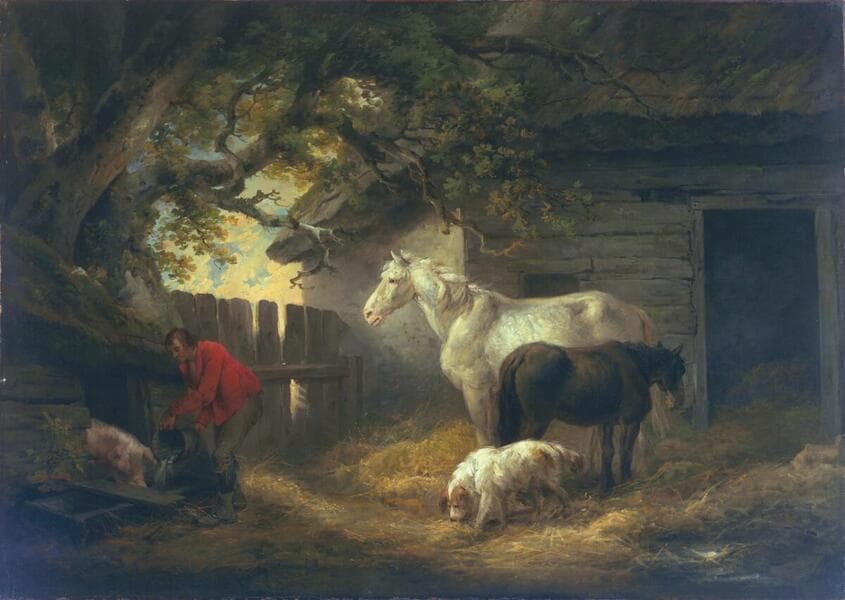
A Farmyard depicts the mundane rural chore of feeding livestock, with a man in a red jacket and gaiters attending to a pig trough while his dog and two horses stand by. The subject is fairly typical of the paintings that Morland produced in phenomenal number during the last decades of the eighteenth century, when nostalgia for a simplified rustic existence made his depictions of rural life extremely popular. Morland's reassuring imagery presents the English countryside as the site of a stable and well-regulated feudal economy, and his naturalistic observations carried the conviction of authority. These characteristics earned his work high praise for its "Englishness," a notion that informed at least one critic's response to A Farmyard when it was exhibited at the Royal Academy in 1792. Other painters of the English countryside were "fearful of wetting their feet with the morning dew," the critic claimed, and so they sat indoors at their fireside and created pastiches of Ruisdael, Wijnants, and other Dutch landscapists. Morland, by contrast, heartily immersed himself in the muck and mire of native country life, so that "you see Nature in her true colours, and his scenery, as well as his animals, Is English,--English, Sirs! from top to toe!"
Notwithstanding the critical notion of Morland's "Englishness," his approach to rural subject matter was actually influenced by Dutch landscape and low-life genre painting. Once held in poor esteem, these paintings steadily increased in value during the late-eighteenth and early-nineteenth centuries. Morland emulated Dutch example by applying his rich, painterly technique to ostensibly coarse subject matter, thereby recasting the prosaic realities of rustic life as subject matter fit for art. In A Farmyard, he seized on instances of splendor amid the squalor. In the fence, yellow light spills out from between the slats and bursts through a hole near the ground. The loose, rhythmic sweep of his brush conveys an impression of the rich texture of the dog's fur, while also providing a sense of its motion as it snuffles in the hay. A different technique is employed in the white horse, which is defined through strong tonal contrasts applied with short, choppy strokes. Apart from their representational value, these passages possess intrinsic beauty simply as paint, applied with finesse and exuberance.
A Farmyard is an unusually large work for Morland, who generally painted on a smaller scale. The picture's size is especially surprising in light of the artist's circumstances at the time he painted it. Having been declared bankrupt in 1791, he was legally bound to pay off a fixed sum of £120 each month--the approximate sum that a painting of this size would have commanded. However, Morland reportedly preferred to generate cash more quickly through the rapid execution of small canvases, so that by 1791 he had essentially abandoned the production of time-consuming large-scale pictures. It is likely that this painting was undertaken for the specific purpose of attracting attention at the Royal Academy in order to drum up interest in his other paintings. Not only in size, but in composition, A Farmyard appears calculated to catch the eye from a distance. It is composed of bold juxtapositions of light and dark, with the brilliantly illuminated white horse at the center of the canvas set off by the contrasting darkness of the background and foreground, and by the brown horse standing alongside it. When compared with the subtle color transitions that typify Morland's smaller paintings, the dramatic effects in this picture are striking.