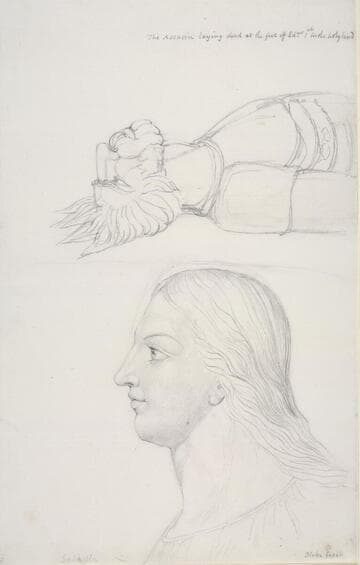
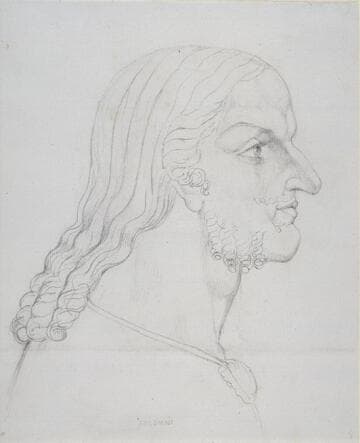
left image (Uriah): 5 7/8 x 4 13/16 in. (15 x 12.2 cm.)
right image (Bathsheba): 6 11/16 x 4 1/8 in. (17 x 10.4 cm.)
sheet: 8 x 12 13/16 in. (20.3 x 32.6 cm.)
Medium
pencil on wove paper
Description
Two profiles on one sheet.
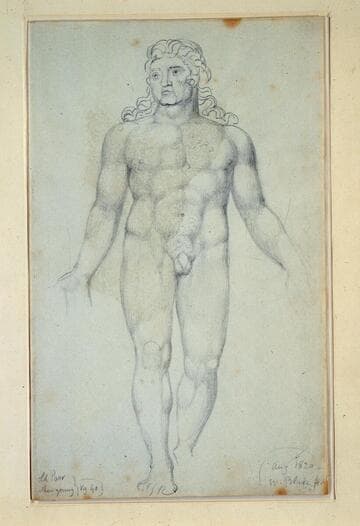
Rossetti 1863, 244, described Blake's Uriah as "a heavy, stupid man, with a huge cerebellum and enormous bull-neck," and Bathsheba as "sweet, soft, yielding, witty." The story of Uriah, his wife Bathsheba, and King David is told in II Samuel 11. The woman's face in Blake's tempera painting of ca. 1799-1800, "Bathsheba at the Bath" (Tate Gallery; Butlin 1981, No. 498) is of the same general type as her visionary portrait, but neither rendering shows clearly individualized features. Blake also drew a visionary head of "David"-apparently the Biblical king as a rather feminine youth (collection of F. Bailey Vanderhoef, Jr., Ojai, California; Butlin 1981, No. 698).
Like Solomon (adjacent), this is another of Blake's "Visionary Heads." King David, desiring to marry the beautiful Bathsheba, sent her husband Uriah into a battle in which he was killed (see II Samuel 11-12).