Visual Materials
Daily: 10 A.M.–5 P.M.
Closed on Tuesdays
1151 Oxford Road
San Marino, CA 91108

Image not available
Visual Materials
A photograph album of people with their motorcycles and automobiles, on outdoor excursions in Southern California in the early-20th century. Most images have writing on the back and feature a group of two men and two women named Eleanor, Hazel, Otto, and Russell (surnames unknown). In one photograph, they stand next to their motorcycles, wearing goggles, with pennants reading: "1915 San Francisco," "Riverside," and "Redlands," presumably in the midst of a road trip. Otto is also seen standing in front of a "New Era Motor Cycle" store in Redlands, California, and pushing his motorcycle with a spare tire strapped to the front. Other images include riders in an automobile in Tijuana, Mexico, 1915; visiting Big Bear Lake and dam; and a caravan of automobiles driving up a mountain road. Three photographs at Lake Arrowhead feature an Essex Motor Company automobile painted with advertising reading: "The N-Durance Essex, driven by Charles H. Holdson," 1923.
photCL 633
Visual Materials
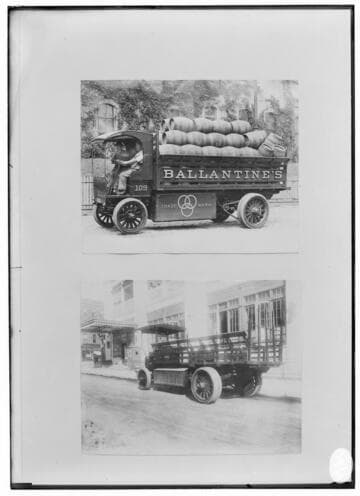
T3.1 Transportation - Autos, Trucks, & Railcars - Slide Negative - Autos and parts. [Two photos, one of a milk truck, and the other of the typical chassis with an Edison battery. The chassis is labeled, showing its different parts.]
photCL SCE 02 - 01589
Image not available
Manuscripts
This collection contains the personal and professional papers of American railroad mechanical engineer and innovator William Riley McKeen Jr. (1869-1946) who developed some of the first gasoline-powered railroad motor cars, beginning in 1905 for the Union Pacific Railroad. In 1908, he became president of the McKeen Motor Car Company, which built over 150 of the pioneering motor cars through 1917. The materials are primarily focused on the McKeen motor cars and the history of their promotion and production, 1905-1917. Materials include promotional booklets and ephemera, news clippings, scrapbooks, operating manuals, McKeen's personal notebooks and over 300 photographs. Series 1 begins with McKeen's youth and schooling, with examples of some of his engineering notes and workbooks. There are also notes on designing his house, a genealogy of the McKeen family, and his father's estate settlement papers, which include correspondence between McKeen and his siblings. McKeen's professional work and concerns are reflected in several notebooks he kept during his career, with detailed notes related to employees, design issues and other work in the railroad mechanical shops. There are only a few letters of business correspondence, and just one copy of a letter from E. H. Harriman (no original). Among the personal papers is a file of documents related to a 1912 lawsuit brought against McKeen and his second wife, Mary, by Mary's former husband, Charles Hull, in Omaha, Nebraska. This file contains documents that would be of interest to medical and social history researchers: a detective's transcript of observations of prostitutes and activities at brothels (collected to disparage Mr. Hull). Series 2 contains McKeen motor car materials, primarily promotional brochures and ephemera (including a package of custom cigarettes), operating manuals, production statistics, news clippings and articles. See also Series 3 and 4 for clippings and photographs of McKeen motor cars. Series 3 contains three scrapbooks: A) a personal ledger, with clippings; B) a scrapbook of over 100 clippings about the McKeen Motor Car Company, 1907 -- 1920; and C) a scrapbook of photographs and clippings about McKeen motor cars in Australia, 1911-1912. Series 4 contains photographs, including a set of Union Pacific company photographs of McKeen motor cars over the years 1905-1911. McKeen appears in some photographs, and there are some views of employees, Omaha shop buildings, engines and production views. Other photographs show McKeen motor cars on various railroads, some wrecks, engine parts, and views of the McKeen Highway Coach, a passenger vehicle introduced in 1915.
Image not available
Manuscripts
This collection contains the personal and professional papers of American railroad mechanical engineer and innovator William Riley McKeen Jr. (1869-1946) who developed some of the first gasoline-powered railroad motor cars, beginning in 1905 for the Union Pacific Railroad. In 1908, he became president of the McKeen Motor Car Company, which built over 150 of the pioneering motor cars through 1917. The materials are primarily focused on the McKeen motor cars and the history of their promotion and production, 1905-1917. Materials include promotional booklets and ephemera, news clippings, scrapbooks, operating manuals, McKeen's personal notebooks and over 300 photographs. Series 1 begins with McKeen's youth and schooling, with examples of some of his engineering notes and workbooks. There are also notes on designing his house, a genealogy of the McKeen family, and his father's estate settlement papers, which include correspondence between McKeen and his siblings. McKeen's professional work and concerns are reflected in several notebooks he kept during his career, with detailed notes related to employees, design issues and other work in the railroad mechanical shops. There are only a few letters of business correspondence, and just one copy of a letter from E. H. Harriman (no original). Among the personal papers is a file of documents related to a 1912 lawsuit brought against McKeen and his second wife, Mary, by Mary's former husband, Charles Hull, in Omaha, Nebraska. This file contains documents that would be of interest to medical and social history researchers: a detective's transcript of observations of prostitutes and activities at brothels (collected to disparage Mr. Hull). Series 2 contains McKeen motor car materials, primarily promotional brochures and ephemera (including a package of custom cigarettes), operating manuals, production statistics, news clippings and articles. See also Series 3 and 4 for clippings and photographs of McKeen motor cars. Series 3 contains three scrapbooks: A) a personal ledger, with clippings; B) a scrapbook of over 100 clippings about the McKeen Motor Car Company, 1907 -- 1920; and C) a scrapbook of photographs and clippings about McKeen motor cars in Australia, 1911-1912. Series 4 contains photographs, including a set of Union Pacific company photographs of McKeen motor cars over the years 1905-1911. McKeen appears in some photographs, and there are some views of employees, Omaha shop buildings, engines and production views. Other photographs show McKeen motor cars on various railroads, some wrecks, engine parts, and views of the McKeen Highway Coach, a passenger vehicle introduced in 1915.
Image not available
Manuscripts
This collection contains the personal and professional papers of American railroad mechanical engineer and innovator William Riley McKeen Jr. (1869-1946) who developed some of the first gasoline-powered railroad motor cars, beginning in 1905 for the Union Pacific Railroad. In 1908, he became president of the McKeen Motor Car Company, which built over 150 of the pioneering motor cars through 1917. The materials are primarily focused on the McKeen motor cars and the history of their promotion and production, 1905-1917. Materials include promotional booklets and ephemera, news clippings, scrapbooks, operating manuals, McKeen's personal notebooks and over 300 photographs. Series 1 begins with McKeen's youth and schooling, with examples of some of his engineering notes and workbooks. There are also notes on designing his house, a genealogy of the McKeen family, and his father's estate settlement papers, which include correspondence between McKeen and his siblings. McKeen's professional work and concerns are reflected in several notebooks he kept during his career, with detailed notes related to employees, design issues and other work in the railroad mechanical shops. There are only a few letters of business correspondence, and just one copy of a letter from E. H. Harriman (no original). Among the personal papers is a file of documents related to a 1912 lawsuit brought against McKeen and his second wife, Mary, by Mary's former husband, Charles Hull, in Omaha, Nebraska. This file contains documents that would be of interest to medical and social history researchers: a detective's transcript of observations of prostitutes and activities at brothels (collected to disparage Mr. Hull). Series 2 contains McKeen motor car materials, primarily promotional brochures and ephemera (including a package of custom cigarettes), operating manuals, production statistics, news clippings and articles. See also Series 3 and 4 for clippings and photographs of McKeen motor cars. Series 3 contains three scrapbooks: A) a personal ledger, with clippings; B) a scrapbook of over 100 clippings about the McKeen Motor Car Company, 1907 -- 1920; and C) a scrapbook of photographs and clippings about McKeen motor cars in Australia, 1911-1912. Series 4 contains photographs, including a set of Union Pacific company photographs of McKeen motor cars over the years 1905-1911. McKeen appears in some photographs, and there are some views of employees, Omaha shop buildings, engines and production views. Other photographs show McKeen motor cars on various railroads, some wrecks, engine parts, and views of the McKeen Highway Coach, a passenger vehicle introduced in 1915.
mssMcKeen
mssMcKeen
mssMcKeen