Opening Hours
Daily: 10 A.M.–5 P.M.
Closed on Tuesdays
1151 Oxford Road
San Marino, CA 91108
Manuscripts
Daily: 10 A.M.–5 P.M.
Closed on Tuesdays
1151 Oxford Road
San Marino, CA 91108

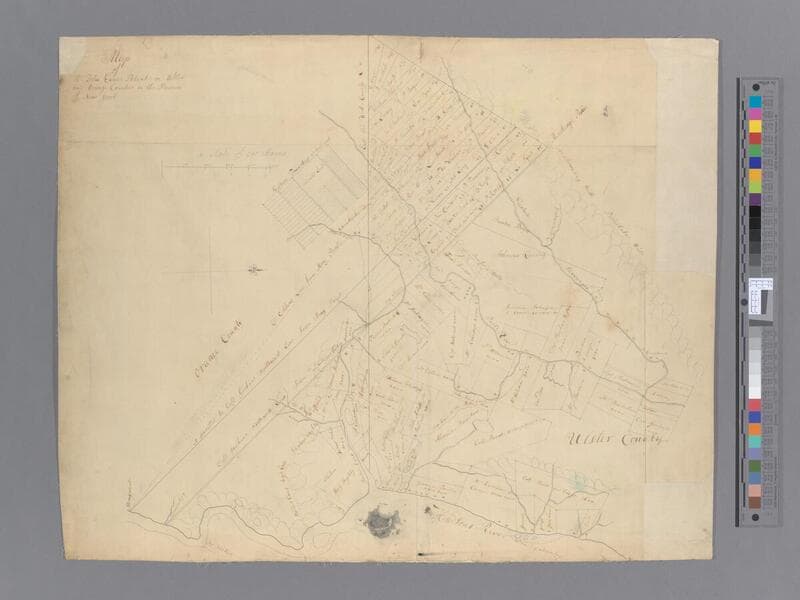
![Map of Ulster and Orange counties, New York showing settlements between the Blue Mountains and the Hudson River [cartographic material]](/_next/image?url=https%3A%2F%2Frail.huntington.org%2FIIIF3%2FImage%2F22APN4NUVRT9%2Ffull%2F%5E360%2C%2F0%2Fdefault.jpg&w=750&q=75)
Manuscripts
Manuscript map showing the settlement of lands granted to Capt. John Evans in 1691. By 1726, Cadwallader Colden was engaged in surveying "Evan's Grant" in regard for quit rents. It notes the extent of settlement, and locates the remarkable houses, villages, churches and county towns. Depicts the area around modern day Kingston, Newburgh and Goshen.
mssHM 15442
![Map of manorial grants along the Hudson River, approximately 1726 [cartographic material]](/_next/image?url=https%3A%2F%2Frail.huntington.org%2FIIIF3%2FImage%2F22APN4NU2YT5%2Ffull%2F%5E360%2C%2F0%2Fdefault.jpg&w=750&q=75)
Manuscripts
Manuscript rough copy by Samuel Holland, approximately 1757, made from an original by Cadwallader Colden (1688-1776) following his initial survey in 1726. Documents the extensive New York land grants made by the Crown from 1684 and 1716. Is also an early depiction of the topographical layout of the area. The most southerly point depicted is at the 39th parallel and the most northerly the 43rd. The map encompasses territory from lower New Jersey to old Fort Burnett on the Hudson, north of Sarasota Lake. Two sheets stitched together.
mssHM 15440
![Plan of the harbor of New York [cartographic material]](/_next/image?url=https%3A%2F%2Frail.huntington.org%2FIIIF3%2FImage%2F22APN4MO714D%2Ffull%2F%5E360%2C%2F0%2Fdefault.jpg&w=750&q=75)
Manuscripts
Manuscript map rough draft by Samuel Holland and Charles Rivez, appears to be taken from an earlier map that depicts the period 1735. Related to William Bradford's map of the harbor, published in 1735.
mssHM 15451
![A map of the province of New-York & part of New Jersey [cartographic material]](/_next/image?url=https%3A%2F%2Frail.huntington.org%2FIIIF3%2FImage%2F22APN4MO8RID%2Ffull%2F%5E360%2C%2F0%2Fdefault.jpg&w=750&q=75)
Manuscripts
Manuscript map by Charles Rivez, showing the boundaries between the provinces of New York and New Jersey. The Hudson and Mohawk rivers are well defined, and the forts, towns and settlements along them are depicted. Lake George and the territory to the north of Ticonderoga are shown, and the settlements, towns and roads of New Jersey are shown through the northern part of Burlington county.
mssHM 15453
![Map of the Great Pattent or Hardenburg Pattent [cartographic material]](/_next/image?url=https%3A%2F%2Frail.huntington.org%2FIIIF3%2FImage%2F22APN4MO7TJ4%2Ffull%2F%5E360%2C%2F0%2Fdefault.jpg&w=750&q=75)
Manuscripts
Manuscript map showing a portion of the vast "Great Patent" or "Hardenbergh Patent" and locating the settlement at Station Point at the old border between New York and New Jersey. The grant made to Johannes Hardenbergh in 1708 consisted of approximately two million acres of land situated in Ulster, Greene, Orange, Sullivan and Delaware Counties, New York. Originally drawn by Cadwallader Colden in approximately 1726 when he undertook his survey of quit rents in the province. This appears to be a rough draft executed by Samuel Holland, approximately 1757. Amended in a common ink with the location of some of the families who settled the area as part of their South Sea charter in 1754, as well as names such as Mathew Phenix, Saml. Wool, James Graham, Conelius Ragers, and others.
mssHM 15444
![Map of the province of New York showing settlements along the Hudson and the Mohawk, with distances from Albany [cartographic material] / draft by Charles Rivez](/_next/image?url=https%3A%2F%2Frail.huntington.org%2FIIIF3%2FImage%2F22APN4MONCOW%2Ffull%2F%5E360%2C%2F0%2Fdefault.jpg&w=750&q=75)
Manuscripts
Manuscript map done by Charles Rivez, approximately 1756. Depicts the roads and water routes from New York up the Hudson to Fort Edward and beyond to Wood Creek, and Lake Ontario to the west. The roads depicted here were used by Shirley in his march from Albany to Oswego during his attempt to attack Niagra, and those used by Sir William Johnson on his way to Lake George.
mssHM 15447