Opening Hours
Daily: 10 A.M.–5 P.M.
Closed on Tuesdays
1151 Oxford Road
San Marino, CA 91108
Daily: 10 A.M.–5 P.M.
Closed on Tuesdays
1151 Oxford Road
San Marino, CA 91108

Visual Materials
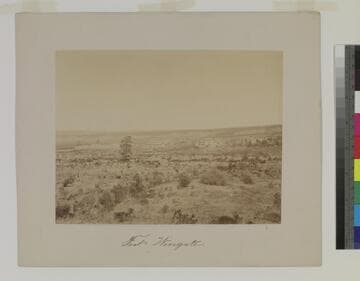
Panorama of U.S. military post, Fort Wingate, New Mexico. Shows officer's quarters and barracks.
photCL 292 (13)
Image not available
Visual Materials
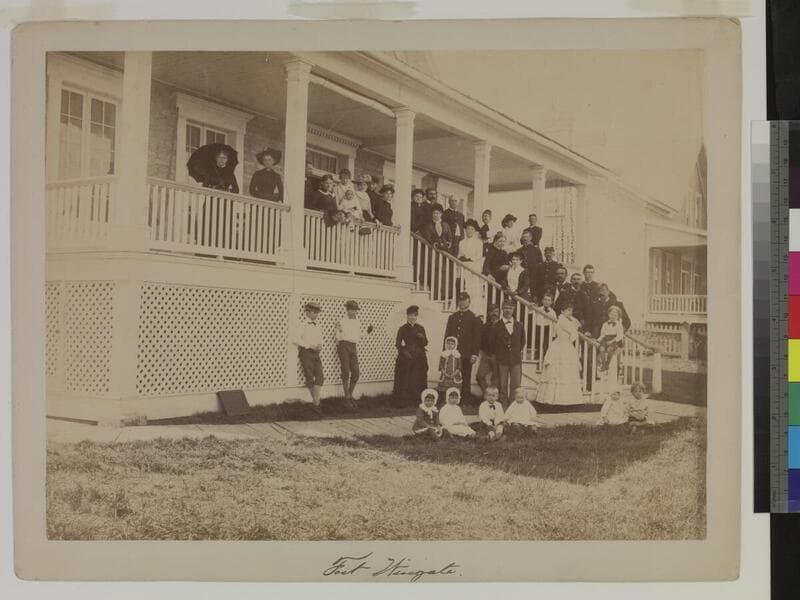
Views of frontier United States Army forts in Wyoming and Nebraska made by Pvt. Charles Howard, 1876-1877, and two views of Fort Wingate, New Mexico, ca. 1870s by an unidentified photographer. The photographs are mostly broad views of the military posts and their surrounding landscapes, showing cavalry, barracks and other buildings. The forts illustrated are Camp Canby, Camp Sheridan and Camp Robinson in Nebraska; Fort Fetterman, Fort Laramie and Fort McKinney in Wyoming Territory; and Fort Wingate in New Mexico. Besides views of the forts, there is one view of the town of Cheyenne; the Red Cloud Indian Agency, Nebraska; and a group portrait of soldiers and their families at Fort Wingate.
photCL 292
Visual Materials
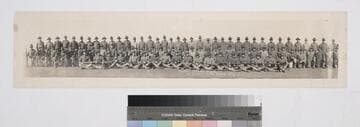
Group portrait of U.S. Army soldiers in uniforms and holding rifles at Fort MacArthur in San Pedro, California.
photCL 555
Visual Materials
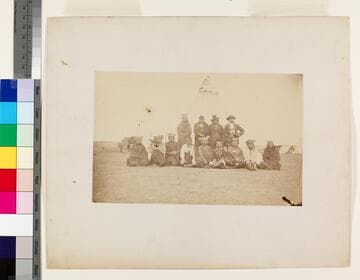
Group portrait of several Indian men and one or two non-Indian U.S. soldiers.
photCL 189 (1)
Image not available
Visual Materials
An album of photographic postcards pertaining to battles along the U.S.-Mexico border during the Mexican Revolution, approximately 1913-1916. Images include soldiers and officers, military camp life, views of artillery and trenches, Yaqui Indian soldiers, U.S. Army cavalry and refugee camps. Notable among the photographs are many views of dead soldiers and executions by hanging or firing squad. The compiler of this disbound album is unknown; photographs are mounted on paper album pages, and there are many handwritten captions on the pages. Dates written in captions range between 1913 and 1916, and several make reference to battles at Naco and Agua Prieta in Sonora, Mexico in 1913. Other locations represented include military encampments at Nogales, Arizona and Agua Prieta; a refugee camp at Douglas, Arizona; and a bird's-eye-view of the town of Columbus, New Mexico. Some photographs show child soldiers brandishing guns, civilian spectators viewing bodies, and one view of a U.S. airplane squadron. There are three photographs of Pancho Villa, including a group portrait with Gen. Rodolfo Fierro and Gen. Hugh Lenox Scott. Other portraits include Álvaro Obregón and officers; Yaqui leader Luis Bule; Francisco I. Madero; Pascual Orozco and General P.E. Calles. There is one view of the dead body of Enrique Portillo; other photographs of executed men are identified by nicknames or surnames only. Most of the photographic postcards are by Walter H. Horne (credit "W.H. Horne Co.") of El Paso, Texas, with several also by photographer Calvin ("Cal") Osbon of Douglas, Arizona. Osbon's photographs are notable for lengthy, descriptive captions imprinted in the images. The formats are almost all photographic postcards, except for a few smaller photographs and one larger group portrait labelled "Carranza Cabinet" showing Venustiano Carranza and others at Agua Prieta, May, 1914.
photCL 173
Image not available
Visual Materials
A disbound album of primarily portrait photographs of Plains Indians, taken by photographer William E. Irwin from the 1890s to early 1900s, in Indian Territory. His images document the Chiricahua Apache, Comanche, and Kiowa Indians who lived near Anadarko and Fort Sill, Oklahoma; some photographs may have been taken at Irwin's studio at Chickasha, Indian Territory. Besides the studio and field portraits, there are also candid views illustrating late 19th-century Plains Indians in their daily lives; several views of cowboys and cow herding; Fort Sill; tepees; landscapes; and one view of a Wichita Indian grass house or wickiup. Notable portraits include those of Geronimo, seated, posing with headdress and revolver; Appeahtone (Kiowa Chief) and his wife; and Quanah Parker (Comanche Chief) with two of his wives. Many of the photographs focus on Comanche and Kiowa Indians posing for studio portraits. These portraits depict infants and children, young women, mothers, scouts, and warriors, many identified by name. Named individuals include Poor Buffalo, White Buffalo, Lone Wolf, and Little White Shield, among others. Field photographs show Apache, Kiowa, and Comanche encampments; a Wichita grass house; both cowboys and Indians caring for their herds; and views in and around Anadarko and Fort Sill, Oklahoma.
photCL 161