Opening Hours
Daily: 10 A.M.–5 P.M.
Closed on Tuesdays
1151 Oxford Road
San Marino, CA 91108
Daily: 10 A.M.–5 P.M.
Closed on Tuesdays
1151 Oxford Road
San Marino, CA 91108
Visual Materials
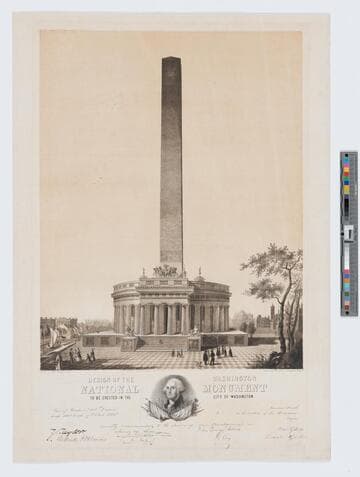
Image of an eye-level street view of architect Robert Mills' design for the Washington National Monument with onlookers in the foreground, and the United States Capitol and the city of Washington, D.C., in the distance; vignette of a head-and-shoulders portrait of President George Washington at bottom centered; blank contribution form and printed endorsement in the bottom margin with eight signatures of Zachary Taylor, Millard Fillmore, John Quincy Adams, Albert Gallatin, Daniel Webster, and others, printed in bottom margin.
priJLC_VIEW_000610
Image not available
Visual Materials
No old shelf mark. Title supplied by cataloger. Mount Olympus National Monument was created in 1909, and Olympic National Park was formed in 1938; Chehalis County (absent) was renamed Grays Harbor (present) in 1915. Probably from the early 1930's through association. Wrapped around a tube from the U.S. Dept of Interior, Geological Survey, addressed to Col. Lawrence Martin, Chief, Division of Maps, Library of Congress, Washington, D.C. and postmarked December 11, 1934. Col. Martin visited the Huntington at about that time and made a number of recommendations regarding the map collection. MS notes: Red lines and notes regarding shelters. Prime meridian: GM. Relief: hachures. Projection: Polyconic. Printing Process: Blue line print.
ephMPWASH0004
Image not available
Manuscripts
This series contains correspondence and papers documenting the National Institute, including materials related to The Institute's forerunners: The Metropolitan Association; The Columbian Institute; and the Washington Museum The organization of the National Institution for the Promotion of Science (later incorporated as the National Institute), including membership and the constitution, by-laws and rules for the Institute The Museum (housed in the United States Patent Office), including the acquisition of curiosities and the collections of the United States Exploring Expedition, commanded by Charles Wilkes, 1838-1842 The Smithson bequest, including his interest and influence in the final disposition of the gift and the original custody of Smithson's collections of minerals, pamphlets and personal effects. Some notable items include: The plan of organization for the Metropolitan Society or Association (June 15, 1816) in the handwriting of Edward Cutbush, with signatures of the original members A notebook kept by John Varden of subscribers to the Washington Museum, 1840-1841 A note by Joel Roberts Poinsett, c. 1840, of the members to confer on the Smithson bequest An August 23, 1848, letter from Joseph Libbey Folsom sending a specimen of the gold found at Sutter's Mill and some other minerals from California.
mssRH
Visual Materials
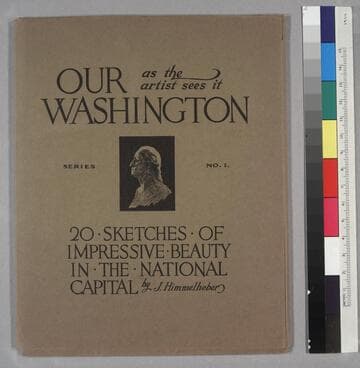
One portfolio of unbound images, copyright 1931, entitled Our Washington as the Artist sees It: 20 sketches of impressive beauty in the national capital, Series No. 1, by J. B. Himmelheber, published by Grafico, Washington, D.C. This portfolio is comprised of 15 images of buildings and monuments in Washington, D.C. The set of plates are laid into a brown paper portfolio that is illustrated with an image of George Washington. Some of the images included in the set are: the Capitol Building, the Washington Monument, Columbus Memorial Fountain, The White House, The National Cathedral of Saint Peter and Saint Paul, and the Library of Congress. A description is printed on the verso of each plate. "[Copyright symbol] J.B.H. 1931, Reproduced + Published Wash. D.C. Box 243 Grafico" is printed on the back cover of the portfolio.
ephKAEE
Image not available
Manuscripts
This collection contains papers and materials related to the Shaw and Gregory families and their relatives, the Van den Heuvel family, Ralph Isaacs Ingersoll, and John Church Hamilton. These materials date chiefly from 1820 to 1870. Among John Shaw's materials is his 1810 diary detailing his journey down the Mississippi River on his way to annex the Republic of West Florida. Other items include a letter from Shaw to his father-in-law, Ebenezer Breed, and a letter addressed to Shaw regarding his daughter's education. The papers include correspondence exchanged between Shaw's eldest daughter, Elizabeth "Kate" Shaw Gregory, and her husband, the naval commander Francis Hoyt Gregory. These letters discuss family affairs, social life in New Haven, Connecticut, and Francis Hoyt Gregory's impressions of Brazil. The correspondence also mentions the seizure of the Porpoise, a brig used to transport enslaved people, by his ship, the Raritan, and other naval affairs during Gregory's navy service. Additionally, there are letters between Ralph Isaacs Ingersoll and his son Charles Roberts Ingersoll, the father-in-law and husband respectively of Gregory's daughter Virginia. These discuss American politics, observations on the Russian court, and European unrest. Included too is his correspondence with John Church Hamilton, Colin McRae, Jacob Adrian Van den Heuvel, and others regarding the estates of Charles Ward Apthorp and Cornelius Van den Heuvel. Court summons and order for publication of citations regarding the will of Charlotte A. Van den Heuvel are also included.One copied diary of Anna Marilla Baker Gregory, who married Henry Edmund Gregory, the son of Francis Hoyt Gregory and grandson of John Shaw, is also accompanied by a typescript copy and a letter from William H. Hale. This diary was created as a gift for her son, Henry "Harry" Baker Gregory. It discusses her time as a teacher to the Sioux Indians and life as a woman on the frontier; after Harry's passing, she continued to write entries into the 1920s and 1930s. Fifty-one photographs included in this collection encompass loose photographs and one Gregory family photograph album. Additional documents include certificates of military and federal appointments, one signed by President Abraham Lincoln and another by President Ulysses S. Grant, legal paperwork and court summons, and a family coat of arms. Ephemera consists of one Certificate of the Naval Benevolent Organization signed by John Shaw and its frame, one Book of Common Prayer inscribed by multiple Gregory family members, certificates from the Washington National Monument Society, a Freemasons certificate, one Proclamation of Thanksgiving by Governor Charles R. Ingersoll, an obituary newspaper clipping, a transcription of a tombstone inscription, and one Yale University bicentennial badge.
Image not available
Manuscripts
Letters that Edward Kirby wrote to his wife and eldest son Jake between 1827 and July 1848 constitute the largest portion of the collection. Kirby's peacetime letters describe his travels in Wisconsin, Michigan, and New York State, and his trips to Washington, D.C., and discuss family news, business investments, the management of his two-thousand acre farm, the increasingly complicated financial affairs, the fallout from the Panic of 1837, and local news, including the events of the Patriot War (1837) in the neighboring Canada. Kirby, a leader of the local Whigs, also discusses state and national politics, in particular the internal improvements, protective tariff, and the annexation of Texas. Kirby also recounts Washington news and rumors and comments on various aspects of military life as well as the news of the Second Seminole War. Included is a 1840 letter from William H. Seward soliciting Kirby's opinion on the "candidates." Kirby's letters written during the Black Hawk War discuss the progress of the war, the outbreak of cholera, peace negotiations, and the allegations against Winfield Scott. The Mexican War letters describe Kirby's journey to Northern Mexico and his war experiences, including the battle of Monterey, the siege and taking of Vera Cruz, the battles that marked Scott's march to Mexico City, and the occupation of the Mexican capital. Kirby also recounts news that were circulated at Taylor's and Scott's headquarters, in particular rumors of the eagerly awaited peace negotiations, discusses the financial operations of the United States Army, and shares his impressions of Mexico. The letters describe Winfield Scott, Nathan Towson, William Jenkins Worth, Zachary Taylor, John E. Wool, Jefferson Davis, Joseph Eggleston Johnston, George Gordon Meade, his nephew Edmund Kirby Smith, and others. Also included are Kirby's commissions and his certificate of membership in the Aztec Club. The collection also includes letters that Edmund Kirby, Jr. wrote to his brother Reynold Marvin Kirby in 1860-1863. The letters counsel his brother on the course of his studies and a college selection, (Marvin chose to go to the Geneva College, and his brother paid his tuition), vividly describe the life at the Military Academy on the eve of the Civil War, and discuss the secession crisis and other aspects of national politics. The letters written from the battlefields in Virginia describe the Union positions at Edwards Ferry and the Mud March of 1862 and blast the radical Republicans in Congress. The last letter, entirely devoted to Marvin's studies, is dated March 3, 1863. Also included is a letter of condolence from Henry Jackson Hunt to Kirby's mother. Also included are two letters addressed to Ephraim Kirby from Uriah Tracy (1788, Oct. 18), reporting on the on the proceedings of the state General Assembly, including the passage of "a very benevolent act relative to Africans" and Aaron Burr (1801, Feb.) requesting an urgent meeting, and Gideon Grange's letter to Thomas Worthington introducing Ephraim Kirby as the newly appointed commissioner on the Spanish Boundary.
mssShawg
mssEK