Visual Materials
The Entertainment subseries is comprised of sheet music published in the United States between 1794 and 1899, with the bulk of materials dated between 1840 and 1899. Materials cover a broad range of subject areas including performers (actors, actresses, minstrels, musicians, singers, singing groups, and duets), fetes (balls, carnivals, circuses, fairs, and expositions, including the 1876 Centennial), magic, comic songs, composers and lyricists, social and performance dances (polkas, mazurkas, quadrilles, schottisches, and waltzes, some concerning Austrian ballet dancer Fanny Elssler). Also included are scores about musical instruments (guitar, lute, mandolin, harp, piano, and organ), music stores, patriotism (foreign and domestic), and productions (theatrical and concert). The latter includes a 1794 version of See Brother See which was performed in the opera The Children in the Wood. A sizable portion of this subseries contains comic songs and minstrelsy that use stereotypical vernacular, offensive language, and reinforce racial stereotypes that audiences of the time found acceptable and agreeable (such as Blackface).
Prominent Nineteenth century performers in the subseries include the Alleghanians, Sara Bernhardt, Charlotte Mignon "Lotta" Crabtree, the Hutchinson Family Singers, Henry Irving, May Irwin, Jenny Lind, Margaret (Maggie) Julia Mitchell, the Rainer Family, Lillian Russell (the Queen of Song), William J. Scanlan, and Lydia Yeamans (the New Jenny Lind).
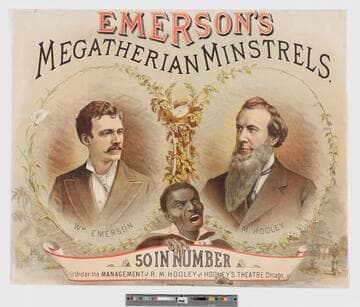
Prominent minstrel troupes in the subseries include Buckley's Serenaders (established by James Buckley, 1803-1872), Christy's Minstrels (led by Edwin P. Christy, 1815-1852), and Bryant's Minstrels (led by Dan Bryant, 1833-1875). Both Christy's and Bryant's Minstrels were the longest-lasting troupes to have formed before the American Civil War. Other troupes include the Virginia Minstrels (led by Daniel Decatur Emmett, 1815-1904). Also included are scores by Emerson, Allen and Manning (founded by Billy Emerson, 1846-1902); the Ethiopian Serenaders; the Harmoneons; Kunkel's Nightingale Opera Troupe (founded by George Kunkel, one of the first promoters of nineteenth-century American Minstrelsy, 1822 or 1823-1885); and the San Francisco Minstrels.
Prominent composers and lyricists found throughout the subseries include Basile Bares (1845-1902), formerly enslaved in Louisiana and the first African American to copyright his music; Mrs. L. L. Deming; Emma Edwards; Jennie Engel; Stephen Collins Foster (1826-1864), composer of household and Minstrel songs; Patrick Sarsfield Gilmore (1829-1892), composer and early creator of Big Band music; Charles Grobe; Edward Harrigan (1844-1911), a member of comedy teams of Harrigan and Braham, and Harrigan and Hart. Also included are Charles (1840-1923) and Jacob Kunkel (1846–1882); Dan Lewis, African American composer and minstrel performer; Stephen Charnak Massett (1820-1898); John Philip Sousa (1854-1932); Johann Baptist Strauss II (1825-1899); and Theo Von La Hache (1822-1869), composer of Confederate songs.
Throughout the subseries are scores for notable productions including Aladdin; Amelie or, The Love Test; The Black Crook; The Bohemian Girl; The Barber of Seville; and Cinderella. Other productions include Der Freischutz; Faust; Fra Diavolo; The Huguenots; Il Travatore; La Sonnambul; The Merry Wives of Windsor; and Uncle Tom's Cabin.
priJLC_SMUS