Manuscripts
Plan of the tenements on the South Fork of Bullskin :
Image not available
You might also be interested in
Image not available
Plan of tenements on South Fork Bullskin
Manuscripts
Autograph document. Plan shows the tracts leased to Joseph Kerlin, Abraham Swanger, William Peterson, Jacob Fryer, William Bartlett, and Kennedy, as well as the one sold to Philip Pendleton in January 1772. (1 page)
HM 5508
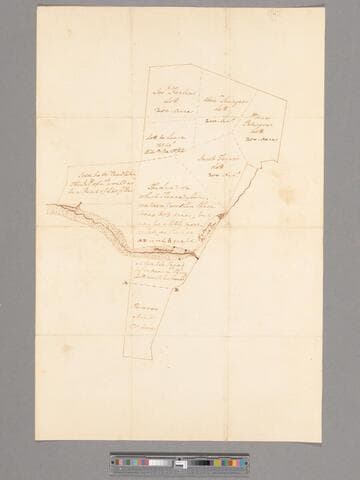
Plan of tenements on South Fork Bullskin
Manuscripts
Autograph document. Plan shows the tracts leased to Joseph Kerlin, Abraham Swanger, William Peterson, Jacob Fryer, William Bartlett, and Kennedy, as well as the one sold to Philip Pendleton in January 1772.
mssGW
![A plan of Fort Lyttleton at Port Royal in South Carolina [cartographic material]](/_next/image?url=https%3A%2F%2Frail.huntington.org%2FIIIF3%2FImage%2F22APN4MOI3J9%2Ffull%2F%5E360%2C%2F0%2Fdefault.jpg&w=750&q=75)
A plan of Fort Lyttleton at Port Royal in South Carolina [cartographic material]
Manuscripts
Manuscript map depicts layout of Fort "Lyttleton" [more commonly spelled "Lyttelton"] in Port Royal, South Carolina, showing the outline plan of the fort. Lines are drawn in red and black. An inset shows the canon elevations, with bar scale given as 2.75 inches = 40 feet (1:175). Signed: "Em. Hess, Lieut. in the Royal American Regiment".
mssHM 15399
![Plan of the South Fort at Halifax and the Fort of St. George's Island with three elevations. [cartographic material]](/_next/image?url=https%3A%2F%2Frail.huntington.org%2FIIIF3%2FImage%2F22APN4MOI7DQ%2Ffull%2F%5E360%2C%2F0%2Fdefault.jpg&w=750&q=75)
Plan of the South Fort at Halifax and the Fort of St. George's Island with three elevations. [cartographic material]
Manuscripts
Manuscript map showing southern limits of Halifax, with the South Battery, the fort and number of mounted guns. Georges Island is depicted in detail with a proposed plan of fortifications. The island was named after King George II shortly after Halifax was settled by the British in 1749 and has been known as "George's Island" and more currently "Georges Island".
mssHM 15426
Image not available
George Washington Bean diary
Manuscripts
Typescript of Bean's 1855-1856 diary, which details interactions between Mormon missionaries at Las Vegas, New Mexico, and local Indians, including baptisms, trade, and some hostilities. Included are Bean's account of a journey from Las Vegas to California across the Mojave in October-November 1855 (which included stops in San Bernardino, Los Angeles, the San Gabriel Mission, and El Monte) and of travels between Las Vegas and the "Colorado Muddy" in 1856. Bean also references an encounter with the "murderers" of J.W. Gunnison, an Army captain killed in an Indian massacre in 1853; remarks on the camp visit of explorers Jules Remy and Julius Lucius Brenchley, who published "A Journey to Great Salt Lake City" in 1861; mentions his attendance of a performance of J.H. Martineau's "Missouri Persecutions;" and describes various interactions with Las Vegas Mission President William Bringhurst. The diary concludes with a series of prayers/poems dedicated to "The Wives and Families of the L.V. Missionaries," "The Pioneers of '47," and "Pres. B. Young and His Counselors," as well as the minutes of a meeting held "under the Bowery" at Las Vegas on June 24, 1856 and minutes of a celebration of the Fourth of July at Las Vegas, and a song entitled, "I Got Drunk Again."
mssHM 72278
Image not available
Mission Homestead Association. Certificate of stock in Mission Homestead Association issued to S.A. Vance
Manuscripts
The collection was assembled by author and collector Grahame H. Hardy. The documents and manuscripts demonstrate the range of legal, administrative, municipal, and real estate-related transactions initiated by railroad and mining interests, businessmen, and municipalities in the San Francisco Bay area, Northern California, and western Nevada. Included in this series are legal proceedings, title deeds, mining reports and claims. Correspondence includes business and personal letters to and from Northern California lawyers, railroad and mining entrepreneurs in California and Nevada, and parties involved in the construction of the Nicaragua Canal. Included in this series are letters pertaining to the case of Daniel Sill, a San Francisco-based blacksmith and the trial of A.J. Jackson, an African American tried and acquitted in Marysville, California. Lastly, ephemera include four items: a Mission Homestead Association certificate of stock; one check payable to Jack H. Haverly, a promoter of minstrel shows, from theater producers and brothers, Gustave Frohman and Charles Frohman; the baptism certificate of Everett Loftus Saxondale Kenna; and an undated glossary of mining terms. Prominent persons and organizations featured in the collection include: California Academy of Sciences, founded in 1853 as the one of the first scientific academies west of the Atlantic seaboard; Central Pacific Railroad Company, established in 1861 and financed in part by Leland Stanford and Collis P. Huntington, who are also mentioned in the collection; William Heath Davis (1822-1909), San Francisco merchant and author, spouse of Maria de Jesús Estudillo, who played a key role in the founding of the California cities of Oakland and San Diego; John Brooks Felton (1827-1877), San Francisco Bay Area lawyer and judge, as well as one-time mayor of Oakland, California; Joseph Pendleton Hoge (1810-1891), former U.S. Representative of Illinois and later lawyer and judge of the San Francisco Superior Court; and M.G. Upton, former official reporter of the California Assembly and author of the urban planning critique, "The Plan of San Francisco" (1869).
mssHM 72670-72753