Manuscripts
Photographs, clippings, ephemera
You might also be interested in
Image not available
Manuscripts, correspondence, cloth map
Manuscripts
The collection consists of letters, manuscripts, photographs, one cloth map, and a few artifacts collected by Herbert Myrick related to western history, mainly the Battle at Little Bighorn. Subjects include Dakota Native Americans, Fort Abraham Lincoln, Fort Yates, and Standing Rock Indian Reservation. The collection contains 125 photographs, from approximately 1860 to approximately 1910, of Northern Plains Native Americans, U.S. 7th Cavalry members, and the Little Bighorn battlefield. It includes photographs of the following individuals: Frederick William Benteen, Bullhead, Crow Foot, George Armstrong Custer, Myles Walter Keogh, James McLaughlin, Rain in the Face, Sitting Bull, Standing Holy, Tiburcio Vasquez, George Daniel Wallace, and Young Man Afraid of His Horse. There are also 41 photographs of cowboys and ranch life. Additional persons represented in the collection include David F. Barry, Elizabeth Bacon Custer, and Herbert Myrick. Artifacts in the collection include a lock of Custer's hair, a cartridge from Custer's pistol, and a cloth map of the Custer battlefield drawn by T.B. Whitmore (who claimed to have witnessed the battle).
HM 49754-49860
Image not available
Herbert Myrick collection
Manuscripts
The collection consists of letters, manuscripts, photographs, one cloth map, and a few artifacts collected by Herbert Myrick related to western history, mainly the Battle at Little Bighorn. Subjects include Dakota Native Americans, Fort Abraham Lincoln, Fort Yates, and Standing Rock Indian Reservation. The collection contains 125 photographs, from approximately 1860 to approximately 1910, of Northern Plains Native Americans, U.S. 7th Cavalry members, and the Little Bighorn battlefield. It includes photographs of the following individuals: Frederick William Benteen, Bullhead, Crow Foot, George Armstrong Custer, Myles Walter Keogh, James McLaughlin, Rain in the Face, Sitting Bull, Standing Holy, Tiburcio Vasquez, George Daniel Wallace, and Young Man Afraid of His Horse. There are also 41 photographs of cowboys and ranch life. Additional persons represented in the collection include David F. Barry, Elizabeth Bacon Custer, and Herbert Myrick. Artifacts in the collection include a lock of Custer's hair, a cartridge from Custer's pistol, and a cloth map of the Custer battlefield drawn by T.B. Whitmore (who claimed to have witnessed the battle).
mssHM 49754-49909

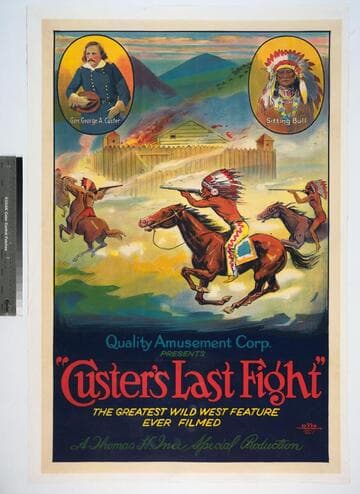
Quality Amusement Corp. presents "Custer's last fight" the greatest wild west feature ever filmed
Visual Materials
Image of an outdoor scene showing Native American Indians on horseback shooting rifles in a battle, with a military fort that is on fire and the United States Cavalry charging down a mountains in the background; with a top left vignette of a half-length portrait of United States Army officer and cavalry commander George Custer (captioned "Gen. George A. Custer") in a military uniform with gloves and hat, and a top-right head-and-shoulders portrait of Lakota Sioux Chief Sitting Bull (captioned "Sitting Bull") wearing a headdress; the scene depicts the 1876 Battle of Little Bighorn between Plains Indian tribes and the United States Army 7th Cavalry Regiment in the Black Hills of Montana; the poster advertises the film "Custer's Last Fight" released by the Quality Amusement Corporation and based on footage from a 1912 movie produced by Thomas Ince.
priJLC_ENT_001377
Image not available
Leonard Herbert Swett papers
Manuscripts
The first section of the collection consists mainly of letters written by Leonard Herbert Swett to his parents, Leonard and Laura R. Swett, while spending part of the summer of 1875 with George Armstrong Custer. The letters include descriptions of encounters with Custer and the members of Custer's entourage, of treaty negotiations with the Arikara and Dakota chiefs, of a hunting excursion, and of life with the 7th Cavalry in general, as well as references to the political situation that decided Custer's orders regarding the Native Americans, including to General Sheridan and the War Department. Also included is a telegram sent to Leonard Swett by Custer, reporting on Leonard Herbert Swett's health; an anonymous description of experiences at Fort Lincoln; a description of Charles Eastman's comments on the Battle of Little Bighorn; and a 1932 letter from a university fraternity in Ithaca, New York. The second section of the collection is made up of letters written by Leonard Herbert Swett to his parents, who lived in Chicago, while on a year-long trip around Europe. In the letters he talks in detail about each city he visits and his daily activities, the costs of things, his frustration at trying to learn French, and his homesickness and desire to return to Chicago. Swett visits the following places: London; Brussels; Paris, Marles, Lyon, and Nice, France; Wiesbaden, and Leipzig, Germany; Lausanne, Switzerland; Milan, and Venice, Italy. Leonard Swett is the author of two letters, written to his wife while he was in Paris with his son.
mssSwett
Image not available
Leonard Herbert Swett papers
Manuscripts
The first section of the collection consists mainly of letters written by Leonard Herbert Swett to his parents, Leonard and Laura R. Swett, while spending part of the summer of 1875 with George Armstrong Custer. The letters include descriptions of encounters with Custer and the members of Custer's entourage, of treaty negotiations with the Arikara and Dakota chiefs, of a hunting excursion, and of life with the 7th Cavalry in general, as well as references to the political situation that decided Custer's orders regarding the Native Americans, including to General Sheridan and the War Department. Also included is a telegram sent to Leonard Swett by Custer, reporting on Leonard Herbert Swett's health; an anonymous description of experiences at Fort Lincoln; a description of Charles Eastman's comments on the Battle of Little Bighorn; and a 1932 letter from a university fraternity in Ithaca, New York. The second section of the collection is made up of letters written by Leonard Herbert Swett to his parents, who lived in Chicago, while on a year-long trip around Europe. In the letters he talks in detail about each city he visits and his daily activities, the costs of things, his frustration at trying to learn French, and his homesickness and desire to return to Chicago. Swett visits the following places: London; Brussels; Paris, Marles, Lyon, and Nice, France; Wiesbaden, and Leipzig, Germany; Lausanne, Switzerland; Milan, and Venice, Italy. Leonard Swett is the author of two letters, written to his wife while he was in Paris with his son.
mssSwett
Image not available
Life and adventures of Captain William G. Felton, California Bill
Manuscripts
The manuscript memoirs, prepared by William G. Felton in 1886. The memoirs cover Felton's military service, including the battle of Lewisburg, the siege of Vicksburg, his time at the Camp Ford Stockade Prison, and his post-war career. Included are accounts of his experiences in stage coaching in Wyoming and South Dakota, including an incident with the Dakota Indians, after which Felton was sent to Fort Laramie; the Battle of Little Bighorn; Crazy Horse's death at Camp Robinson; farming in California and Nevada; and mining in Colorado. Felton specifically talks about Buffalo Bill, Crazy Horse, George Crook, George Custer, Ulysses S. Grant, Henry Heth, Wild Bill Hickok, and Joseph Reynolds.
mssHM 68183