Rare Books
The history of ink : including its etymology, chemistry and bibliography
Image not available
Rare Books
Image not available
Daily: 10 A.M.–5 P.M.
Closed on Tuesdays
1151 Oxford Road
San Marino, CA 91108

Image not available
Manuscripts
A collection of 9,601 items from 1786 to 1973, which consists of professional and personal material related to Edwin Francis Gay's life and multifaceted career. The collection documents his career in the civil service, at Harvard University, the New York Evening Post, and the Huntington Library; there are also some papers related to the National Bureau of Economic Research. Subjects include European economic recovery after World War I; international economic relations after World War II; United States business; and Gay's voluminous research notes on European and American economic history. Also included are Gay's notes on the Temple family papers in the Stowe collection at the Huntington Library and correspondence and papers relative to Herbert Heaton's book Scholar in action : Edwin Francis Gay (Cambridge, Harvard University Press, 1952). The collection also includes business, family and personal correspondence, documents, genealogy, printed material, photographs, clippings, and ephemera. Also present is Woodrow Wilson telegram to Edwin Francis Gay, 1919 September 17 (GY 3292) in Box 124.
mssGY
Image not available
Rare Books
This is the story of rail-intermodal, the process of transporting truck trailers or containers on specifically designed railroad cars, including the development of Gene Ryan's Rail-Trailer Co., General Motors flirtation with a depressed center-car design, the establishment of Trailer Train, Southern Pacific's truck-trailer train experiement between Los Angeles-San Francisco (handling only company-owned Pacific Motor Trucking trailers), the separation of Pennsylvania Railroad's influence over Trailer Train, the combination rail-highway units familiarly called Rail Van and RoadRailer. Featured are the various hitch arrangements, the once popular trailer-leasing program, the expansion of United Parcel from a department store delivery service to the nation's largest freight carrier and their influence on rail-piggyback--Adapted from jacket.
644084
Image not available
Manuscripts
A volume with autograph diagrams, plans, and maps in ink and color; with one map laid in: "...Plan of Topography of forty square miles with a Brigade Encamped...finished by A. Brice Nov. 18, 1784," and one map removed and placed in a separate portfolio: "The Attack and Defeat of the American fleet under Benedict Arnold...upon Lake Champlain the 11th Oct. 1776." Also laid in portfolio: 1901 newspaper clippings about Benedict Arnold which were removed from volume. The Geometry volume is inscribed: "Alexander Adair Brice his Father's Book given him by his Mother - 1806."
mssHM 972
Image not available
Manuscripts
The papers provide a unique perspective of 20th century California history and American business history and more specifically, a view of business practices in Los Angeles. The Business Files, the largest series of the collection has 6,436 items. This material includes invoices, receipts, bills of lading, purchase orders, bid requests, bids, statements, and other general account and job information including handwritten notes, drawings, construction plans and diagrams. The Correspondence series contains 768 items. Most of the correspondence is also business-related. The Photographs and Negatives series contains 1,110 items. The photographs (and negatives) include views of jobs (at various stages of completion), plants, machinery, as well as a few aerial views of the company's jobs. The Ephemera series contains 124 items. The series includes: business-related newsletters and bulletins, brochures and publications, newspaper clippings; tax forms, several LA Paving Company related artifacts, a copy of the 1926 Who's who in Los Angeles and a copy of Scratches: a volume of cartoons and caricatures of Los Angeles citizens, 1911 (Ernest R. Werdin is in both volumes). There is also one folder related to E. Russell Werdin's involvement in the USC Alumni Association. The 38 volumes include bid requests, daily job reports, invoices, journals, one photograph album, a plant and shop register, and stock certificates.
mssLA Paving Co records
Image not available
Manuscripts
The papers provide a unique perspective of 20th century California history and American business history and more specifically, a view of business practices in Los Angeles. The Business Files, the largest series of the collection has 6,436 items. This material includes invoices, receipts, bills of lading, purchase orders, bid requests, bids, statements, and other general account and job information including handwritten notes, drawings, construction plans and diagrams. The Correspondence series contains 768 items. Most of the correspondence is also business-related. The Photographs and Negatives series contains 1,110 items. The photographs (and negatives) include views of jobs (at various stages of completion), plants, machinery, as well as a few aerial views of the company's jobs. The Ephemera series contains 124 items. The series includes: business-related newsletters and bulletins, brochures and publications, newspaper clippings; tax forms, several LA Paving Company related artifacts, a copy of the 1926 Who's who in Los Angeles and a copy of Scratches: a volume of cartoons and caricatures of Los Angeles citizens, 1911 (Ernest R. Werdin is in both volumes). There is also one folder related to E. Russell Werdin's involvement in the USC Alumni Association. The 38 volumes include bid requests, daily job reports, invoices, journals, one photograph album, a plant and shop register, and stock certificates.
mssLA Paving Co records
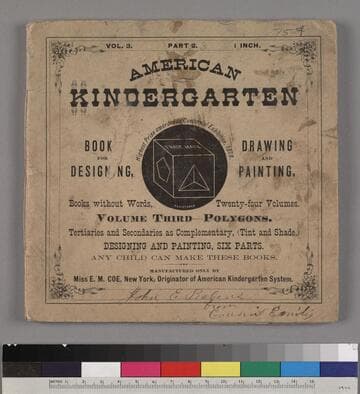
Visual Materials
One scrapbook created from a completed drawing exercise book entitled American Kindergarten Book for Designing, Drawing and Painting. Volume Third- Polygons, manufactured by Miss E.M. Coe, New York, "Originator of American Kindergarten System", not before 1876. The scrapbook is 24 unnumbered pages in length; the polygon exercises have been drawn and colored in pencil and crayon. Images and poetry, cut out from magazines and newspapers, as well as several chromolithograph images, are mounted to the pages. There is ms. writing in ink and pencil throughout. "John E. Robens, from Cousin Emily" is written in ms., in ink, at the bottom of the front cover. "75 [cents cymbol]" is written in ms., in pencil, in the upper right-hand corner of the front cover.
ephKAEE