Skip to content

Rare Books

Fifth Chinese daughter

Image not available


You might also be interested in

  • Image not available

    The Golden Lotus : a translation from the Chinese original of the novel, Chin pʻing mei

    Rare Books

    A saga of ruthless ambition, murder, and, famously, Chinese erotica, The Golden Lotus (also known as The Plum in the Golden Vase) has been called the fifth Great Classical Novel in Chinese Literature and one of the Four Masterworks of the Ming Novel. Admired in its own time for its literary qualities and biting indictment of the immorality and cruelty of its age, this Chinese classic has also been denigrated for its sexual frankness. It centers on Ximen Qing, a young, dissolute, and politically connected merchant, and his marriage to a fifth wife, Pan Jinlian, literally "Golden Lotus." In her desire to influence her husband and, through him, control the other wives, concubines, and entire household, she uses sex as her primary weapon. The Golden Lotus lays bare the rivalries within this wealthy family while chronicling its rise and fall.

    654409
  • Image not available

    Red star over China

    Rare Books

    The first Westerner to meet Mao Tse-tung and the Chinese Communist leaders in 1936, Edgar Snow came away with an authorized account of Mao's life, as well as a history of the famous Long March and the men and women who were responsible for the Chinese revolution. Out of that experience came this book--a classic work about the birth of the Communist movement in China.

    654154
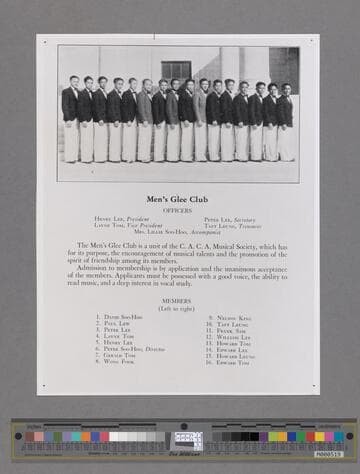
  • Chinese American Citizen Alliance. Men's Glee Club

    Chinese American Citizen Alliance. Men's Glee Club

    Manuscripts

    Copy image of a page from an unknown publication that has an image of the Chinese American Citizen Alliance's Men's Glee Club, a description of the club, and listing of the officers and members. Member in th ephotograph, left to right, are: David SooHoo, Paul Lew, Peter Lee, Layne Tom, Henry Lee, Peter SooHoo (Director), Gerald Tom, Wong Fook, Nelson King, Taft Leung, Frank Sam, William Lee, Howard Tom, Edward Lee, Howard Leung, and Edward Tom.

    mssSooHoo

  • Image not available

    Eliza Roxey Snow diaries

    Manuscripts

    Two diary volumes kept by Eliza R. Snow, primarily during her travels from Nauvoo, Illinois, to Salt Lake City, Utah, from 1846-1847. The first diary begins with Eliza's departure from Nauvoo with the family of Stephen Markham (Eliza lived in the Markhams' attic room for a time) in Heber Kimball's company. It traces their travels through Iowa and their time waiting out the winter weather at Winter Quarters. Eliza writes of the difficulties of the trip, particularly dissent among the traveling companions and their many illnesses and deaths. She thinly masks her intense loneliness ("Altho' so much alone, I feel no despondency," she wrote. "Surely happiness is not altogether the product of circumstances."). She initially tried to find support from Heber Kimball (she writes that she asked to be "number'd among his children...[and] from this time I call him father"), but ultimately found solace in religion and camaraderie with her sister-wives and other women in the company. Eliza also described her experiences driving a wagon, trading with the Pottawatomie tribe, and encounters with hostile Indians (she writes of the shooting of an Omaha Indian chief by a rival tribe in December 1846). The diary also contains a variety of poems and epitaphs, including "The Camp of Israel, A Song for Pioneers" (No.1, No.2, and No.3, also titled "Let Us Go"); "In All Things Rejoice," a song for the Camp of Israel; "A Journeying Song for the Camp of Israel, dedicated to Prest. Young & Lady;" "The Twelve, To Prest. B. Young;" and "To the Saints in Europe." (The pages with entries made between August 17, 1846, and October 28, 1846, are missing). The second diary volume resumes in June 1847, when Eliza left Iowa in the wagon of Robert Peirce, which was part of the Second Fifty headed by Bates Noble. The diary traces the company's travels across the plains and their arrival in the Salt Lake Valley in the autumn of 1847. In Utah Eliza initially shared a cabin with Clara Decker Young and made caps to trade for other goods, and the diary recounts her experiences through September 1849. It also includes her poem "A Song of the Desart [sic]." Individuals mentioned in the diaries include Heber Kimball, Stephen Markham, Parley P. Pratt, Lorenzo Snow, Brigham Young, and Mary Ann Angell Young.

    mssHM 27522 (1-2)

  • Image not available

    Charles F. Lummis photographs of El Alisal, family members, and other subjects

    Visual Materials

    This collection of photographs by Charles F. Lummis consists of 383 glass plate negatives and 5 autochromes (glass plate color photographs), dating from approximately 1888-1923. A large portion of the images document the construction of Lummis' stone residence, El Alisal, in what is now Highland Park, Los Angeles, which he began building in 1898 and finished in 1913. Exterior and interior progress views show details of construction, such as a window Lummis made of a collage of glass photographic plates. Lummis also photographed the land he bought for his house, which shows a largely untouched Arroyo Seco dotted with oak trees and a few other houses. The collection also contains numerous portraits of Lummis' four children with his second wife, Eve, seen at various ages: Turbesé (born 1892), Amado (born 1894), Jordan "Quimu" (born 1900), and Keith (born 1904). Other portraits include Eve Lummis and several notable Western writers and artists: John Muir, Charles M. Russell, Ed Borein, John T. Doyle, Vicente Blasco Ibañez, Eugene Manlove Rhodes, Julia Bracken Wendt, and Thomas Moran. The five autochrome portraits of art collector and dealer Grace Nicholson show her in different poses, wearing a pink fancy dress and hat, and in a Chinese robe. Based on the different format and professional appearance of the Nicholson images, there is some doubt as to whether Lummis took them or they just came into his possession. Lummis is seen in several self-portraits, at various ages, 1877-1909, and in some family groupings. A few images are photographs of photographs or paintings. Lummis also appears in some scenes at Rancho Camulos, Ventura County, with members of the Del Valle family. Various other subjects include: Lummis' earlier home on Forester Avenue, Los Angeles (1890s); California missions; Eve Lummis and others at Isleta pueblo, New Mexico, where she taught school; Native Americans from Isleta at El Alisal with Lummis' family; and miscellaneous unidentified scenes. The bulk of glass plates are 5 x 7 inches, with some 8 x 10 inches, and many have names or dates written at the bottom in Lummis' hand, with his initials.

    photCL 72