Opening Hours
Daily: 10 A.M.–5 P.M.
Closed on Tuesdays
1151 Oxford Road
San Marino, CA 91108
Daily: 10 A.M.–5 P.M.
Closed on Tuesdays
1151 Oxford Road
San Marino, CA 91108

Image not available
Manuscripts
The manumission of a 49-old man named Frank issued by his owner, Adrian Martens of Flatbush, King Co., N.Y., in accordance with An Act Concerning Slaves and Servants passed by the New York legislature on April 8, 1801, that provided that all slaves under 50 years, capable of providing for themselves, be freed by 1825. Countersigned by the Overseers for the Poor of the Township of Flatbush.
mssHM 69812
Image not available
Rare Books
"Is it possible that, like fingerprints, no two water surfaces are the same? With their swirls and ripples and concentric circles they possess an intricate beauty that is truly individual. And when a surface remains eerily undisturbed, it becomes a mirror, taking on the identity of whatever is close by. William Wylie's gorgeous black and white photographs capture every watery nuance and are here perfectly complemented by Merrill Gilfillan's beautiful introduction and an equally poetic afterword by Wendell Berry"--Publisher's description.
653295
Rare Books
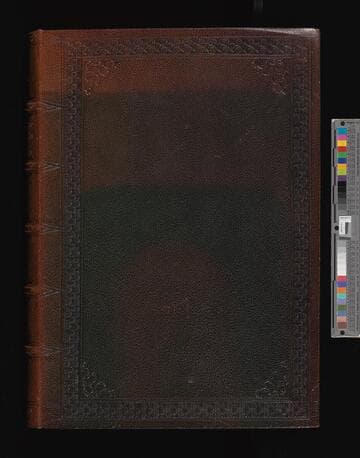
Title from caption on leaf a2v. Place and date of imprint from colophon; full colophon reads: Expliciunt. Note edite siue compilate: atq[ue] rursus: per reuerendum magistrum in artibus graduatum Stephanum de Masparrautha nomine dictum. Fueru[n]t impresse in vrbe i[n]signi Vale[n]tie. Anno incarnate deitatis. Millesimo. Quadringe[n]tesimo. Nonagesimo octauo die mercuris vicesima quarta: me[n]sis Octobris. Printer from ISTC. Mead gives printer as "Nicolaus Spindeler". Chancery quarto, with paper measuring 20.7 x 14.7 cm. Signatures: a-i⁸ k⁴ (a1 blank). Final page blank.
91594
Image not available
Rare Books
"Terri Weifenbach has received international acclaim for her gorgeous, vividly colored landscape photographs--and deservedly so. She has been described as 'the Emily Dickinson of photography' and the work in this new book can only strengthen her reputation as a truly original force in contemporary art. Weifenbach creates images based on seemingly unexceptional pastoral scenes that become quite extraordinary through her masterful presentation of their subject matter. Sometimes a whole picture is shot out of focus, or perhaps just one detail--a leaf, a bud, a blade of grass--is sharply focused, commanding attention, while the rest gently recedes into a soft and mellow blur. The results are breathtaking as, dream-like and entrancing, they evoke gentle memories of hazy summer days. The images for this, the artist's third monograph, were made in Lana, a small Italian village nestling in the mountainous South Tyrol"--Publisher's description.
653293
Image not available
Rare Books
"'The underground man' brings Macdonald's cool, pragmatic detective, Lew Archer, to a tragic fire that ravages a hillside community in Southern California. It enmeshes him in the lives of a group of troubled people searching for happy endings but fatally entangled in a web of murder and extortion stretching back through fifteen years--an angry father whose whole life has been a kind of breakdown, a mother using her son as a scapegoat, a part of alienated adolescents who believe they are rescuing a child from the adult world, and a sad woman living with a dreadful secret. The result is a novel that mingles unfaltering suspense with that extraordinary perception of an American life-style (West Coast Affluent) that is the hallmark of Ross Macdonald"--Page [1].
636044
Image not available
Rare Books
The Rosy Crucifixion may be Miller's masterpiece. It is an extended account of Miller's efforts to become a writer and relates his struggles, financial and spiritual, in detail. At the same time, it recreates the tone and texture of Miller's environment, and brings alive his varied cronies. Written in a relaxed, naturalistic American prose, the book is at times uproariously funny, especially when Miller pokes fun at himself. Nexus, the last book of Henry Miller's trilogy, is widely considered to be one of the landmarks of American fiction. In it, Miller vividly recalls his many years as a down-and-out writer in New York City, his friends, mistresses, and the unusual circumstances of his eventful life. It is autobiographical and tells the story of Miller's bizarre second marriage and its development into an extraordinary and legendary ménage à trois.
654793