Opening Hours
Daily: 10 A.M.–5 P.M.
Closed on Tuesdays
1151 Oxford Road
San Marino, CA 91108
Daily: 10 A.M.–5 P.M.
Closed on Tuesdays
1151 Oxford Road
San Marino, CA 91108

Image not available
Manuscripts
Sketch manuscript map shows Commodore Perry's fleet entering Edo bay, probably on the 8th of March, 1854, given that seven vessels are shown. The bay is roughly outlined, showing Perry's fleet in the center, as well as the location of major landmarks including the city of Edo, the towns of Futtsu and Tateyama near to the entrance to the bay, and the three heavily fortified artificial islands which stood in the bay close to the city of Edo. Text beside the second ship indicates this is Perry's vessel, text along the shoreline tells us which clan was defending that section of coastline.
mssHM 83876
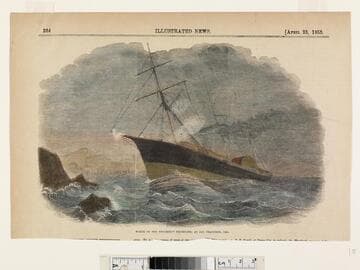
Visual Materials
"264 Illustrated News [April 23, 1853"--across top of the page. "15--"--on frame mat. The image is of the first Tennessee operated by the Pacific Mail Steamship Company; built in 1849, she was purchased in October, 1849, from the Savannah Steam Navigation Company; from 1850 to 1853, she operated between San Francisco and Panama; she was wrecked on 6 March 1853, at Bolinas Bay, four miles north of the entrance to San Francisco Bay. Focus of item: Tennessee.
priJHK 00617
Image not available
Manuscripts
Scroll documenting Commodore Matthew C. Perry's first expedition to Japan in 1853. The scroll begins with a map showing the Pacific through Uraga Channel to Edo Bay, with the American squadron's route marked out in red. Japanese defense locations are also noted. Detailed notes on the size and types of the foreign ships are given and the number of cannon noted. Following the map are four official reports. "List of fiefdom lords' names who participated in the event of the foreign ships' arrival" is a firsthand account by Matsudaira Ecchu no kami about the first diplomatic encounters with Perry. "Advice to the local commissioners" is dated 12 June 1853 and recounts that four foreign ships were spotted from Otsu village, Miura Ward and Sagami province. The third report is dated 9 June and is written by five of the fiefdom lords reporting their meeting with the Americans. The final report, "A list of fiefdom lords' troop strength" enumerates the number of troops at the disposal of 33 lords, and their responsibilities in the event of an invasion.
mssHM 83968
Image not available
Manuscripts
This manuscript describes a man named Hisa and a woman named Kame during the Edo (also known as Tokugawa) period in Japan. As part of the practice of shumon aratame, they had to stand on a fumi-e, a likeness of Jesus and Mary, to prove that they were not Christians. In the Edo period of Japan, the government used shumon aratame as part of an effort to eradicate Christianity.
mssHM 84473
Image not available
Manuscripts
Kōyasu was an Edo period samurai, known for his research in western gunnery. Kōyasu 恒康 was a penname for Nakajima Toranosuke 中島虎之助 (18181863)
mssHM 81209
Image not available
Rare Books
Black and white kawaraban, dating from probably the 1850s, depicts a figure who resembles other portraits of members of Perry's mission to Japan. The term used to describe his position is the Japanese equivalent of "Imperial Commissioner" - an expression originally used to designate emissaries from the Chinese imperial court, but also applied to senior members of the Perry mission. The name "Kihadansu Anan" does not correspond to the name of any members of the mission, but may be an misreading of the name of Commander Henry A. Adams or Lieutenant Joseph H. Adams. The text tells us that in response to his king's order he landed in Yokohama with an application to trade.
647774