Rare Books
A floating city and the blockade runners
Image not available
You might also be interested in
Image not available
Blockade Runner "Teazer" after her capture. (#7426)
Visual Materials
The Singleton Collection is organized into four discrete yet interrelated units. The first consists of 79 photographs by Mathew Brady (1823-1896) and Alexander Gardner (1821-1882) of scenes of the Civil War taken between 1861 and 1865. Included are group portraits of generals with their staffs, important wartime sites and activities, and photographs of paintings depicting various skirmishes. While the photographs were taken by Brady and Gardner during the war, the images were printed around 1885 by John Taylor and marketed by the firm of Taylor & Huntington. These photographer-entrepreneurs hoped to capitalize on twenty-fifth anniversary war reunions and commemorations by reissuing the once-familiar views. On the verso of each image is a partial list of the photographs sold by Taylor & Huntington for 75 cents a piece. The second grouping of photographs depicts two views of Abraham Lincoln and portraits of the Lincoln conspirators and their execution. These were also taken by Brady and Gardner during the war and, as with the first group, printed and issued around 1885 by Taylor & Huntington. Of particular rarity are the fourteen photographs of the Lincoln assassination conspirators including portraits of David Herold, George Atzerodt, Edward Spangler, two views of Lewis Payne, two views of Michael O'Laughlin, and an unidentified conspirator. Additionally, there is a complete set of three images depicting the execution of Mrs. Surratt and the conspirators taken by Alexander Gardner on July 7, 1865, as well as three of the five known images documenting the execution of Captain Wirz, the notorious Keeper of Andersonville Prison. Eighty-three cabinet portraits of Confederate Generals and other Southern leaders by George S. Cook (1819-1902) comprise the third section of the collection. Cook was a friend and former employee of Matthew Brady, and he provided E.& H.T. Anthony Co. with portraits from the South, including the first portrait of Colonel Robert Anderson. These portraits may come from sources other than Cook as he purchased competing photographers negatives, issuing them on his mounts. These portraits were taken in the 1860s but printed between 1880 and 1890 when Cook operated his Richmond, Virginia studio at 913 East Main Street. The last grouping of photographs contains 210 images by William H. Tipton (1850-1929), the self-described "Battlefield Photographer." The imperial-sized photographs depict the numerous monuments erected on the Gettysburg battlefield to honor the soldiers who fought and died in this decisive battle. The photographs date from the 1880s. The Singleton Collection constitutes of one of the most complete historic archives of the Gettysburg monuments.
photCL 445
Image not available
001
Manuscripts
"Great Shakes of a Snake's Tale - Projection": 1946. "Great Shakes of a Snake Tale" - hauling boats - map - volcanic rock formations - aerial views - Balanced Rock - waterskiing - cascades - waterfall - boats at shore - Indian rock drawings - ferry (Brownlee?) - loading boat - boats on river - camp scenes - running rapids - bailing - swallow nests and young - flowers and insects - rattlesnake: free, caught, held, dead - canyon scenes - fawn - low airplane - Lewiston? - tip out - One Way Club certificates.
R054
Image not available
John Tyler, Sherwood Forest, Virginia, letter to Robert Tyler :
Manuscripts
Letter to his son regarding the crops at the Sherwood Forest plantation, activities of his wife and other children; also discusses strategies for the 1860 presidential convention in Charleston, cotton, his presidency, and current president James Buchanan.
mssHM 23233
Image not available
001
Manuscripts
"Salmon River - 1946 (Master) ('Great Shakes of a Salmon Tale')": 1946. Nevills Expedition with Marston family down the Salmon River in 1946.
R063
Image not available
Los Angeles: a succinct history of the city
Manuscripts
This manuscript is a history of the city of Los Angeles, dating from the arrival of Spanish missionaries in the 18th century. Of the city's early history, Stephens writes, "For many years, Los Angeles was but an outpost of San Gabriel. Its population was gradually increased by the arrivals of newly discharged soldiers and their families." He tells the tale of the early privateer Joseph Chapman, whom he calls "The First Settler," and "The Great Flood" of 1825 which was followed by three years of "drouth." He speaks very highly of Hugo Reid. Most of the historical content is mentioned only briefly, with little to no detail. The final entries are dated mid-1885.
mssHM 19829
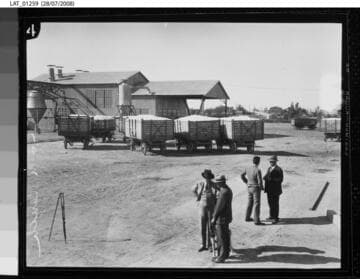
Cal-Mex Ranch cotton gin mill
Manuscripts
Black and white photograph of the cotton gin mill at Cal-Mex Ranch. Four men, on with a dog on a leash, are shown conferring in the foreground. Behind them are several 4-wheeled wooden carts of cotton and the cotton gin mill itself.
mssLAT 01259