The Huntington’s blog takes you behind the scenes for a scholarly view of the collections.
Globalizing the Protestant Reformations
Posted on Wed., Dec. 6, 2017 by
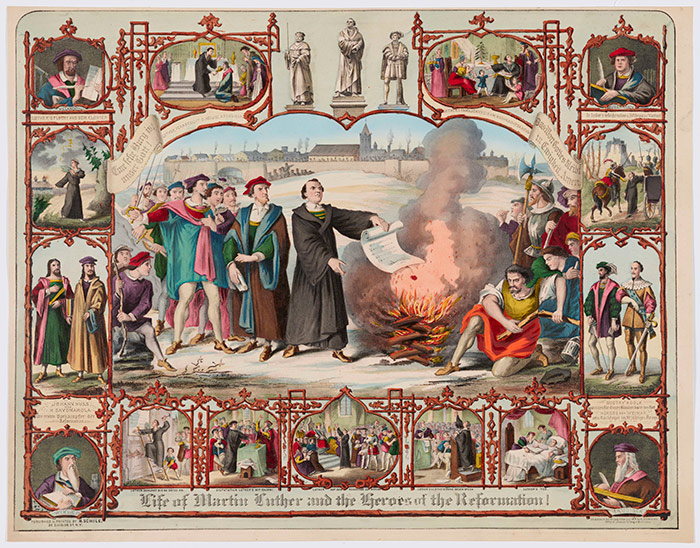
H. Breul and H. Brückner, Life of Martin Luther and Heroes of the Reformation, 1874, hand-colored lithograph, H. Schile; New York. The Huntington Library, Art Collections, and Botanical Gardens.
The origins of the Protestant Reformations are often traced to the German friar Martin Luther (1483–1546), who on Oct. 31, 1517, posted a document with 95 theses against the indulgence trade—in which donors paid the Catholic Church to remit punishment for sins. These theses began to outline Luther’s disputes with the Catholic Church. Luther’s calls for reform would eventually lead to a global movement that gave rise to the Protestant faiths.
To investigate the nature and significance of the Protestant Reformation as a global phenomenon, I am convening a conference, “Globalizing the Protestant Reformations,” which will be held Dec. 8–9, 2017, in The Huntington’s Rothenberg Hall.
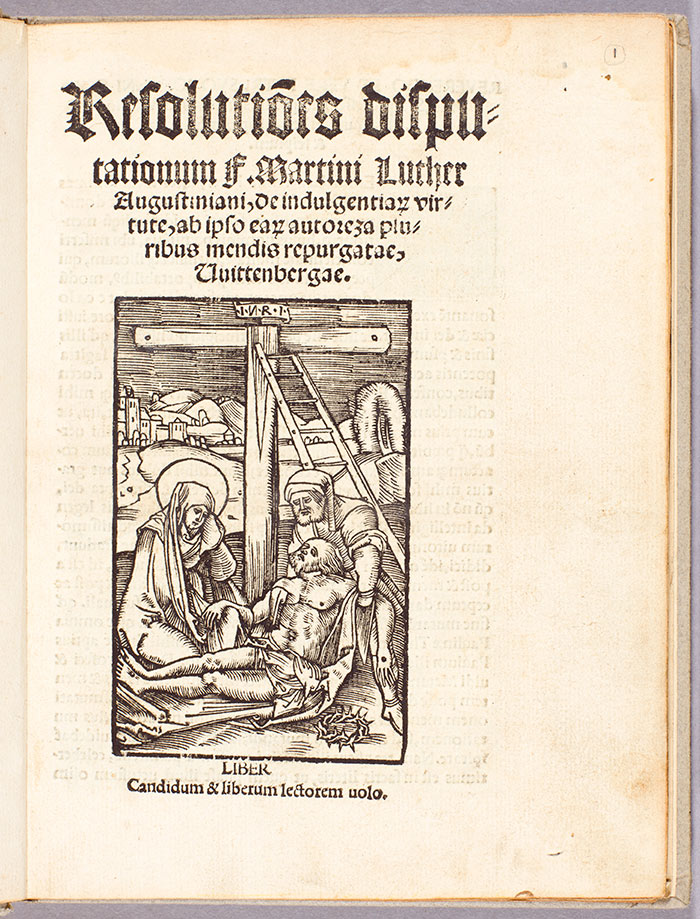
The title page of Disputatio pro declaration virtutis indulgentiarum (Disputation on the Power of Indulgences) by Martin Luther (1483–1546), 1519. The original document of the “Ninety-five Theses” has not survived, but versions of it were published almost immediately by printers across Europe. Luther wrote his tract in Latin, the language of the Church, which suggests that he had clerics in mind and never suspected his arguments would reach a popular audience. This volume was printed in Leipzig, some 45 miles away from Wittenberg, where Luther lived. It is the earliest version of the “Ninety-five Theses” in The Huntington’s collection. The title page’s illustration depicts Christ’s deposition from the cross. The Huntington Library, Art Collections, and Botanical Gardens.
It will be crucial for the next decades of scholarship to investigate religious change as multi-centric and interconnected across Western and non-Western worlds. The point of incorporating neglected global dimensions is to chart the vitality of varied reformed traditions, which confronted different institutional settings and could significantly challenge political and cultural ideas of mainstream European faiths.
This scholarship has already begun. A decade ago, for instance, historian Jon Sensbach told the story of Rebecca Protten, a Caribbean woman born in 1718 whose life was changed by the Moravian Church, one of the oldest Protestant denominations in the world. As a child, she had a conversion experience and later joined their mission. On the Danish sugar island of St. Thomas, she and her followers created the earliest African Protestant congregation in the Americas.
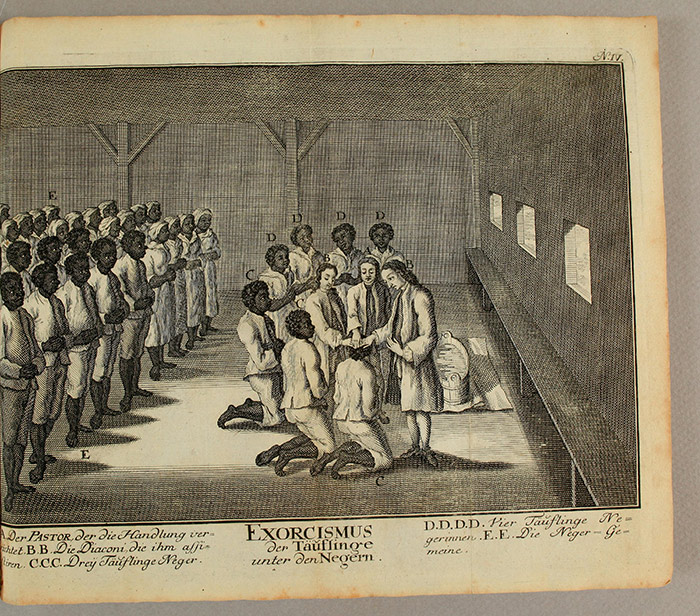
Exorcismus der Täuflinge unter den Negern. Plate IV. From David Cranz. Short, reliable news of the Church Unitas Fratrum. Halle, 1757. John Carter Brown Library.
In Pennsylvania, Quakers, Mennonites, Huguenots, Lutherans, and Calvinists from five different European nations created a pluralistic “holy experiment.” These encounters have inspired scholars to ask how Protestant traditions were enriched, reshaped, and pluralized in new worlds and how those experiences, in turn, influenced Europe, contributing to the history of the “long Reformation” of the 17th and 18th centuries.
Protestants took different paths in marking the difference to, or excluding, specific groups. They also differed in how they mapped out internal hierarchies, considered interfaith relations, understood science and commerce, and weighed in on moral discourses on such issues as social inequality. They sustained diverse approaches to the question of how God comes alive to people individually or collectively and through what practices the supernatural can be known. Conceptions of resistance, gender, or the supernatural could be worked out in distinctive ways, as could the emotions that believers learned and understood.
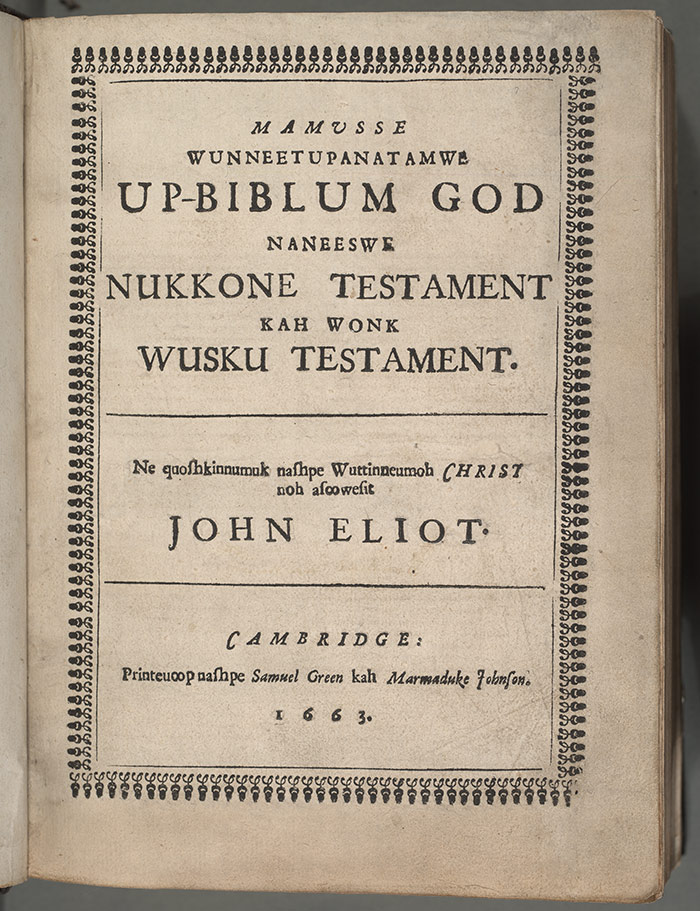
Mamusse wunneetupanatamwe Up-Biblum God [Bible in Massachusett]. Cambridge, Mass., 1663. The Huntington Library, Art Collections, and Botanical Gardens.
During the conference, leading scholars from the United States, Australia, Germany, and Switzerland will investigate cultural and emotional meanings of ideas about the divine and ask how Protestant perceptions and practices shaped demarcations of the feminine or masculine, commercial practices, notions of temporality and violence, spatiality, and sensual, visual, and material culture.
The conference will include a visit to The Huntington’s exhibition “The Reformation: From the Word to the World,” which draws on its rich holdings of Protestant writings. During the conference sessions, we will address questions about the nature of religious encounters among people of different Christian faiths in relation to their European traditions. Other important areas of study will include the considerable links between Protestant centers of missionary thought across Europe and the wider world around 1700—for instance, examining how Bostonian clergymen could network with German Pietists in India.
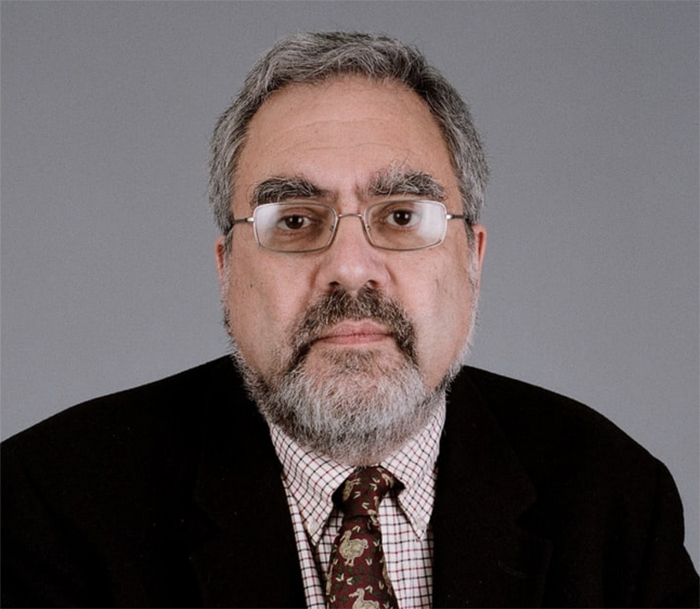
Anthony Grafton, the Henry Putnam University Professor of History at Princeton University, will deliver the Crotty Lecture, “Christian Origins in Early Modern Europe: The Birth of a New Kind of History.” The lecture takes place on Thursday, Dec. 7, 2017, at 7:30 p.m. in Rothenberg Hall.
Preceding the conference, Anthony Grafton, the Henry Putnam University Professor of History at Princeton University, will deliver the Crotty Lecture, “Christian Origins in Early Modern Europe: The Birth of a New Kind of History.”
The lecture takes place on Thursday, Dec. 7, 2017, at 7:30 p.m., also in Rothenberg Hall. Grafton will explore who created knowledge about religion, how authority could be claimed and defended, and look at new forms of inquiry and explanation. These new perspectives show the dynamism of a rich field of Reformation scholarship that will allow us to better understand not just the European past, but a history of the world. A global and connected account of the Protestant Reformations is long overdue.
You can listen to Anthony Grafton's lecture on SoundCloud.
Ulinka Rublack is professor of Early Modern European History at the University of Cambridge. Her books include The Astronomer and the Witch: Johannes Kepler’s Fight for his Mother , Dressing Up: Cultural Identity in Renaissance Europe, and Reformation Europe.