Opening Hours
Daily: 10 A.M.–5 P.M.
Closed on Tuesdays
1151 Oxford Road
San Marino, CA 91108


Have you ever been to a museum or a county fair and seen an exhibit where women are dressed in old-timey clothing and sitting by a spinning wheel? This is an example of a myth made real. Spinning wheels like this one are part of a persistent trend to idealize the lifestyle of America’s early settlers of European origin.
This spinning wheel is an example of an early nineteenth century “walking wheel” made specifically for spinning wool. It is like hundreds of others across the country that are used to furnish historic homes and living history sites. Spinning wheels are not rare, but they are iconic.
The role of the spinning wheel in early homes is a big part of an often told story of the American past. However, when we see a spinning wheel, it raises images of a time when the country was young and life was very different from today. Most of us can imagine an image of a woman in an old-fashioned dress sitting by a cozy fire with her spinning wheel, spinning the yarn for her family’s clothes.
We can believe that back in those days everyone lived in rural areas and made things from scratch: their clothes, their food, and their candles. We think the early settlers were self-sufficient and productive and never complained about how hard the work was. This type of story or myth is an example of romanticism. It leaves out the unpleasant details to make the situation seem “not so bad.” Usually everyone in the mythical version of this story is white and speaks English. Have you seen this kind of performance at a historical site or museum? Some parts might be true, and some parts of the story are missing.
In 1876, the United States celebrated its centennial. It was a time to look back at our history and who we had become as a country. Finding examples of the colonial past meant people could find symbols and images of what we think it means to be American. It was called the Colonial Revival and was most prominent between 1880 and 1940. The ideas of the Colonial Revival showed up in the way people depicted life in the past. Community fairs and newly formed historic sites regularly featured spinning demonstrations with women dressed in colonial costume. There were dozens of examples in late nineteenth century literature in which authors use the backdrop of the colonial kitchen hearth (complete with spinning wheel) to tell stories of a simpler life or of a time when families gathered together for story time with grandma. Images like these and many others came back again in the 1920s and in the 1970s, and probably will in the 2020s too!
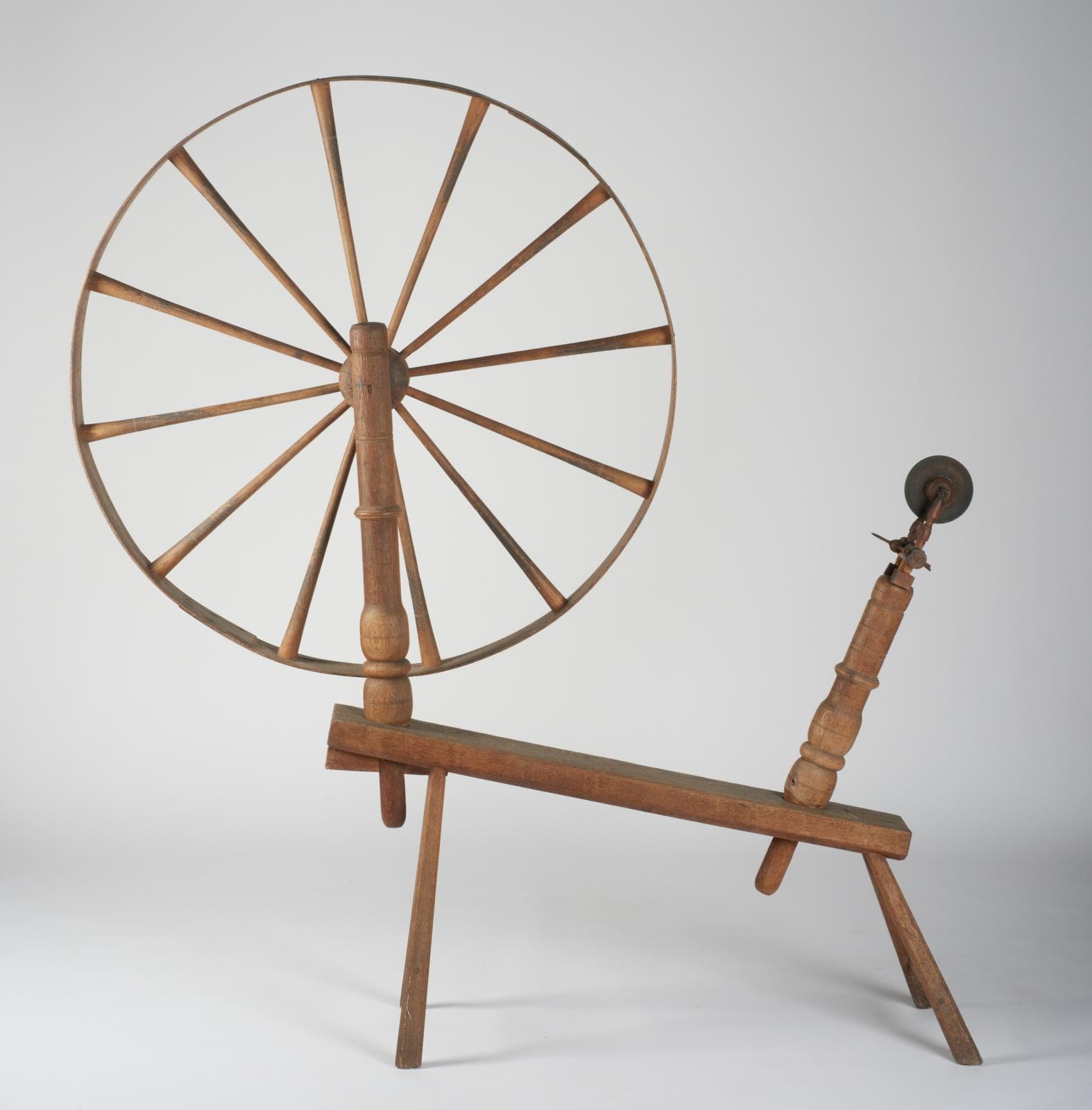
American women did make heavy use of the spinning wheel in America’s colonial days. Probate records (lists of things people own when they die) from homes in Connecticut and Massachusetts show that by 1674, 50 percent of homes owned a spinning wheel.
This particular device was used to make yarn from wool. Spinning wheels help to twist fibers together tightly as a person draws out the yarn with their fingers. Smaller spinning wheels with a foot pedal are also common and were used to spin flax into linen.
The walking wheel transforms wool into yarn by spinning the wheel and walking forward and backward in a pattern to encourage the wool or other fiber to twist. Many other spinning wheels were used while sitting down and operated with a foot pedal.

When people see the images of spinning wheels, they rarely include all perspectives on the story. For example, one reason for spinning wheels and looms in early America was because of the tariffs that England imposed on the colonies. These taxes made it very difficult to buy cloth or the equipment and supplies to make it, so people needed to make their own tools. That lends itself to the story that early Americans were very self-sufficient and suggests that maybe they didn’t need those goods from England.
What about the people who were doing the spinning? We know it was a woman’s task, but we also know that it was an exhausting and long process. As part of the household labor, it is very likely that enslaved women were doing much of the spinning for a household, and usually these were young girls.
Investigate the Wool Act of 1699 and consider the implications of the law on colonists. What other laws imposed on colonists might have influenced a need for self-sufficiency? Consider other acts related to the idea of profitable trade or mercantilism that affected colonists including the Hat Act 1732, Molasses Act 1733, and Iron Act 1750.
OPEN TODAY: 10 A.M.–5 P.M.