Opening Hours
Daily: 10 A.M.–5 P.M.
Closed on Tuesdays
1151 Oxford Road
San Marino, CA 91108

John Brewster Jr. painted this portrait in 1801. He was D/deaf from birth and learned to paint from a minister who was also a painter, but never studied formally. His family was well connected. His father was a physician and served in the Connecticut General Assembly, and John Brewster Jr. used those networks to secure commissions in Connecticut, Massachusetts, and Maine, where he later moved. Prior to the development of American Sign Language (ASL), other D/deaf language systems existed, including “home signs” that were specific to each family. Given the number of portraits by him that survive, he was clearly a successful painter who was much sought after by the upper middle class in New England.
As a travelling painter, Brewster would stay with different families for many weeks at a time and sometimes put an ad in the local paper to advertise his services. He probably also used writing to communicate with the people he painted about what they wanted in their portrait. Brewster, like other itinerant painters of the time, very regularly used the same poses and props to help him save time. Around 1805 he started signing his paintings.
Below is an example of an ad that Brewster placed in the Newburyport, Massachusetts Herald and Country Gazette on December 25, 1801.

“John Brewster, Portrait and Miniature Painter,
Respectfully informs the Ladies and Gentlemen of Newburyport, that if they wish to employ him in the life of his profession, he is at Mr. James Prince’s, where a specimen of his paintings may be seen. He flatters himself, if any will please to call, they will be pleased with the striking likenesses of his, and with the reasonableness of his prices.
Note. If there is no application made to him within ten days he will leave town.”
The Subject
Though the identity of the subject is uncertain, she may be Elizabeth Stone Coffin, wife of Major David Coffin, who was a relative by marriage of the painter John Brewster, Jr. Mrs. Coffin would have been thirty-nine years old in 1801 when this portrait was painted. She was the mother of seven with an eighth on the way (eventually she would have twelve children, though two died in infancy). Her husband was a highly educated minister as well as a ship’s captain, cargo ship owner, and investor who owned a distillery and a store.

Historically, portraits like this were commissioned (ordered and paid for) by either the subject or a member of the subject’s family. Having your portrait done was a luxury, even if you found an inexpensive artist, because it cost both money to pay the artist and time to sit still while the artist worked. Early Americans were eager to find ways to show off their wealth and success, and having a portrait made was one way to do so.
A portrait could convey the wealth and social status of the sitter in terms of dress or surroundings and portray something important about their role in society through the objects they held or used in the image.
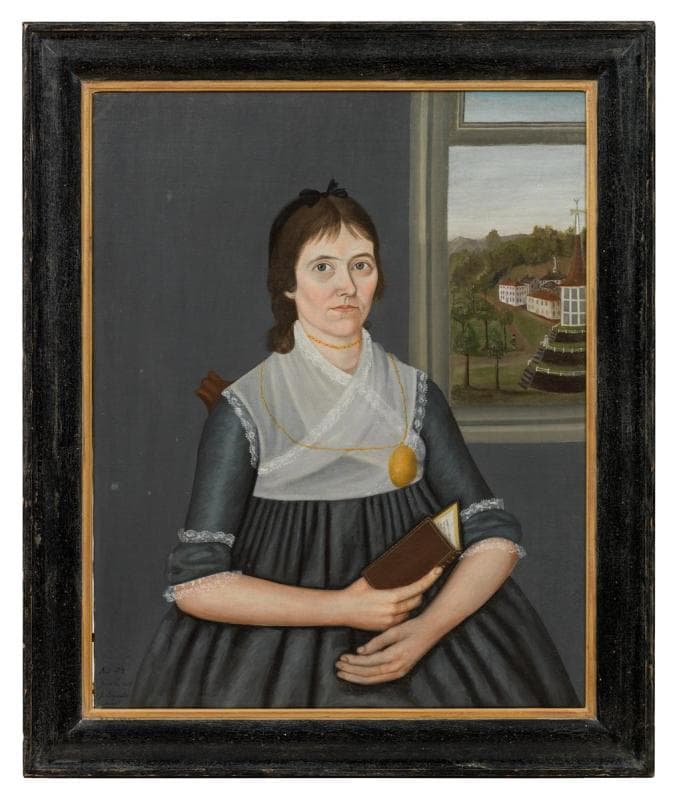
When viewing this portrait, one thing you might notice right away is that Elizabeth Stone Coffin is holding a book. What book might she be holding? What might be important about her locket?
In this painting the open window reveals an intriguing background. Looking closely, we can see a group of buildings, including an elaborate one in the foreground with a weather vane. This might give us a clue about where the portrait was made, but it might also be a suggestion of an ideal or imagined world.
Brewster worked quickly. This painting is dated June 10, 1801 and the painting of Major David Coffin is dated on June 13!
Questions for Discussion
Suggested Activities
