Opening Hours
Daily: 10 A.M.–5 P.M.
Closed on Tuesdays
1151 Oxford Road
San Marino, CA 91108


This hat was created by a Haudenosaunee (hoe-dee-no-SHOW-nee) craftsperson in the mid-nineteenth century. The Haudenosaunee is an alliance of six nations, the Mohawk, the Oneida, the Onondaga, the Cayuga, the Seneca, and the Tuscarora. These nations are more commonly known as the Iroquois Confederacy. They continue to live in territories and reservations in current-day New York, Wisconsin, Oklahoma, and North Carolina. Each of the six nations share many cultural similarities, but they all have distinct languages and cultural practices too.
The opening of the Erie Canal in the 1820s helped bring many people to the region where Haudenosaunee people lived, and this resulted in a booming tourist trade. This flowery, beaded cap was a one of many produced for sale to tourists in the Niagara Falls vacation destination in approximately 1870.
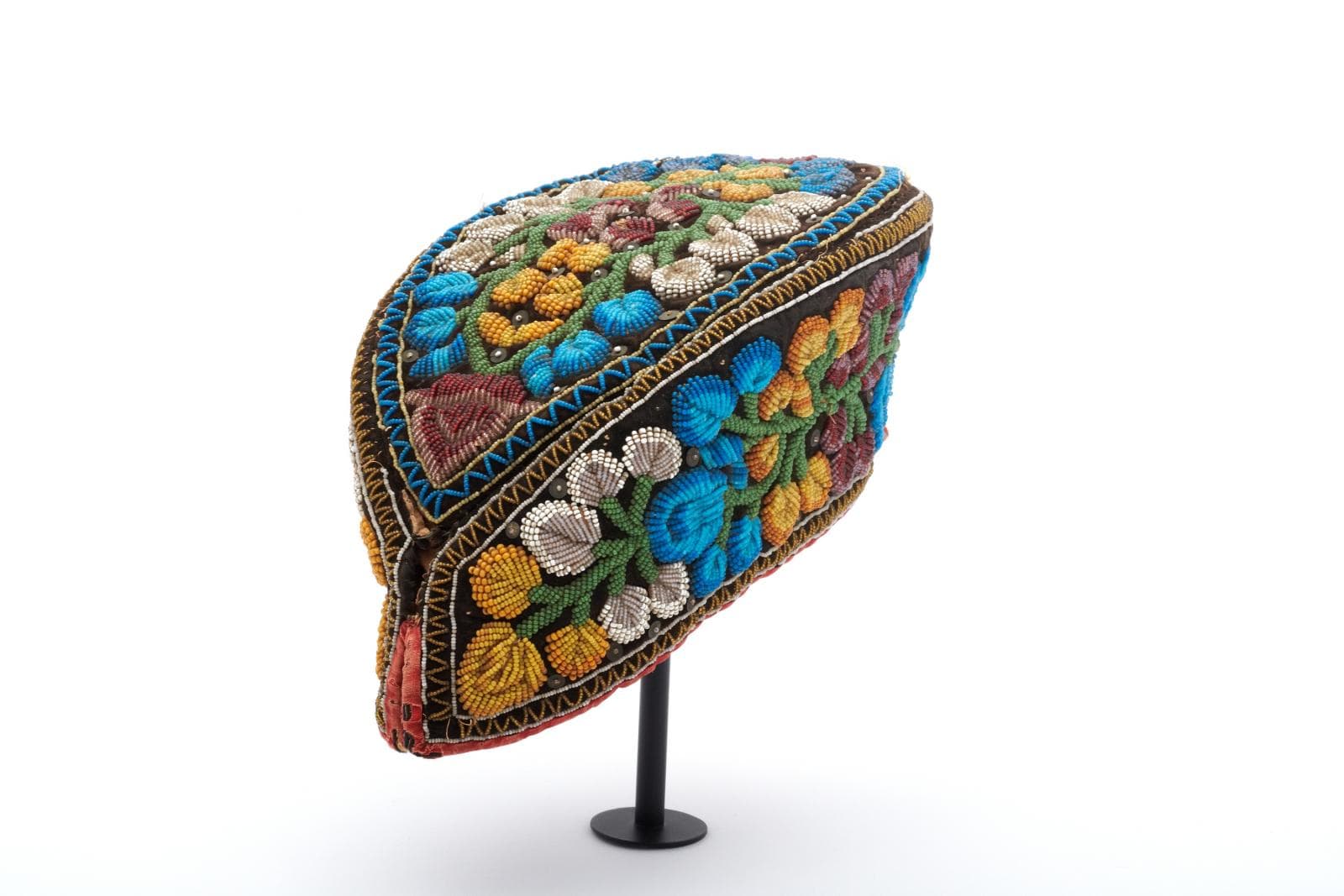
There are thousands of small beads painstakingly sewn to the hat by hand. Beads have been an important element in Haudenosaunee life since before Europeans arrived in what is now known as America. Originally, beads and other decoration were made of materials like animal bones and teeth, seeds, rocks, and shells. When French, Dutch, and English people came to America, they brought with them beads made of glass as well as other useful materials like cloth thread and metal needles. Through trade with Europeans, the Haudenosaunee obtained these new supplies and incorporated them into their artistic traditions.
Among Native American communities, flowers are important because of their connection to plants, which are meaningful because they were used in medicine, food, and religion. Floral designs would have also helped sell this hat to white tourists. Flowers were very popular with fashionable ladies in this time period (the Victorian Era) who assigned their own meanings, including femininity, to flowers.
The shape and style of this hat originated in Scotland. Haudenosaunee craftspeople probably saw this kind of hat on Scottish soldiers stationed in what is now known as Canada. Queen Victoria’s children in England wore this same kind of hat, which helped to make it popular in both England and the United States.
As local cultures interact with each other through art, tourism, fashion, and other industries, this changes the way culture is produced and consumed. The Haudenosaunee bought beads from European traders as early as the sixteenth and seventeenth century and began to use them in their art. By the nineteenth century, they began to sell their work as souvenirs to the tourists who visited Niagara Falls and other areas in the region. There is no doubt that those sales affected how they chose to share their culture. Since being pushed from their homelands by white colonists, the Haudenosaunee had adapted to their circumstances. They depended on the sale of these souvenirs for survival. In turn, it became a way to share and maintain their traditions to the present day.
Watch this video “Haudenosaunee Beadwork: A History” from PBS, which explores raised beadwork and its importance to Haudenosaunee culture and identity.
Questions for Discussion
OPEN TODAY: 10 A.M.–5 P.M.