Opening Hours
Daily: 10 A.M.–5 P.M.
Closed on Tuesdays
1151 Oxford Road
San Marino, CA 91108

This Lone Star Quilt by Mary Seeds Moon was made in Baltimore around 1840, making it an early example of an American quilt. What is unique about it is the blending of old and new styles and methods in quilting.
Based on census records and family history that came with the quilt, we know Mary Seeds Moon was born in England in 1806. By the late 1820s, she had immigrated to the United States and was living in Baltimore, Maryland. We also know that Mary was a seamstress and likely made many quilts both as part of her work and for her household.
Following the trends in Europe, the city of Baltimore was known for its over-the-top taste in all things home décor, including quilts. By the mid-nineteenth century, textile manufacturing in America was well underway and meant that fabric was readily available and affordable for people to purchase.
Mary’s quilt includes a blending of more traditional English methods of quilting where patterns are cut out of a piece of fabric and then sewn on to the quilt top. She also includes a pieced pattern, which includes cutting very small shapes and sewing them together into a new pattern. The pattern in this quilt and others like it is said to have been influenced by the invention of the kaleidoscope.
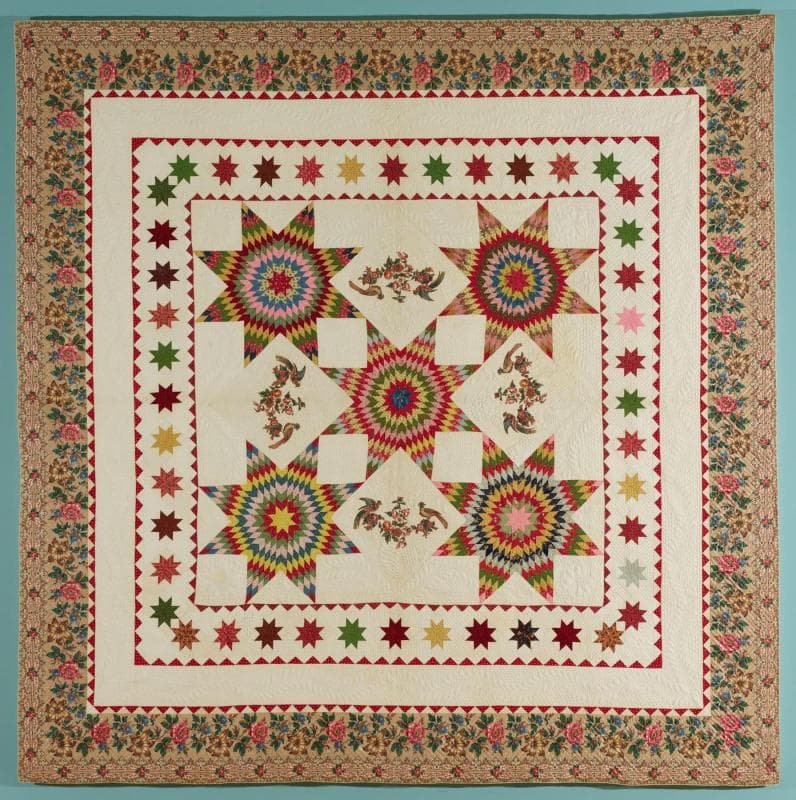
To make this quilt, Mary used a few different methods. She used a technique known as pieced quilting, which involves sewing blocks of fabric together as well as a fancier European style of quilting called “broderie perse.” This technique uses printed fabric appliqued, or attached, to background fabric. It is a very decorative style that often utilized more expensive fabrics, so it wasn’t often found on everyday items. A quilt with a fancier design would be reserved for guest rooms or, in the case of Mary’s Lone Star quilt, for decoration.
This quilt shows Mary’s skill as a seamstress as well as her creativity. She was so good at sewing that she could fit fourteen stitches in one inch of fabric. And, remember she did all this by hand. The sewing machine as we know it was not in widespread use until the 1850s!
The central star design is known as a “Lone Star,” a “Star of Bethlehem,” or even sometimes a “Mathematical Star.” It’s easy to see how math, especially geometry, would be a useful skill when designing a quilt as detailed as Mary’s to fit every piece of fabric into place correctly.
Although it is very difficult to see in the image, this quilt is unusually large. A king size bed is about 76 x 80 inches; this quilt is 128 x 129 inches! Why is it so large? Given the quality of the design and the size, it is possible that the quilt was entered into a local agricultural fair to show off her skill.

Quilts from Baltimore are often known for being very elaborate and ostentatious. Compare and contrast Mary Seeds Moon’s quilt with this elaborate design from Berks County, PA. Do they seem to come from the same perspective? How are they similar or different?

Now compare and contrast the Mary Seeds Moon’s quilt and this one from an Amish quilt-maker. Do they seem to come from the same perspective? How are they similar or different?
OPEN TODAY: 10 A.M.–5 P.M.