Opening Hours
Daily: 10 A.M.–5 P.M.
Closed on Tuesdays
1151 Oxford Road
San Marino, CA 91108

Pieced quilts are a very special and important part of American craft history and art-making. They also have a lot of stories connected to them. Whether through the meaning in the fabrics and materials used, or through their patterns, quilts provide us with many different ways to connect to history, both personally and collectively. Because of their popularity, quilts also lend themselves to lots of different stories and myths about American history and culture.
The general history of quilting is filled with myths about frugality and resourcefulness. Many people believe that early American quilters only made quilts from their left-over clothing scraps. We picture resourceful settlers without any other alternative making do with the little they had. While some quilters did use fabric left-overs (and “scrap quilts” make up their own genre), store-bought fabric was fairly cheap and easy to come by, even in America’s early days.

The Log Cabin quilt in the Fielding Collection was made by an unknown quilter in approximately 1870, which was a popular time for log cabin symbolism and nostalgia for the “old days” of the early American frontier. The early pioneer settler home, the log cabin, became an iconic symbol of the taming of the wild frontier and for achieving the American Dream itself. The log cabin symbol was so popular, a quilt style was named after it.
This style of quilt is called “Log Cabin” because of the pattern. It is made with a central shape, such as a square or a diamond, in the middle. This represents the hearth or fireplace, which is a place of warmth and activity in a log cabin. The center hearth square is surrounded by smaller strips of fabric (the “logs”), with four layers of lighter colored strips on one half and four layers of darker colored strips on the other.

In 1863, Log Cabin quilts become very popular to help raise funds for the Union Army during the American Civil War. It was thought to be in honor of Abraham Lincoln, who grew up in a log cabin. Quilts continued to become very popular as our nation was nearing the year of its centennial in 1876. The 100-year anniversary of the signing of the Declaration of Independence seemed like the perfect time to look at how far the nation had come, from log-cabin living to a prosperous civilization.
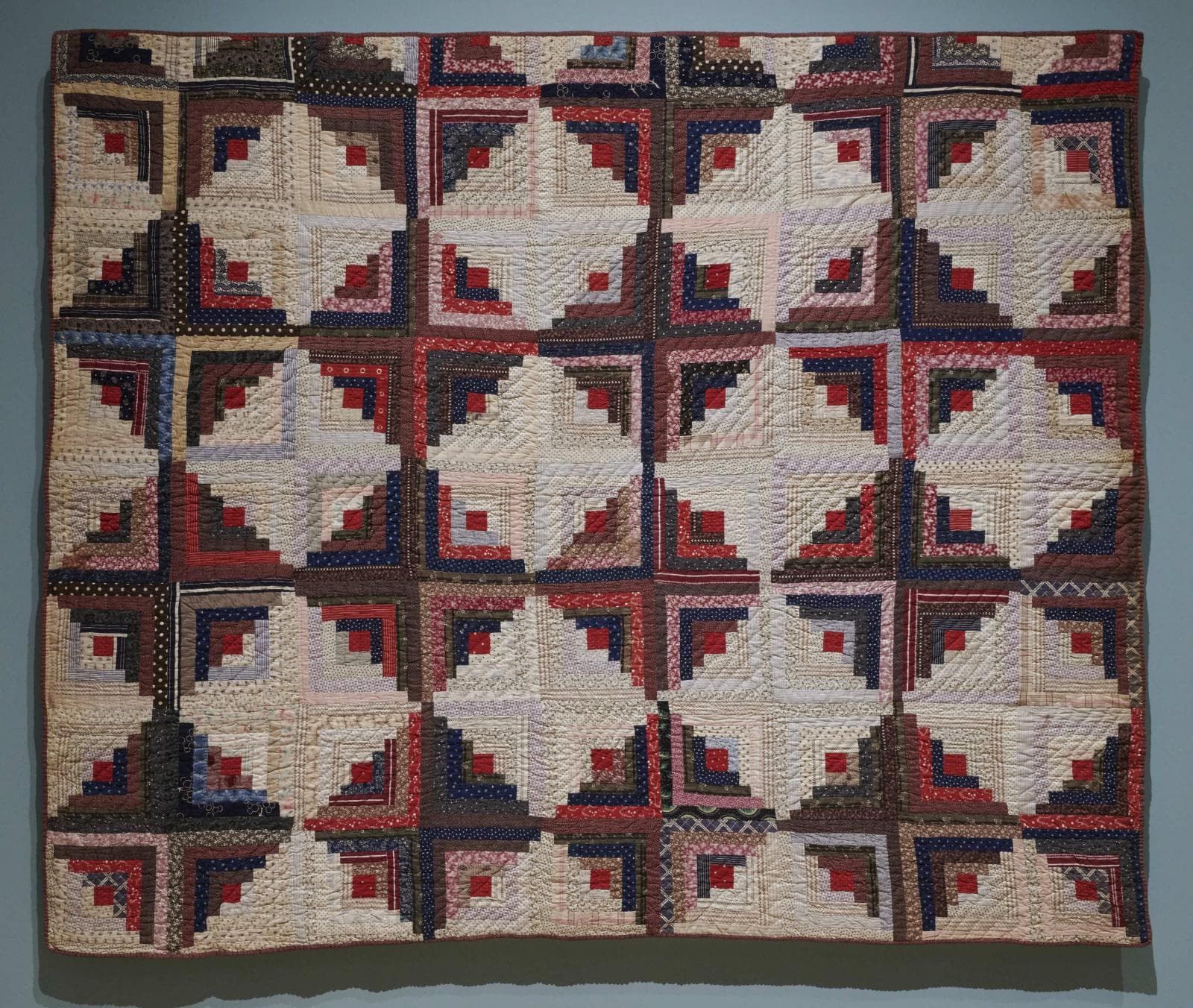
The log cabin pattern isn’t unique to American quilting! Some of the earliest designs of a log cabin pattern design can be found through time and around the world.
During his successful political campaign for president in 1840, William Henry Harrison could be credited with starting the log-cabin craze and being the inspiration for this quilt style. In his campaign advertising, he portrayed himself as a man of the common people who was born in a log cabin and drank hard cider (a popular drink with ordinary farmers). This was not true. He was born on a plantation to one of the wealthiest families in Virginia. But Americans love a rags-to-riches story, even if it isn't real. The log cabin imagery won him the support of the masses and the presidency. It was this same story of humble origins that made this quilt pattern so popular.
Claiming to have been born in a log cabin was viewed as a positive characteristic of a good American. Six presidents were, in fact, born in a log cabin. They include Andrew Jackson, James Polk, Millard Fillmore, James Buchanan, Abraham Lincoln, and James Garfield. Politicians wanted to use the image of a poor individual who rose to lead the country as a way of showing they understood the common person and were worthy of election.
In 1970, individuals in California created a political organization called the Log Cabin Republicans to advocate for the rights of lesbian, gay, bisexual, and transgender (LGBT) Americans.
Their website explains:
“The name of the organization is a reference to the first Republican president of the United States, Abraham Lincoln, who was born in a log cabin. President Lincoln built the Republican Party on the principles of liberty and equality.”
Questions for Discussion
Suggested Activities
CLOSED TODAY