Opening Hours
Daily: 10 A.M.–5 P.M.
Closed on Tuesdays
1151 Oxford Road
San Marino, CA 91108

This painting by Winthrop Chandler shows a variety of characters who represent several levels of social hierarchy in late 1700s America. It was painted to hang in Ebenezer Waters’ home in West Sutton, Massachusetts. Ebenezer Waters (1739-1808) was a civil engineer and surveyor. The painting is called an “overmantel” because it was designed to hang over a mantel and thus be displayed prominently in the home.
This painting may be a house portrait or a landscape painting commissioned for a particular house. It could also be a more general view of the local area. Landscape paintings like these were not generally meant to be an accurate depiction of any particular place or scene. This work is more likely to be a generic portrayal of life in New England that is intended to capture a pleasant feeling, not to be particularly thought-provoking.
Chandler’s vision includes different people with defined roles and is meant to capture a sense of time and place in Massachusetts around the time of the American Revolution.
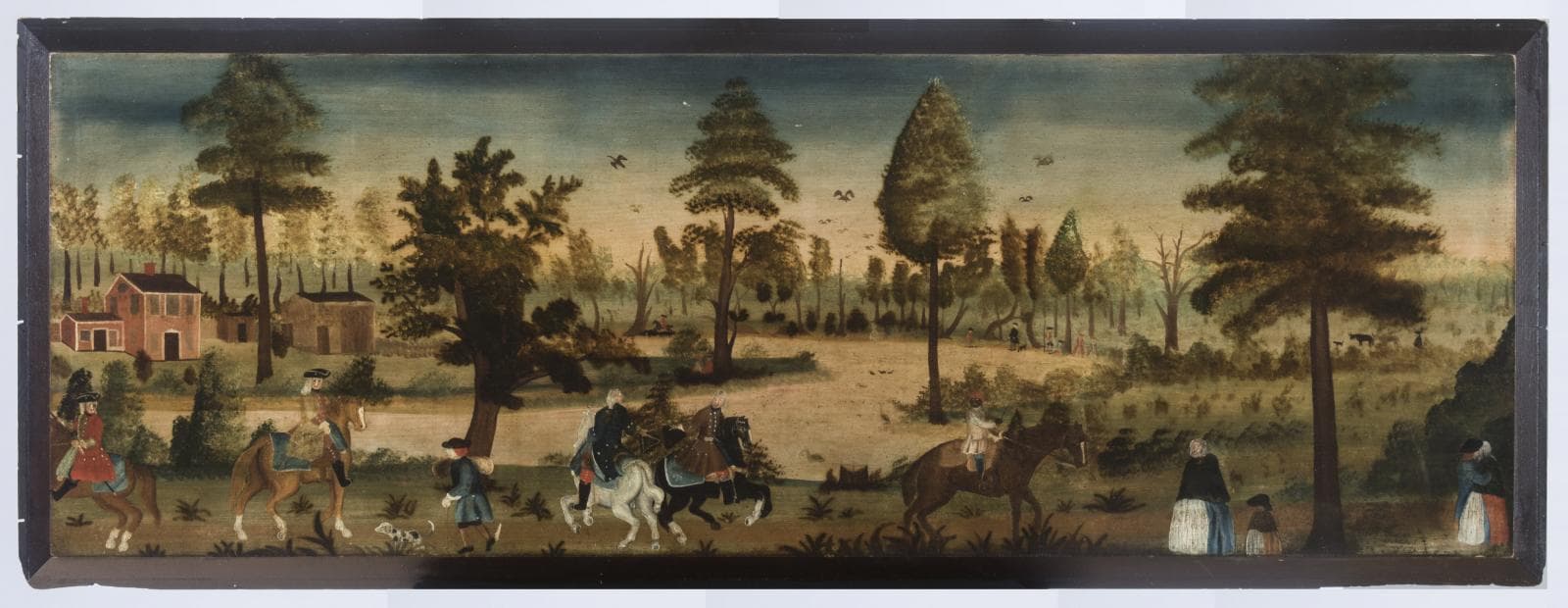
The character of a man carrying a bag appears in other similar works of the time. He may be a traveler or a peddler carrying his goods for sale.
A couple embraces in a shady spot.
It was not unusual to use the space over the fireplace to show the hustle and bustle of public thoroughfares and outdoor spaces. This example is a scene of Boston Common and was made by a young woman named Hannah Otis. As in Chandler’s painting, a lot of activity is taking place. A man on horseback gallops by with a whip in his hand. Another figure tips his cap. Cattle, birds, dogs, rabbits, and a deer share the land and sky. A man in the bottom right corner holds a bow and arrow, ready to hunt. A small boat, perhaps a toy, glides over water. Overall, the embroidery provides a sense of the busy, vibrant exchanges of daily life at the time. For someone spending a lot of time in front of a fireplace, there would be lots of interesting details to contemplate.
English prints often served as the sources for the patterns and designs on large embroideries, including panels made to hang over fireplaces. Here, the men on their horses are similar to figures in English hunting prints.
More people gather on the other side of the water. One man sits beneath a tree, another has a dog by his side. Two women seem to be talking to each other.
Chandler made this overmantel sometime around 1770-1780. This means that Chandler painted it just before slavery was legally abolished in Massachusetts through court cases in 1781-1783. Even before the enslavement of African Americans ended in the area where this was made, African Americans held varied roles in society, and not all African Americans were enslaved. Outside of enslavement, African Americans still faced hardships as indentured servants, apprentices, or free laborers. This painting does not provide much information about the precise role or status of the African American figure on horseback in the front, though he seems well dressed and important on his horse. The inclusion of this figure among the other people taking part in public activities recognizes the presence and importance of African Americans in daily life at the time.
Chandler painted this overmantel for a home. Including houses in the scene adds a homey, local feeling to the painting. One possibility is that it depicts the house in which it was installed.

This image, Family Mansion of David Thayer, from 1830 is an example of a house portrait. This pen and ink drawing shows identifiable members of a household and the surrounding building and farmland. If you look closely you can see a sign that reads “D. Thayer Saddler. It shows a different perspective on life at the time. What ideas could we infer about hierarchy or status from this image? Why might David Thayer have asked for such a portrait? We don’t know much about David Thayer and his family, but we do know that this farmstead was located in or near Bainbridge, New York.
OPEN TODAY: 10 A.M.–5 P.M.
