Opening Hours
Daily: 10 A.M.–5 P.M.
Closed on Tuesdays
1151 Oxford Road
San Marino, CA 91108


Imagine, for a moment, that there is no such thing as 8 a.m. or 5 p.m. For most of human existence, this is how we lived: orienting our schedules to the rhythms of the sun or our physical needs rather than a specific time on a clock.
The word “clock” comes from an Old English word meaning “day measure.” The earliest clocks were primarily used by monks to mark times of worship. Later they were placed in clock towers to summon people to church and workers to their place of work.
A Fancy Clock in the Living Room
This tall case clock (sometimes called a “grandfather clock”) in the Fielding Collection was among the first kinds of clocks widely purchased in America. Crafted with a pendulum mechanism, it was made in about 1820. This seven-foot-tall colossus was more than a timekeeping device, it was also a piece of furniture; the extra height was needed for the long pendulum that swung back and forth. In early America, clocks like these were among the most cherished and expensive items in a family’s home. Around this time, only about 13 or 14 percent of adults in the northern United States owned a clock. Featuring a clock like this in one’s living room would have signified an owner’s wealth or status.
The inner gears and clockworks were made of wood, not metal, something clockmaker Riley Whiting was known for. What’s most interesting about American clocks with wooden works is that they could be made locally, whereas most clocks with metal works up to this point were made and imported from England and only assembled in America. Wood was much less expensive than metal, so more families could have afforded a clock like this. The clock cabinet was made by another craftsman and is painted to look like a variety of different types of wood, which was a popular style in the time period.
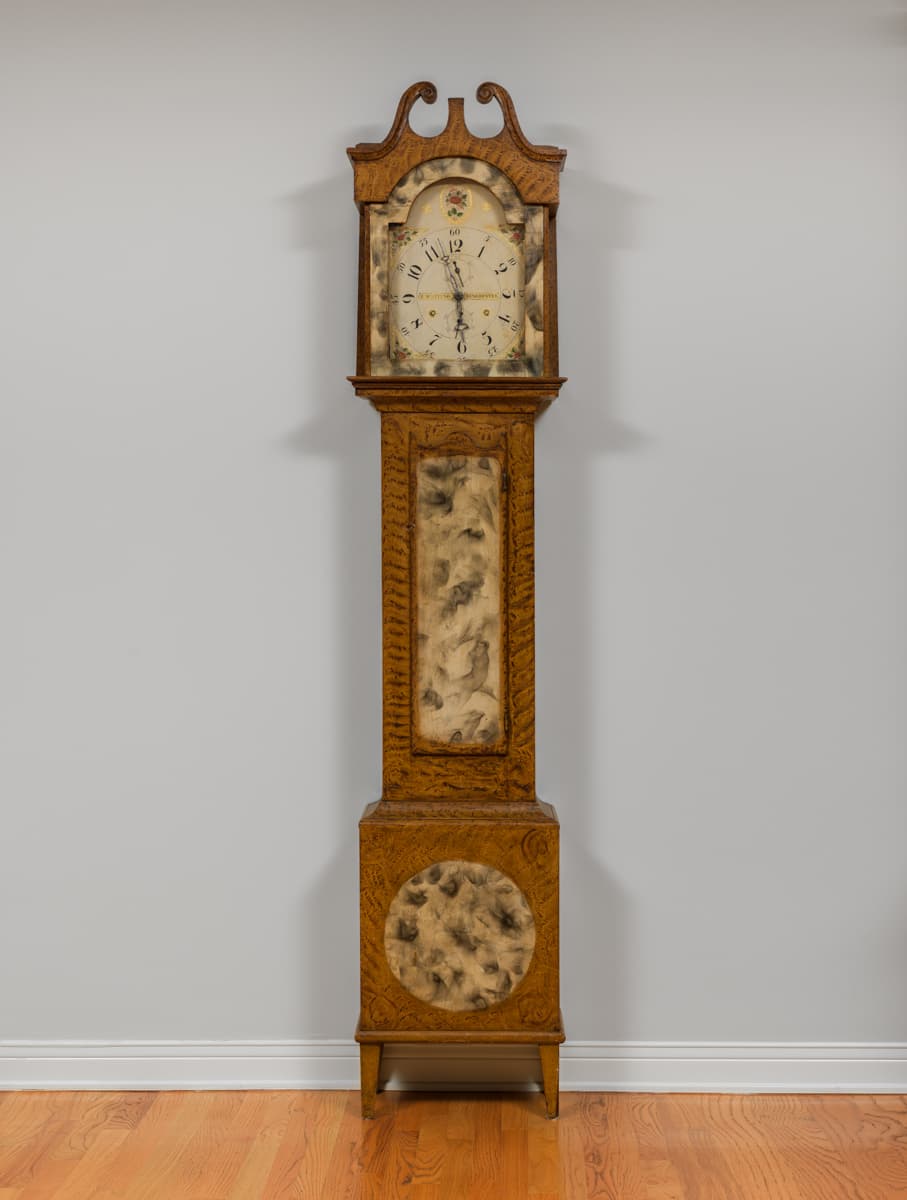
Riley Whiting (American, 1785–1835), Clock movement, Winchester, Connecticut, ca. 1820; Unknown, Painted case, probably Maine, 1820, spine, glass, wood, and paint. Jonathan and Karin Fielding Collection, L2015.41.23
In this video Jonathan Fielding discusses his Tall Case Clock, ca. 1820, by Riley Whiting of Winchester, Connecticut. While Whiting painted the face and made the works, someone else worked on the case, and that is what interests Fielding most: the exuberant painting that makes the clock appear to be housed in a combination of expensive woods and marble.
Dutch astronomer and mathematician Christiaan Huygens (1629-1693) created the first working pendulum clock in 1656. He observed that a weighted pendulum will swing back and forth the same distance each time. This meant that the pendulum clock was able to tell time one hundred times more accurately than previous mechanical models. This was a huge turning point. The improved accuracy increased demand for clocks. When pendulum clocks became available, some tradespeople began to turn clocks into furniture like this one.
This video shows the inner workings of a 3D printed pendulum clock replica built based on Huygens' original designs.
In 1675, Huygens’ genius struck again. He did not want to limit accurate timekeeping to living rooms. His "balance spring" invention made pocket watches accurate within a minute each day and sparked an immediate rise in the demand for on-the-go timekeeping.
Life Changes with Timepiece Availability
The spread of the pendulum clock, like this one, and the more portable pocket watch, changed the way we work and live. Franklin’s idea of “time is money” played out in different ways over our history.
As more and more workers went to work in factories, there was a need to document how long they worked because they were paid by the hour. Time clocks became used to punch in and out of work and became a way of life for factory worker. Schools were also redesigned with bells ringing between class periods and desks aligned in rows to train new generations of workers who moved from farms or workshops to factories. More than just a way to keep track of the hours, clocks allowed newly forming industries to synchronize the actions of their workers.
The ability to accurately know the time no matter where you were led to a dramatic shift in the way that people thought about time. Time was no longer something fluid and dependent on nature. It could be measured and divided in equal portions. The mechanization of time may have inadvertently mechanized lots of other things too, including the way that we work and live. Some researchers think that clocks have disconnected us from our true needs and wants in a way that is unhealthy and less necessary in today’s postindustrial world.
Questions for Discussion
OPEN TODAY: 10 A.M.–5 P.M.