Opening Hours
Daily: 10 A.M.–5 P.M.
Closed on Tuesdays
1151 Oxford Road
San Marino, CA 91108
Have you ever used Aloe vera to treat a sunburn? Maybe you have enjoyed a glass of Aloe vera juice. Aloe vera is the most well-known Aloe, but it is only one of hundreds of Aloe species! Let’s explore a different Aloe! This plant’s scientific name is Aloe mitriformis. This plant’s common name in English is Mitre Aloe. Look closely at the photos and videos below. What do you notice? How do you think this plant has adapted to survive in its environment?
Important safety note: Many Aloes are toxic to humans! Do not open Aloe leaves, consume Aloe juice, or put Aloe gel on your skin without consulting an expert!

Scientific Name: Aloe mitriformis (AH-loh mih-tri-FOR-mis)
Family: Asphodelaceae
Common Name: Mitre Aloe (Eng.); Krans Aalwyn (Afr.)
Range: South Africa, Africa
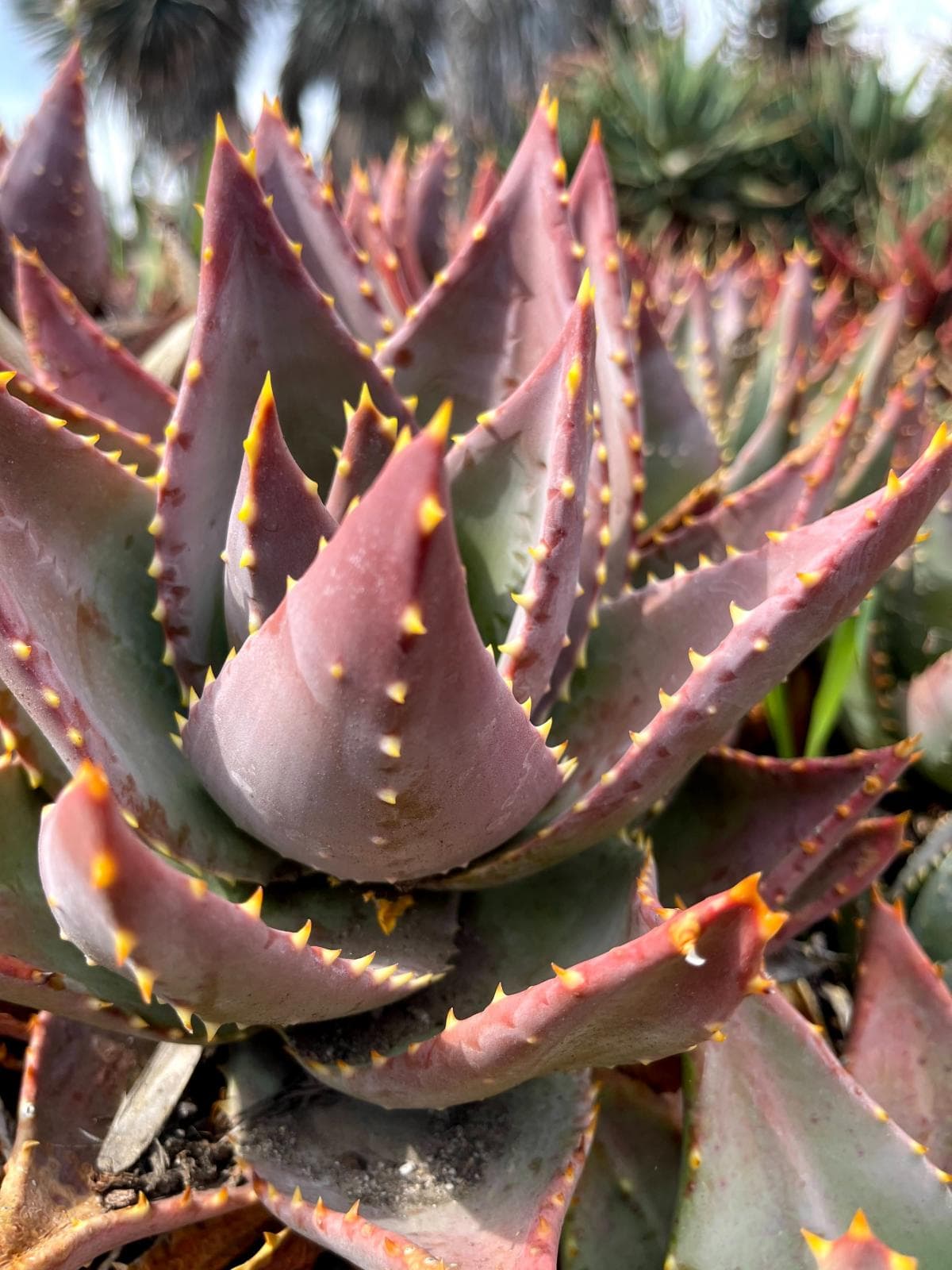
Succulence. These leaves are thick because they are full of water. Succulent plants often have squishy leaves or stems because the organ is filled with liquid! Succulence is when a plant stores water in its leaves or stems. This Aloe stores water in its leaves. When it is very dry in the plant's environment, this plant can use its stored water to help it stay alive. Succulence is an adaptation to help the plant survive in hot and dry environments.
Vertical Leaves. The vertical leaves help the plant stay cool. Overheating is dangerous for people, and it is dangerous for plants too! Vertical leaves are an adaptation to minimize the parts of the plant facing the sun during the hottest part of the day. This shade helps the plant keep its water longer. Vertical leaves are an adaptation to help the plant survive in hot and dry environments.
Pale Leaves. Pale leaves reflect more sunlight than dark leaves. Pale leaves absorb less heat than dark leaves. This prevents overheating! Overheating is dangerous for people, and it is dangerous for plants too! Pale leaves are an adaptation to help the plant survive in hot and dry environments.
Which color do you think best matches the leaves of this plant? Which other colors would you add to these color cards to help us describe the Aloe mitriformis leaves?
Waxy Surfaces. All leaves have a cuticle that protects the leaf and helps to keep water inside. Some stems also have a waxy covering on the outside. Some plants have adapted an especially thick waxy cuticle. When the cuticle is thick, the plant keeps even more water inside! Waxy cuticles are an adaptation to help the plant survive in hot and dry environments.


An Aloe herbarium Specimen | Close Looking at The H
Resources and References
“Aloe Mitriformis.” n.d. Accessed June 7, 2021. http://pza.sanbi.org/aloe-mitriformis.
“Aloe Perfoliata (Mitre Aloe).” 2020. World of Succulents (blog). August 13, 2020. https://worldofsucculents.com/aloe-perfoliata-mitre-aloe/.