Paintings
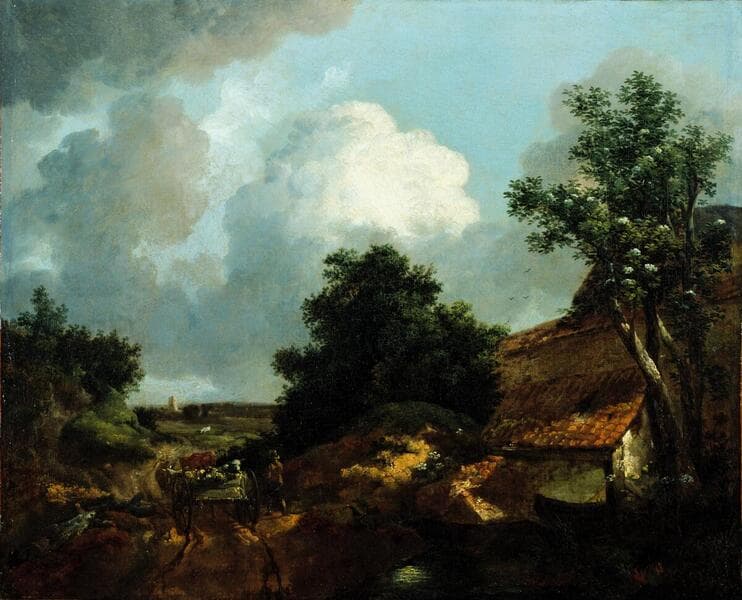
Landscape with Farm Buildings and Country Cart
1 of 2
Dating from the middle of the artist's 1752-59 residence in Ipswich, Suffolk, this rustic scene of a country lane winding past tile-roofed buildings in a wooded landscape demonstrates Gainsborough's translation of Dutch landscape conventions to his early depictions of the English countryside. According to several of his contemporaries, it was chiefly through the paintings of Jan Wijnants (1631/2-1684) and Jacob Ruisdael (1628/29-1682) that Gainsborough learned to look at his native scenery with new eyes, paying greater attention to naturalistic effects of light, weather, and atmosphere. Thus, in the paradoxical phrasing of J.H. Pott's Essay on Landscape Painting (1782), Gainsborough "imitated Wynants" in order to produce a more "faithful representation of English nature." As Pott's remark implies, Gainsborough's early landscapes artfully produce the effect of fidelity to nature without actually documenting any particular location. Indeed, in the early 1760s, when the Earl of Hardwicke asked the artist to paint some "real Views from Nature in this country," Gainsborough demurred, stating, "if his Lordship wishes to have anything tolerable of the name of G[ainsborough]., the subject altogether, as well as figures etc., must be of his own Brain."
In the present painting, seemingly naturalistic observations of light, weather, and atmosphere are skillfully deployed to dramatize the otherwise unremarkable terrain. The brightest and darkest passages of the composition are placed in striking opposition near the center, where a cloud brilliantly illuminated by sunlight is juxtaposed against the deep, rich green of the central tree. The rising, bulbous shapes of these two prominent features cleverly mimic and reinforce one another. Contrasts of light and dark are repeated elsewhere in the sky, where dark clouds create a charged mood of ephemeral and potentially threatening atmosphere. Other striking lighting contrasts are scattered throughout the painting, most noticeably in the foreground, where splashes of sunlight relieve the general gloom. More finely dappled light enlivens the textured foliage and broken ground, which Gainsborough describes with a rich variety of pigments finely touched in with short, delicate strokes of the brush. All of these elements would later come to exemplify the aesthetic category of the "picturesque," which, in contrast to the smoothness and grandeur of the "beautiful," was defined by Uvedale Price as any set of objects that interests the eye through "its intricacy, its sudden and irregular deviations, its variety of forms, tints, and lights and shadows." As an example, Price specified the sort of subject matter we see here: "the rough banks that often enclose a bye-road or a hollow lane."
In the present painting, the rutted bye-road emerges from the shadowy foreground and winds through rough, sandy banks and hedges toward a distant village. Gainsborough's early landscapes frequently make use of such paths as a means of solving the pictorial problem of relating successive planes of the composition. Here, as in many Dutch examples, the path leads our eye into fictive depth and terminates in the vertical element of a church tower, which then directs our gaze up into the sky, creating a sense of light and expansiveness that contrasts with the dark, enclosed foreground area where our ocular journey began.