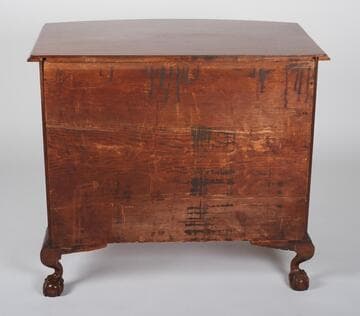
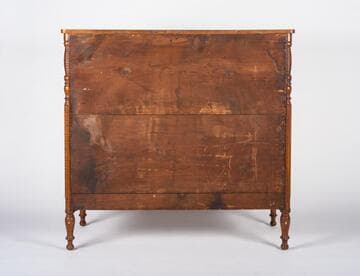
86 3/4 x 39 5/8 x 20 3/8 in. (220.3 x 100.6 x 51.8 cm.)
Medium
American black walnut
Description
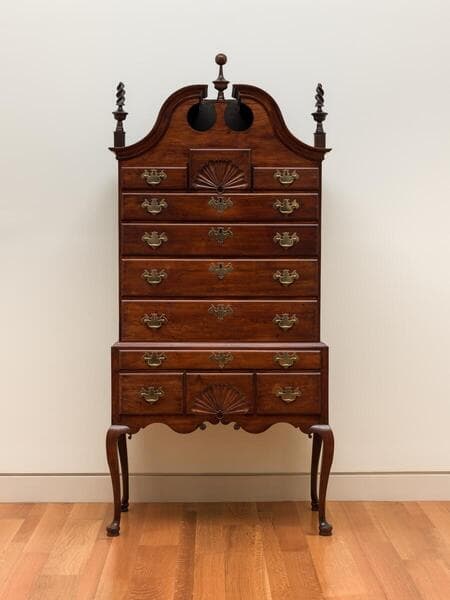
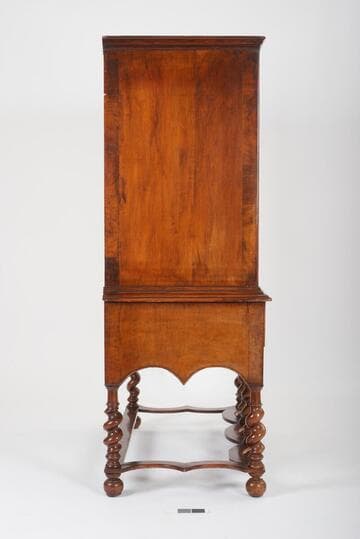
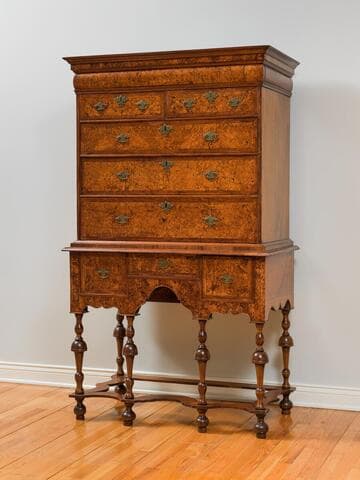
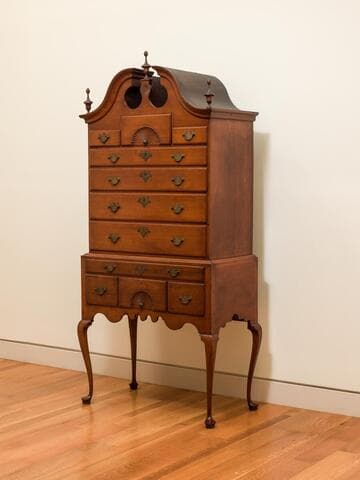
The chest in two parts: the upper case with a bonnet top and three over four drawers, the lower case with one over three drawers, raised on four cabriole legs terminating in pad and disk feet. The swan neck pediment with cove molding centering a drawer with an elaborate fluted fan, and four graduated drawers. The lower case with simple mid-molding, a single full-width drawer above three short drawers, the center drawer carved with a fan to match the upper case, above a shped skirt with a pair of pendant pinwheel rosettes, each knee return with a small pendant scroll, the knee of the cabriole legs with crisp corners, extending to very high pad feet, the pad with scratch molded line decoration. Each drawer with molded edges, the fan drawers fitted with metal ring pulls, the plain drawers fitted with original bail pulls having batwing back plates, the long drawers with a matching ketyhole escutcheon plate, with only the top three full length drawers of the upper case are fitted with locks. American black walnut (by microanalysis), pine secondary wood. Upper case with two board side panels, molded top edge of drawer sides. The design and construction details of this piece clearly indicate the Salem area for its manufacture, however the complex fluted fan is certainly influenced by Boston or Charleston area decoration. This style of fan is typically associated with the workshop of Benjamin Frothingham of Charleston, Massachusetts.
Credit
The Huntington Library, Art Museum, and Botanical Gardens. Gift of Dr. Arthur Bond Cecil and Mrs. Henrietta Smith Cecil
The high chest was popular in America throughout the 18th century, its form evolving in response to changing styles, tastes, and regional interests. In this example, the gracefully curving cabriole legs, raised pad feet, and handsome carved fans are all consistent with broad developments in late baroque design in the Queen Anne style. The chest's enclosed bonnet top, the delicate scroll returns at the knees of the lower case, and the pinwheel rosettes on its gently curving skirt help to identify its specific origins and are typical of the fine carving traditions in Salem, Massachusetts in the third quarter of the 18th century.