Paintings
Saint Anthony Abbot
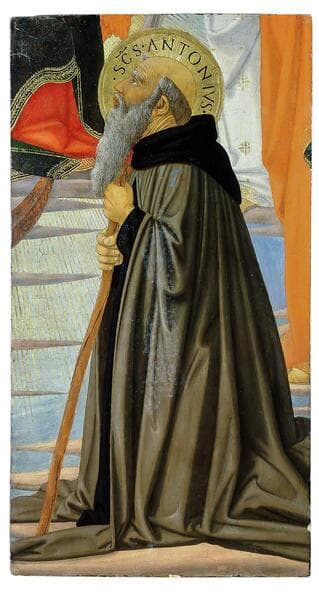
These three panels (#26.100, #2018.6.1, and #2018.6.2) depicting the Virgin and Child in Glory, Saint Ansanus, and Saint Anthony Abbot, all belong to the same altarpiece produced by Cosimo Rosselli in the 1470s. During the late 18th century, the altarpiece was cut down to produce seven panels that could be sold more easily. Reading clockwise from top right, the missing panels depict Saint Bartholomew (in a private collection), Saint Lucy (in a private collection), Saint Catherine of Alexandria (now in the National Gallery, Prague), and Saint John the Baptist (in a private collection). The vivid palette of this altarpiece—combining brilliant hues and gilding that has been inscribed to achieve a glittering effect—is typical of Rosselli's decorative use of color, for which he was famous. Among the very first collectors in the United States to show an interest in Renaissance Italian painting, Arabella Huntington acquired the panel depicting the Virgin and Child in Glory around 1912, prior to her marriage to Henry Huntington. With The Huntington's 2018 acquisition of the Saints Ansanus and Anthony panels, this display represents the first time these three panels have been shown together in over 200 years.