Paintings
Sarah Jackson

Sarah Jackson is portrayed wearing a dress of expensive silk imported from England. The dress, lace mantle, and ruby brooch at Sarah's shoulder indicate her family's wealth and status in Colonial Boston. Her left hand turns inward to grasp her mantle, a gesture that calls attention to her body as well as her garments.
In keeping with Sarah's British-made dress, Copley copied her pose, velvet drapery, and urn from engravings made after British portraits by artists like Godfrey Kneller and Joshua Reynolds. By referring to British portraits, Copley connected his colonial sitters to their homeland and his work to Grand Manner portraiture.
Colonial portraits often marked a special occasion in the life of the sitter. Sarah's family may have commissioned the painting to celebrate her impending engagement to Revolutionary statesman John Hancock. However, Hancock withdrew his attentions, however, and Sarah married Henderson Inches in 1770.
In keeping with Sarah's British-made dress, Copley copied her pose, velvet drapery, and urn from engravings made after British portraits by artists like Godfrey Kneller and Joshua Reynolds. By referring to British portraits, Copley connected his colonial sitters to their homeland and his work to Grand Manner portraiture.
Colonial portraits often marked a special occasion in the life of the sitter. Sarah's family may have commissioned the painting to celebrate her impending engagement to Revolutionary statesman John Hancock. However, Hancock withdrew his attentions, however, and Sarah married Henderson Inches in 1770.
You might also be interested in
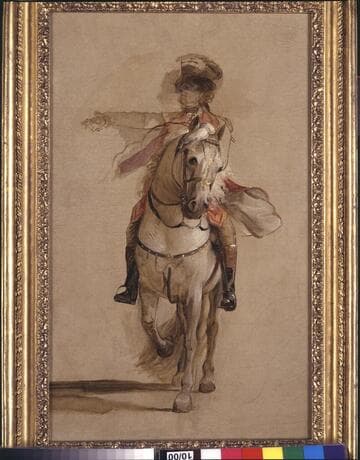
General George Augustus Eliot on a Grey Charger: A Study for the "Siege of Gibraltar"
Paintings
John Singleton Copley
2001.6