Paintings
Anne (Barry) Irwin
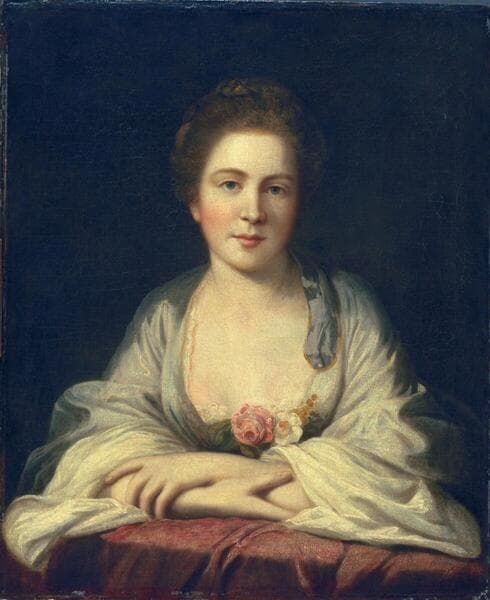
Anne Barry was born in Dublin around 1732, the only daughter of Sir Edward Barry (1696-1776), Bart., M.D., a distinguished physician, member of the Irish House of Commons, and authority on wine. Her father served as physician-general to the forces in Ireland and it was perhaps through him that she met John Irwin (1728-1788), a widowed lieutenant-colonel in the 5th foot (infantry) regiment, who was also an intimate friend of Lord Chesterfield and protégé of the Duke of Dorset. They married in 1753, and four years later his regiment relocated from Ireland to Chatham, Kent. Thereafter, Anne Irwin and her husband were frequently in London, where they became prominent members of society. In 1762, when her husband became a Member of Parliament for East Grinstead, they settled in a house in Queen Anne Street, Cavendish Square. Four years later they moved to Gibraltar, where her husband served as Governor from 1766-1768. Anne Irwin died there on August 12, 1767. Her husband was afterwards appointed Commander-in-Chief of Ireland, Knight of the Bath, and Privy Councillor. He died at Parma, Italy, in 1788, having married a third time.
This portrait utilizes one of Joshua Reynolds's most influential compositions, frequently repeated by the artist and imitated by his rivals. The painting was overcleaned and extensively retouched at some point in its history, so that very little of Reynolds's original paint now remains visible. James Watson's contemporary mezzotint after the painting, representing the sitter within a feigned oval, is too strongly marked by the engraver's own style to convey the character of Reynolds's painting prior to its losses and repaint. Although the portrait can no longer be appreciated fully as a work by Reynolds, it sheds important light on his studio practices and the way that he developed and reinterpreted successful compositions.
Reynolds first adopted the compositiontype employed here during the mid 1750s, when he was seeking to emulate the qualities of sensitivity, intimacy, and casual ease that distinguished the work of his chief rival, Allan Ramsay. In a portrait of 1755 of Lady Caroline Keppel (1737-69), Reynolds departed from the straightforward presentation that he tended to adopt in three-quarter-length portraits and instead represented his sitter as if she were resting her elbows on a stone ledge separating her from the viewer. The painting was engraved in 1757 and Reynolds soon after began to re-work the composition in portraits of other clients. Among the first was Lady Selina Hastings (1742-64), painted in 1759, the younger sister of the 10th Earl of Huntingdon (44.101) and daughter of the famous Methodist evangelist Selina, Countess of Huntingdon.
More remarkably, Reynolds repeated Lady Caroline Keppel's pose in his contemporaneous portrait of Kitty Fisher, a courtesan who at the time was reportedly the mistress of Lady Caroline's brother (and Reynolds's friend) Augustus Keppel. Subtle clues--such as the boldly cocked head and the insinuating gaze from the corners of half-lidded eyes--differentiate Reynolds's treatment of Fisher from the more respectable women whom he had previously represented in this pose. Lest there be any doubt, he included a love letter on the draped ledge in the foreground, partially opened to reveal the words "My dearest Kit." Reynolds studied the position of the arms anew, reversing their arrangement and enhancing the elegant contours of the exposed flesh. Like the portraits of Keppel and Hastings, Fisher's painting was engraved soon after completion; a print by Edward Fisher was published in 1759.