Paintings
Young Hobbinol and Ganderetta

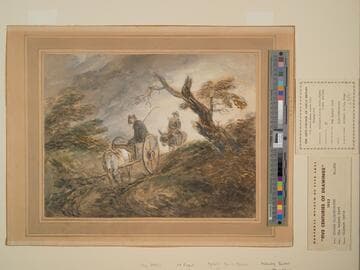
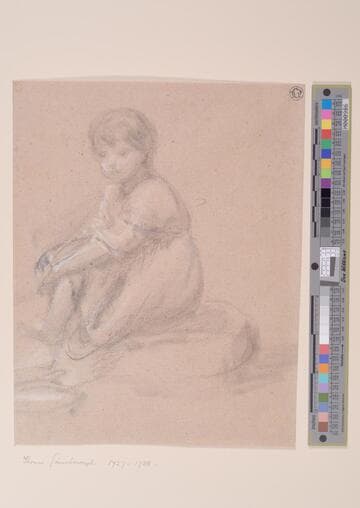
Gainsborough once characterized the ragged rural peasants and agricultural laborers that dot his landscapes as no more than "a little business for the Eye"--compositional accents momentarily distracting our attention from the trees "in order to return to them with more glee." The comment disingenuously understates the actual importance of these figures in reinforcing the themes and moods that Gainsborough intended his landscapes to convey. He acknowledged as much himself during the last seven years of his life, while painting a series of fanciful rural scenes in which the human figure, rather than the land, becomes the principal object of attention. Hobbinol and Ganderetta is an example of this sort of "fancy picture" (as they were known in the eighteenth century), in which the rustic figures of Gainsborough's landscapes and cottage scenes are enlarged to the size of life and treated with tender sympathy. The majority of Gainsborough's paintings of this type represent poor children in rural settings, and are patently designed to tug at our heartstrings by invoking poignant sentiments of compassion and charity. One critic who saw Hobbinol and Ganderetta in 1789 observed, "That pathetic simplicity which is the most powerful appeal to the feelings, is given with peculiar effect in this performance...--the cat--the spoon--the milk-porringer, all aid the scene, and present a view of domestic innocence." Another considered the painting "formed to interest every beholder, to whom the innocence of early life is interesting." Such comments underscore Gainsborough's success in merging the literary ideal of rural simplicity, celebrated in the poetry of James Thomson and William Somerville (1675-1742), with the cult of childhood innocence inculcated by the philosophical writings of Jean-Jacques Rousseau (1712-78).
Although Gainsborough (like his rival Joshua Reynolds) appears to have painted poor children from life, fancy pictures such as Hobbinol and Ganderetta project an artificially palatable version of impoverished rural childhood, in which the torn and tattered rags are charmingly arranged on clean, plump bodies, and the gathering and consumption of food provide reassuring leitmotifs. Here, even the cat is notably well-fed, its exquisitely painted, luxuriant fur lending a sumptuous quality to the scene. Similarly, the rosy cheeks and lips of the children attest to the superior health that cottage children were thought to gain from robust outdoor exercise. Like many of Gainsborough's fancy pictures, Hobbinol and Ganderetta suggests the influence of the Spanish genre and religious painter Bartolomé Esteban Murillo (1617-1682), whose works Gainsborough had studied and copied in the 1770s. In the present work, he emulates not only the warm earthtones and strong chiaroscuro of Murillo, but also the sympathetic naturalism of his observations. In particular, Gainsborough has adopted the physical and emotional intimacy that Murillo brought to his paired groupings of beggar boys and flower girls, as well as the naive complacency that renders these children touchingly oblivious to privations that are all too obvious to the viewer. As others have noted, Gainsborough's emulation of Murillo raised the pretensions of his low-life subjects by setting them within the Old Master tradition. In this way, his fancy pictures achieved an intellectual character approaching that of the grand manner.
Although Gainsborough (like his rival Joshua Reynolds) appears to have painted poor children from life, fancy pictures such as Hobbinol and Ganderetta project an artificially palatable version of impoverished rural childhood, in which the torn and tattered rags are charmingly arranged on clean, plump bodies, and the gathering and consumption of food provide reassuring leitmotifs. Here, even the cat is notably well-fed, its exquisitely painted, luxuriant fur lending a sumptuous quality to the scene. Similarly, the rosy cheeks and lips of the children attest to the superior health that cottage children were thought to gain from robust outdoor exercise. Like many of Gainsborough's fancy pictures, Hobbinol and Ganderetta suggests the influence of the Spanish genre and religious painter Bartolomé Esteban Murillo (1617-1682), whose works Gainsborough had studied and copied in the 1770s. In the present work, he emulates not only the warm earthtones and strong chiaroscuro of Murillo, but also the sympathetic naturalism of his observations. In particular, Gainsborough has adopted the physical and emotional intimacy that Murillo brought to his paired groupings of beggar boys and flower girls, as well as the naive complacency that renders these children touchingly oblivious to privations that are all too obvious to the viewer. As others have noted, Gainsborough's emulation of Murillo raised the pretensions of his low-life subjects by setting them within the Old Master tradition. In this way, his fancy pictures achieved an intellectual character approaching that of the grand manner.