Paintings
James Thomson
James Thomson, a poet, was born in September 1700, the fourth child of the minister Thomas Thomson (1666-1716) of Ednam, Scotland, and his wife Beatrix Trotter, a daughter of Margaret Home and Alexander Trotter of Fogo. In 1715 Thomson commenced studies at Edinburgh University and in 1720 he published three poetic compositions in the Edinburgh Miscellany. Abandoning plans to enter the ministry, he journeyed to London in February 1725 to pursue a literary career. His poem "Winter," published in March 1726, garnered immediate acclaim from such influential literary figures as Aaron Hill and Thomas Rundle, who appreciated its freedom from artificial conventions and its truthful yet imaginative evocation of nature. "Summer" (1727) and "Spring" (1728) followed, and in 1730 the three poems were published along with "Autumn" under the title "The Seasons." In the same year Thomson's play "Sophonisba" was produced at the Theatre Royal, Drury Lane, and the author embarked on a year-long tour of continental Europe. On his return, Thomson devoted himself to the poem "Liberty" (1734-36), and in 1740 he published "Rule Britannia," which became one of his most famous compositions. From 1738 to 1748 Thomson received an annual pension of £100 from the Prince of Wales, to whom he had been introduced by his friend and patron, George, 1st Lord Lyttelton. In 1744 Lord Lyttelton bolstered Thomson's income by appointing him to the sinecure post of surveyor-general of the Leeward Islands. The following year David Garrick produced "Tancred and Sigismunda," the last of Thomson's plays, at Drury Lane. Following a boat ride to Kew, Thomson caught a chill and died on August 27, 1748.
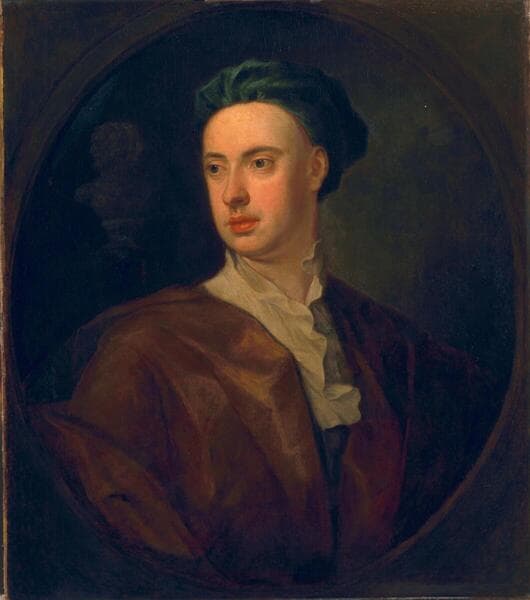
Thomson is represented in the self-consciously artistic dress that eighteenth-century portraitists often employed for men of creative temperament. A subsequent painting by John Patoun (c. 1746) and a marble plaque by an unknown sculptor (n.d.) portrayed Thomson wearing the same combination of velvet turban, linen shirt, and silk drapery. The lack of articulated shoulders in the drapery of the present portrait indicates that the poet is not wearing a sleeved gown, but a large piece of silk, loosely draped in a style reminiscent of the togas and mantles found in antique statues of philosophers and statesmen. The drapery literally cloaks Thomson in classical authority and gravitas. At the same time, it conveys an air of informality appropriate to the sitter's personality. Notoriously indolent, Thomson was reportedly negligent in his dress, although "a dandy in the matter of perukes."[5] Here, a peruke or other contemporary wig would have seemed glaringly anachronistic in combination with the pseudo-classical drapery, and the artist instead shows Thomson wearing a turban on his shaved head. By eliminating such artificial adornments as a wig and contemporary costume, the artist signifies that he shows us the essence of the man, as known to those intimates who would see him in this state of informal undress. The importance of this painting has long been overlooked, its authentic qualities hidden beneath disfiguring overpaint applied by an unknown restorer sometime prior to acquisition by Henry Huntington. Recent x-radiography has revealed the sophistication of the underlying painting, showing that the forms of the face and drapery were originally blocked in with a confidence and skill belied by subsequent insensitive restoration work. What we have here, it now appears, is a painting that has previously been presumed lost: William Aikman's portrait of his friend and countryman James Thomson at the age of twenty-five. The existence of such a portrait has long been known through an engraving by James Basire, published in 1761 with an inscription specifying the name of the artist and sitter, as well as the sitter's age when the painting was originally executed. Most of the differences between our painting and the engraving--such as the patterns of the drapery folds--can now be attributed to the hand of the restorer.
Thomson is represented in the self-consciously artistic dress that eighteenth-century portraitists often employed for men of creative temperament. A subsequent painting by John Patoun (c. 1746) and a marble plaque by an unknown sculptor (n.d.) portrayed Thomson wearing the same combination of velvet turban, linen shirt, and silk drapery. The lack of articulated shoulders in the drapery of the present portrait indicates that the poet is not wearing a sleeved gown, but a large piece of silk, loosely draped in a style reminiscent of the togas and mantles found in antique statues of philosophers and statesmen. The drapery literally cloaks Thomson in classical authority and gravitas. At the same time, it conveys an air of informality appropriate to the sitter's personality. Notoriously indolent, Thomson was reportedly negligent in his dress, although "a dandy in the matter of perukes."[5] Here, a peruke or other contemporary wig would have seemed glaringly anachronistic in combination with the pseudo-classical drapery, and the artist instead shows Thomson wearing a turban on his shaved head. By eliminating such artificial adornments as a wig and contemporary costume, the artist signifies that he shows us the essence of the man, as known to those intimates who would see him in this state of informal undress. The importance of this painting has long been overlooked, its authentic qualities hidden beneath disfiguring overpaint applied by an unknown restorer sometime prior to acquisition by Henry Huntington. Recent x-radiography has revealed the sophistication of the underlying painting, showing that the forms of the face and drapery were originally blocked in with a confidence and skill belied by subsequent insensitive restoration work. What we have here, it now appears, is a painting that has previously been presumed lost: William Aikman's portrait of his friend and countryman James Thomson at the age of twenty-five. The existence of such a portrait has long been known through an engraving by James Basire, published in 1761 with an inscription specifying the name of the artist and sitter, as well as the sitter's age when the painting was originally executed. Most of the differences between our painting and the engraving--such as the patterns of the drapery folds--can now be attributed to the hand of the restorer.