Paintings
Scene from Don Quixote: Sancho Panza Entertains the Duchess
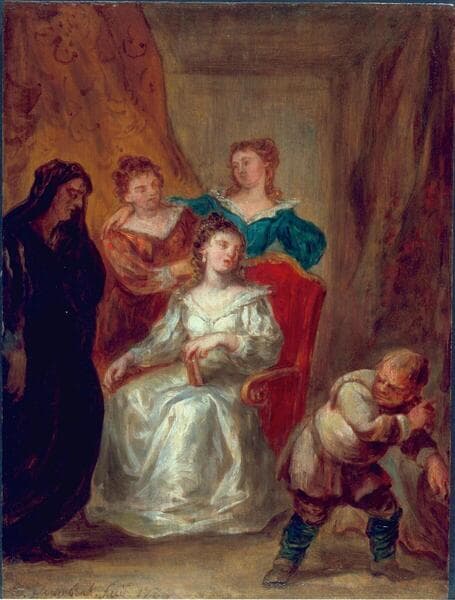
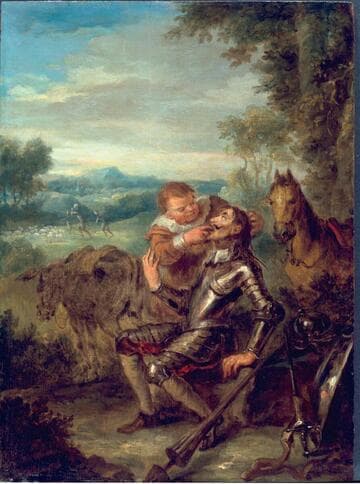
Owing in part to his profligate lifestyle and restless temperament, John Vanderbank failed to achieve the triumphs as a portraitist and history painter that his precocious abilities and expertise in drawing the human figure had led many to expect. Nevertheless, a vivid impression of his potential is glimpsed in numerous vivacious drawings for unrealized historical subjects, and in small, swift, and spirited paintings such as the two panels discussed here. The present paintings relate to Vanderbank's designs for a lavishly illustrated edition of Miguel de Cervantes's celebrated novel Don Quixote (1615). This four-volume edition was published in 1738 (in the original Spanish) by J. & R. Tonson, under the patronage of John, Baron Carteret. Louis Chéron (with whom Vanderbank had set up classes for studying the life model in 1720) had previously designed illustrations for Tonson's editions of Racine (1723) and Plutarch (1724-29), and it was probably to him that Vanderbank owed his commission to contribute to the Cervantes volumes.
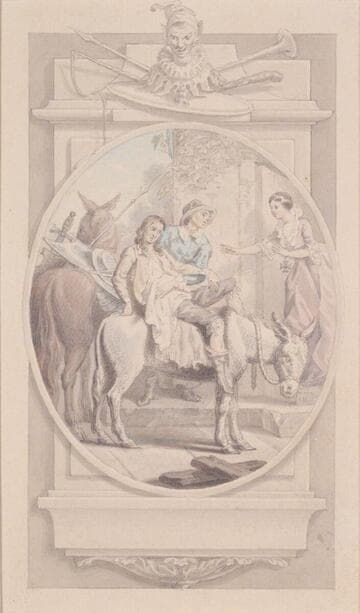
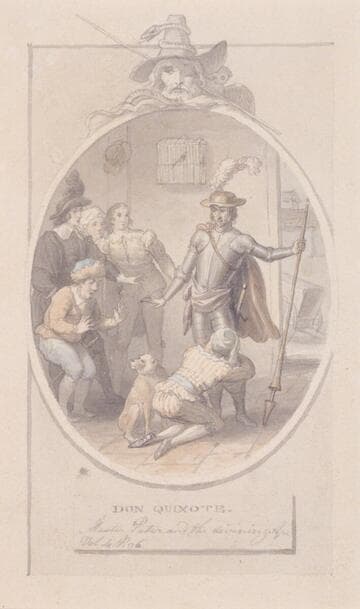
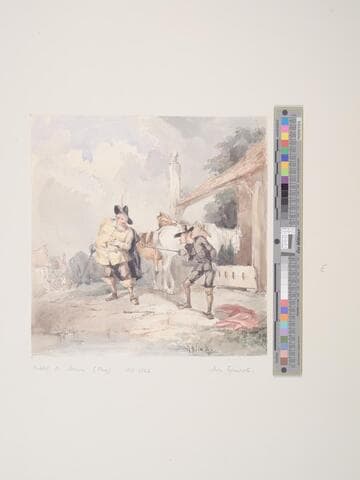
In preparation for the sixty-eight illustrations to Don Quixote, Vanderbank produced at least three sets of drawings, the majority of which are dated from 1726 to 1730. This was clearly a time-consuming project, spanning as many as fifteen years from the first of Vanderbank's drawings in 1723 to the ultimate publication of the book in April 1738, twenty months before the artist's death. Vanderbank lived in and out of debtors' prison during at least six of those years, and the laboriousness of the Tonson project can only have added to his financial difficulties. When, at the end of 1729, his debt was cleared (for the time being) and he moved to a fashionable section of London near Cavendish Square, he found a sympathetic landlord who refused his cash in preference for anything he cared to paint, principally "Storys of Don Quixot." Vanderbank thereafter produced a large number of oil paintings based on the designs he had made for Tonson's edition of the book. The sheer number of these pictures suggests that he was not only producing them for his landlord, but seeking to capitalize on a larger market, created by the phenomenal English enthusiasm for Cervantes's novel. Don Quixote's piquant humor and poignant sentimentality proved immensely popular with a rising middle-class readership, which relished Cervantes's ground-breaking elevation of realism, comedy, and the low-brow to the epic level traditionally reserved for the ideal, tragic, and aristocratic. This new literary public also generated a market for small pictures whose topical or narrative subject matter offered immediate and virtually universal accessibility. British artists found in Don Quixote a wealth of subject matter of precisely the type that appealed to this emergent source of patronage, which they supplied with a steady stream of modest paintings, drawings, and engravings of Quixotic themes.
Vanderbank executed the two Huntington paintings (and others like it) in a broad, summary style that differs markedly from the smoother, more tightly controlled handling in his commissioned portraits. This altered manner undoubtedly reflects the greater speed with which the Don Quixote paintings were executed, but their spirited manner also evokes the lively tone and vernacular idiom of Cervantes's narrative. Vanderbank sustained this fresh quality by approaching the paintings as impromptu reinterpretations (rather than slavish copies) of his designs for engraving. The variations and experiments he pursued in the present two pictures attest to his fertile inventiveness as a designer and painter.