Opening Hours
Daily: 10 A.M.–5 P.M.
Closed on Tuesdays
1151 Oxford Road
San Marino, CA 91108
Visual Materials
Image not available
Daily: 10 A.M.–5 P.M.
Closed on Tuesdays
1151 Oxford Road
San Marino, CA 91108

Image not available
Visual Materials
This collection contains photographs of Los Angeles' Old Chinatown and portraits of its Chinese residents, most dating from the 1890s to the 1900s. Together there are 299 glass plate negatives ranging in size from 3 1/4 x 4 1/4 inches to 8 x 5 inches; an ornate photograph album containing 12 studio portraits of Chinese men and women; and six additional card photograph portraits. Some printed photographs have the imprints of professional photographers and a few of the glass plate negatives are credited to "Yee Photo, L.A. Cal." They may be connected to a photographer "Yee" who at one time had a studio at 510 North Los Angeles Street in Old Chinatown (see photograph Box 8 (1)). This could possibly be Wy Yee, a photographer working during the same time period. It is unclear if he took all the photographs or there was more than one photographer. There are two glass plate images of a photographer's storefront with a sign in Chinese that translates to Jinghua Photo Studio. Scenes in Old Chinatown include: street views of buildings and storefronts; Chinese and a few white people walking in the streets; the interior of a restaurant and three Chinese workers posing for the camera; two men on bicycles; the Chinese community participating in La Fiesta de las Flores parade; and other candid photographs of people in daily activities. Some buildings have store signs in English and Chinese. The majority of photographs are portraits of primarily Chinese sitters. Several are posed studio portraits of men, women, or children, wearing traditional Chinese or western clothing, with elaborate props and backdrops. Other portraits are simple head shots of Chinese men, one of which has the handwritten date "1902," the year that the Chinese Exclusion Act of 1882 was made permanent and required Chinese residents to register and obtain immigration documents. Other photographs include: three studio images of women showing bare shoulders, a Chinese woman posing in a sailor's uniform, and white tourists posing in traditional Chinese clothing. Photographer imprints on card photographs are: Bijou Studio, James Blanchard, George Dewey, J. H. Lamson Company, Michael A. Wesner, and "Yee," who may be photographer Wy Yee, all of Los Angeles. There is one portrait of a Chinese woman by William Shew, San Francisco. The China subseries consists of copies of photographs taken in China, including landmarks and scenes of punishment. Please note that this subseries contains historical images that library users may find harmful, offensive, or inappropriate. Miscellaneous photographs include images of Native Americans and a town in the Southwest.
photCL 624
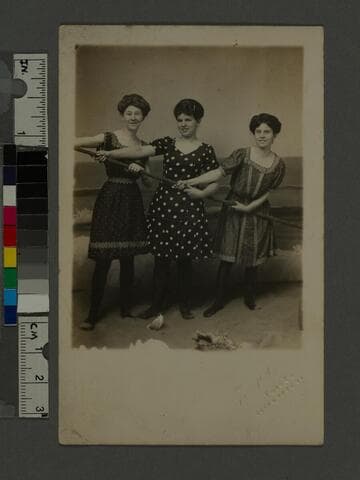
Visual Materials
Image of three women wearing bathing suits and holding a rope in a souvenir studio portrait while posing in front of a painted beach backdrop at Ocean Park in Santa Monica, California.
photCL_555_01_1677
Image not available
Visual Materials
This collection contains photographs of Los Angeles' Old Chinatown and portraits of its Chinese residents, most dating from the 1890s to the 1900s. Together there are 299 glass plate negatives ranging in size from 3 1/4 x 4 1/4 inches to 8 x 5 inches; an ornate photograph album containing 12 studio portraits of Chinese men and women; and six additional card photograph portraits. Some printed photographs have the imprints of professional photographers and a few of the glass plate negatives are credited to "Yee Photo, L.A. Cal." They may be connected to a photographer "Yee" who at one time had a studio at 510 North Los Angeles Street in Old Chinatown (see photograph Box 8 (1)). This could possibly be Wy Yee, a photographer working during the same time period. It is unclear if he took all the photographs or there was more than one photographer. There are two glass plate images of a photographer's storefront with a sign in Chinese that translates to Jinghua Photo Studio. Scenes in Old Chinatown include: street views of buildings and storefronts; Chinese and a few white people walking in the streets; the interior of a restaurant and three Chinese workers posing for the camera; two men on bicycles; the Chinese community participating in La Fiesta de las Flores parade; and other candid photographs of people in daily activities. Some buildings have store signs in English and Chinese. The majority of photographs are portraits of primarily Chinese sitters. Several are posed studio portraits of men, women, or children, wearing traditional Chinese or western clothing, with elaborate props and backdrops. Other portraits are simple head shots of Chinese men, one of which has the handwritten date "1902," the year that the Chinese Exclusion Act of 1882 was made permanent and required Chinese residents to register and obtain immigration documents. Other photographs include: three studio images of women showing bare shoulders, a Chinese woman posing in a sailor's uniform, and white tourists posing in traditional Chinese clothing. Photographer imprints on card photographs are: Bijou Studio, James Blanchard, George Dewey, J. H. Lamson Company, Michael A. Wesner, and "Yee," who may be photographer Wy Yee, all of Los Angeles. There is one portrait of a Chinese woman by William Shew, San Francisco. The China subseries consists of copies of photographs taken in China, including landmarks and scenes of punishment. Please note that this subseries contains historical images that library users may find harmful, offensive, or inappropriate. Miscellaneous photographs include images of Native Americans and a town in the Southwest.
Image not available
Visual Materials
Suffragist group photo. Standing, back row: Bessie Starr Keefer (Canada); Rachel Foster (America); Sophia Magelsson Groth (Norway); Margaret Dilke (England); May Wright Sewall (America); Alice Scatcherd (England); Margaret Moore (Ireland). Seated, front row: Laura Ormiston Chant (England); Susan B. Anthony (America); Isabelle Bogelot (France); Elizabeth Cady Stanton (America); Matilda Joslyn Gage (America); Alexandra Gripenberg (Finland). In 1888, Susan B. Anthony and other leading feminists founded the International Council of Women. The council sought to “impress the important lesson that the position of women anywhere affects their position everywhere.” Many of the women pictured in this delivered addresses during the council’s three-week-long inaugural gathering.
photPF 11097
Image not available
Visual Materials
This collection contains photographs of Los Angeles' Old Chinatown and portraits of its Chinese residents, most dating from the 1890s to the 1900s. Together there are 299 glass plate negatives ranging in size from 3 1/4 x 4 1/4 inches to 8 x 5 inches; an ornate photograph album containing 12 studio portraits of Chinese men and women; and six additional card photograph portraits. Some printed photographs have the imprints of professional photographers and a few of the glass plate negatives are credited to "Yee Photo, L.A. Cal." They may be connected to a photographer "Yee" who at one time had a studio at 510 North Los Angeles Street in Old Chinatown (see photograph Box 8 (1)). This could possibly be Wy Yee, a photographer working during the same time period. It is unclear if he took all the photographs or there was more than one photographer. There are two glass plate images of a photographer's storefront with a sign in Chinese that translates to Jinghua Photo Studio. Scenes in Old Chinatown include: street views of buildings and storefronts; Chinese and a few white people walking in the streets; the interior of a restaurant and three Chinese workers posing for the camera; two men on bicycles; the Chinese community participating in La Fiesta de las Flores parade; and other candid photographs of people in daily activities. Some buildings have store signs in English and Chinese. The majority of photographs are portraits of primarily Chinese sitters. Several are posed studio portraits of men, women, or children, wearing traditional Chinese or western clothing, with elaborate props and backdrops. Other portraits are simple head shots of Chinese men, one of which has the handwritten date "1902," the year that the Chinese Exclusion Act of 1882 was made permanent and required Chinese residents to register and obtain immigration documents. Other photographs include: three studio images of women showing bare shoulders, a Chinese woman posing in a sailor's uniform, and white tourists posing in traditional Chinese clothing. Photographer imprints on card photographs are: Bijou Studio, James Blanchard, George Dewey, J. H. Lamson Company, Michael A. Wesner, and "Yee," who may be photographer Wy Yee, all of Los Angeles. There is one portrait of a Chinese woman by William Shew, San Francisco. The China subseries consists of copies of photographs taken in China, including landmarks and scenes of punishment. Please note that this subseries contains historical images that library users may find harmful, offensive, or inappropriate. Miscellaneous photographs include images of Native Americans and a town in the Southwest.
Image not available
Visual Materials
This collection contains photographs of Los Angeles' Old Chinatown and portraits of its Chinese residents, most dating from the 1890s to the 1900s. Together there are 299 glass plate negatives ranging in size from 3 1/4 x 4 1/4 inches to 8 x 5 inches; an ornate photograph album containing 12 studio portraits of Chinese men and women; and six additional card photograph portraits. Some printed photographs have the imprints of professional photographers and a few of the glass plate negatives are credited to "Yee Photo, L.A. Cal." They may be connected to a photographer "Yee" who at one time had a studio at 510 North Los Angeles Street in Old Chinatown (see photograph Box 8 (1)). This could possibly be Wy Yee, a photographer working during the same time period. It is unclear if he took all the photographs or there was more than one photographer. There are two glass plate images of a photographer's storefront with a sign in Chinese that translates to Jinghua Photo Studio. Scenes in Old Chinatown include: street views of buildings and storefronts; Chinese and a few white people walking in the streets; the interior of a restaurant and three Chinese workers posing for the camera; two men on bicycles; the Chinese community participating in La Fiesta de las Flores parade; and other candid photographs of people in daily activities. Some buildings have store signs in English and Chinese. The majority of photographs are portraits of primarily Chinese sitters. Several are posed studio portraits of men, women, or children, wearing traditional Chinese or western clothing, with elaborate props and backdrops. Other portraits are simple head shots of Chinese men, one of which has the handwritten date "1902," the year that the Chinese Exclusion Act of 1882 was made permanent and required Chinese residents to register and obtain immigration documents. Other photographs include: three studio images of women showing bare shoulders, a Chinese woman posing in a sailor's uniform, and white tourists posing in traditional Chinese clothing. Photographer imprints on card photographs are: Bijou Studio, James Blanchard, George Dewey, J. H. Lamson Company, Michael A. Wesner, and "Yee," who may be photographer Wy Yee, all of Los Angeles. There is one portrait of a Chinese woman by William Shew, San Francisco. The China subseries consists of copies of photographs taken in China, including landmarks and scenes of punishment. Please note that this subseries contains historical images that library users may find harmful, offensive, or inappropriate. Miscellaneous photographs include images of Native Americans and a town in the Southwest.
photCL 624
photCL 624
photCL 624