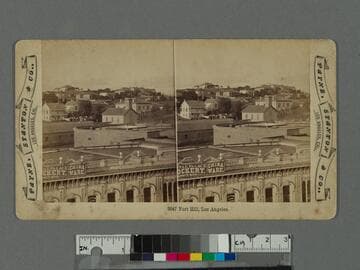
View looking northwest towards Fort Moore Hill (also known as Fort Hill) in downtown Los Angeles, California, with the Downey Block building on Main Street in the foreground with the partially obscured sign "Crystal Palace Crockery, China Ware" and a sign in the window "J.W. Stump Law Office." The First Congregational Church is visible on New High Street with the Kimball Mansion directly to its right.
58 glass negatives in 2 boxes; 4 x 5 and 5 x 7 inches. People and scenes in Los Angeles and vicinity. George Haley (1879-1963) was a photographer for the "Los Angeles Evening Herald" newspaper (after 1931, called the "Herald Express") from 1913-1956.
An album of 36 photographs (5 x 7 inches) with detailed, typed captions pasted below. Views show American soldiers in France during World War I; battle scenes; war dead; one view of King George V decorating an American soldier; bombed buildings; French villagers with soldiers; women in military service; a parade of soldiers in New York.
The album compiler is unidentified and the photographs are uncredited, though appear to have been made by a professional photojournalist or military photographer, based on proximity to battle action. Album has typed title: "Photographic History of the A.E.F. in France, 1917-1919" on the first page.
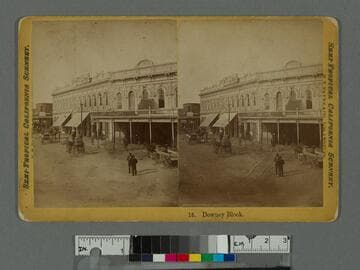
Image of the corner of Temple Street and Main Street in Los Angeles, California, showing the Downey Block building, with dirt street and horse-drawn wagons in the foreground. Visible signs and lettering on the Downey building include "Carpets," "Levy and Coblentz, wholesale dealers in wines and liquors" (located at 71 Main Street in the 1875 Los Angeles city directory) and "I.O.O.F." and "New York Millinery Store" can be seen on the building in the background.
This album comprises over 300 photographs on 142 pages, showing a young couple at home and on travels in Southern California, Arizona, New Mexico, Oregon and Mexico. Notable in the album are views of Southern California Edison power stations and equipment, 1918-1925, (pp. 116 – 135); the Ocean Park Pier fire, 1923 (pp. 69-73); and damage from the Long Beach earthquake, 1933 (pp. 136-143).
"G.A.F." is embossed on the cover and there are many views of a man named "G. A. Follette," who is presumably the album compiler and may have been a Southern California Edison employee (see p. 54). Most photographs have handwritten captions, but people are named by first name only, except "Marcel Frenay" (p. 6).
Other views include: P.E. Rod & Gun Club rabbit hunt, 1921 (p. 24, 26); Balboa Beach; Newport Beach; caves at La Jolla; Tahquiz Canyon; Mission San Juan Capistrano; Alpine Tavern (Mount Lowe); buffalo grazing at Balboa Park, San Diego; Mt. Rubidoux; San Gabriel Mission; Portland, Oregon; Tijuana, Mexico and a cockfight; cotton harvesting, Imperial Valley; automobile travel and camping; Topanga Canyon landslide (pp. 50-51); flying small airplane over Catalina Island (p. 61); movie set of a medieval castle in Griffith Park (p. 66); "Charles Nelson" ship at sea (p. 13); Spadena House and Willat Studio (a.k.a. "The Witch's House"), Beverly Hills (p. 20).