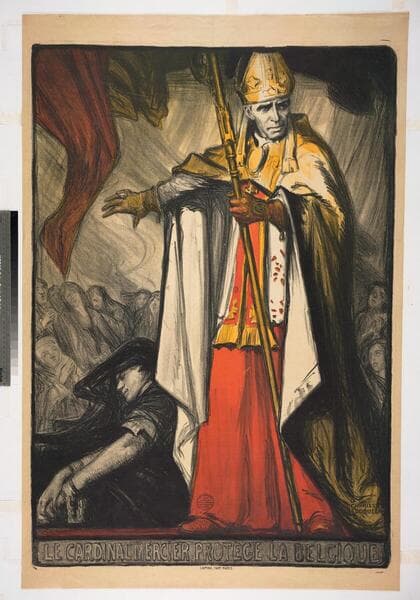
Prints, advertising; Image of Belgian Cardinal Désiré-Joseph Mercier in full regalia standing with a wounded man at his feet and praying people in the background as a symbol of Belgium's resistance to German occupation in World War I.
This collection is arranged in two parts--Manuscripts and Correspondence. While the bulk of the collection contains questionnaires ("Modele de La Formule No. 4") and surveys ("Liste No. II") written in French, select materials contain correspondence, publication announcements, and various drafts of Green's publication of Andrea Alciati and His Books of Emblems: A Biographical and Bibliographical Study, which was later published in 1872. Museums, university libraries, public libraries, personal libraries, and other institutions throughout Europe and the United States responded to Green's request to locate such materials. Such organizations included the Hague Royal Library, the Sir William Stirling-Maxwell Library, the Cambridge University Library, the Coppenhagen Royal Library, the Amiens Library, the Royal Library of the University of Turin, the Leuven University Library, and much more. Recipients who acted as the liaisons for the aforementioned repositories included modern emblem specialists (G.S. Cautley and Sir William Stirling-Maxwell), librarians, and library staff. Since a large extent of the materials received were written in English, French, German, and Italian, different spelling variation of the name Andrea Alciati were used including Andreas Alciatus and Andrea Aliciato.
This collection contains research files of English art historian R. B. Beckett, chiefly consisting of study photographs and clippings collected from the late 1940s to early 1960s documenting the works of John Constable and other English artists including William Blake, Thomas Gainsborough, Thomas Rowlandson, J. M. W. Turner, and Richard Wilson. In addition there are also images and clippings related to English portraiture, as well as sporting and comic images. The artist research files contain study art photographs and clippings, with some occasional correspondence and notes and manuscripts by Beckett. Six artists (Blake, Constable, Gainsborough, Rowlandson, Turner, and Wilson) are distinguished as their own subseries, and their files typically contain study photographs, article clippings, some scattered manuscripts and correspondence, and exhibition catalogues. The largest of these are the John Constable files (Boxes 3-9), which includes seven boxes of study images. Other art images in the collection are arranged either in the "Artists (various)" subseries (Box 13) or in the "Portrait artists" subseries (Boxes 14-15). While some of the images are professional photographs acquired from museums, most of the images are clippings from British magazines such as The Connoisseur and Burlington. Most of the images are not annotated or only contain brief handwritten identifications typically of the artist, painting title, date, dimensions, etc. Overall there are very few manuscripts by Beckett in the collection. Exceptions consist of a sketchbook from the late 1920s containing pencil sketches of landscapes by Beckett and a few documents. The correspondence is chiefly from galleries, museums, and publishers related to Beckett's research and publications.
This collection is arranged in two parts--Manuscripts and Correspondence. While the bulk of the collection contains questionnaires ("Modele de La Formule No. 4") and surveys ("Liste No. II") written in French, select materials contain correspondence, publication announcements, and various drafts of Green's publication of Andrea Alciati and His Books of Emblems: A Biographical and Bibliographical Study, which was later published in 1872. Museums, university libraries, public libraries, personal libraries, and other institutions throughout Europe and the United States responded to Green's request to locate such materials. Such organizations included the Hague Royal Library, the Sir William Stirling-Maxwell Library, the Cambridge University Library, the Coppenhagen Royal Library, the Amiens Library, the Royal Library of the University of Turin, the Leuven University Library, and much more. Recipients who acted as the liaisons for the aforementioned repositories included modern emblem specialists (G.S. Cautley and Sir William Stirling-Maxwell), librarians, and library staff. Since a large extent of the materials received were written in English, French, German, and Italian, different spelling variation of the name Andrea Alciati were used including Andreas Alciatus and Andrea Aliciato.
This collection is arranged in two parts--Manuscripts and Correspondence. While the bulk of the collection contains questionnaires ("Modele de La Formule No. 4") and surveys ("Liste No. II") written in French, select materials contain correspondence, publication announcements, and various drafts of Green's publication of Andrea Alciati and His Books of Emblems: A Biographical and Bibliographical Study, which was later published in 1872. Museums, university libraries, public libraries, personal libraries, and other institutions throughout Europe and the United States responded to Green's request to locate such materials. Such organizations included the Hague Royal Library, the Sir William Stirling-Maxwell Library, the Cambridge University Library, the Coppenhagen Royal Library, the Amiens Library, the Royal Library of the University of Turin, the Leuven University Library, and much more. Recipients who acted as the liaisons for the aforementioned repositories included modern emblem specialists (G.S. Cautley and Sir William Stirling-Maxwell), librarians, and library staff. Since a large extent of the materials received were written in English, French, German, and Italian, different spelling variation of the name Andrea Alciati were used including Andreas Alciatus and Andrea Aliciato.
This collection is arranged in two parts--Manuscripts and Correspondence. While the bulk of the collection contains questionnaires ("Modele de La Formule No. 4") and surveys ("Liste No. II") written in French, select materials contain correspondence, publication announcements, and various drafts of Green's publication of Andrea Alciati and His Books of Emblems: A Biographical and Bibliographical Study, which was later published in 1872. Museums, university libraries, public libraries, personal libraries, and other institutions throughout Europe and the United States responded to Green's request to locate such materials. Such organizations included the Hague Royal Library, the Sir William Stirling-Maxwell Library, the Cambridge University Library, the Coppenhagen Royal Library, the Amiens Library, the Royal Library of the University of Turin, the Leuven University Library, and much more. Recipients who acted as the liaisons for the aforementioned repositories included modern emblem specialists (G.S. Cautley and Sir William Stirling-Maxwell), librarians, and library staff. Since a large extent of the materials received were written in English, French, German, and Italian, different spelling variation of the name Andrea Alciati were used including Andreas Alciatus and Andrea Aliciato.
This collection is arranged in two parts--Manuscripts and Correspondence. While the bulk of the collection contains questionnaires ("Modele de La Formule No. 4") and surveys ("Liste No. II") written in French, select materials contain correspondence, publication announcements, and various drafts of Green's publication of Andrea Alciati and His Books of Emblems: A Biographical and Bibliographical Study, which was later published in 1872. Museums, university libraries, public libraries, personal libraries, and other institutions throughout Europe and the United States responded to Green's request to locate such materials. Such organizations included the Hague Royal Library, the Sir William Stirling-Maxwell Library, the Cambridge University Library, the Coppenhagen Royal Library, the Amiens Library, the Royal Library of the University of Turin, the Leuven University Library, and much more. Recipients who acted as the liaisons for the aforementioned repositories included modern emblem specialists (G.S. Cautley and Sir William Stirling-Maxwell), librarians, and library staff. Since a large extent of the materials received were written in English, French, German, and Italian, different spelling variation of the name Andrea Alciati were used including Andreas Alciatus and Andrea Aliciato.