Opening Hours
Daily: 10 A.M.–5 P.M.
Closed on Tuesdays
1151 Oxford Road
San Marino, CA 91108
Visual Materials
Daily: 10 A.M.–5 P.M.
Closed on Tuesdays
1151 Oxford Road
San Marino, CA 91108

Visual Materials
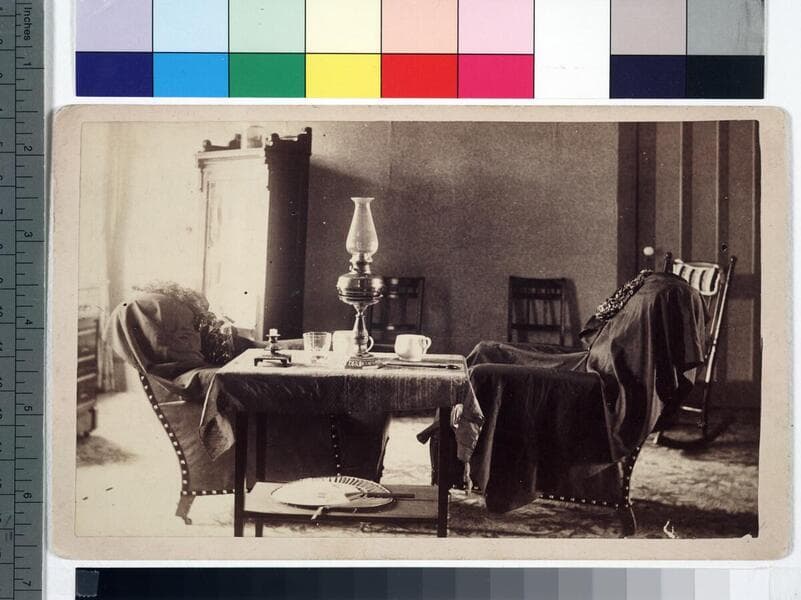
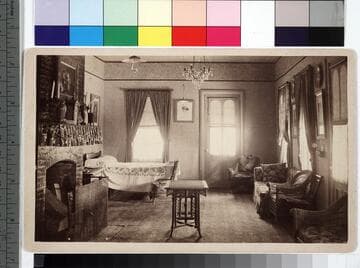
A view of a bedroom of the house in Mount McGregor in Wilton, New York, where President Ulysses S. Grant died in 1885. There is a fireplace on the far left, a bed in the back left corner, a table in the center of the room, and a chair and sofa on the right. There is a wreath resting on the back of the chair.
photPF 4023
Manuscripts
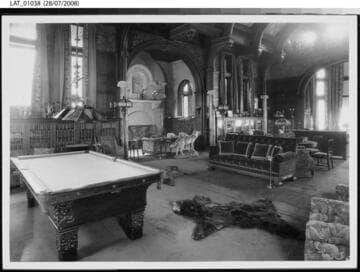
Black and white photograph. View of ornate lounge / billiard room with high arched ceiling, wood paneling, and marble pillars in one of the lodges at Vermejo Ranch. Several comfortable couches are positioned throughout the room, and animal skin rugs dot the floor. A stuffed wolf trophy, a fireplace, and several bookshelves are also visible. LAT 01033, 01037, 01038, 01039, and 01041 show different views of the same room.
mssLAT 01038
Image not available
Visual Materials
A view of the dining room in the west end of the Patton residence in San Marino. There is a heavy, oval-shaped wooden table slightly left of center surrounded by four chairs with cushioned seats. Four more matching chairs are lined up against the wall in the background, below a painted portrait of a woman, and in front of a small fireplace. There is a chandelier hanging over the table, a screen decorated with a peacock on the right, and a heavy wooden sideboard on the left.
photCL 282 (214a)
Image not available
Visual Materials
This album contains 14 professional photographs of the porches and interiors of the home of Hans Jevne at 910 S. San Rafael Avenue in Pasadena, California. These images were taken shortly after the new residence was completed in 1913. In addition, there are 5 loose snapshots of the exterior and grounds of the house, as well as 4 additional snapshots (one dated January 13, 1916) of Jevne's daughters, Vera Henneberger and Mina Braly, and Arthur Braly in equestrian clothing with horses. Each photograph in the album has a caption written in ink in the lower margin: "Porch overlooking Pasadena and mountains" -- "Carriage entrance porch" -- "Living" (2 views) -- "Dining room" --"Dining room and breakfast room" -- "Hall" -- "Hall and Stairs" -- "Upstairs sitting room" (2 views) -- "Blue spare (bed)room" -- "Pink spare (bed)room" -- "Upper Hall" -- "Billiard room."
photCL 490
Visual Materials
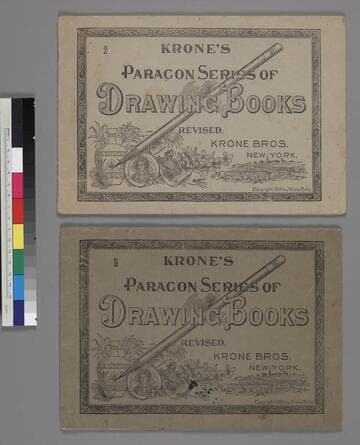
Two drawing books entitled Krone's Paragon Series of Drawing Books, Nos. 2 and 9, revised, published by Krone Bros., New York, copyright 1905. Book no. 2 is 16 pages in length, and is a series of line exercises, progressing from simple, single lines to combinations of lines to construct images such as flowers, patterns and shapes. The front cover of both books are bordered and illustrated, including a life-size pencil diagonally positioned across the cover. The back cover of each contains general directions for drawing, materials needed, and a listing of the titles in the series. The inside of the front and back covers of Book No. 2 provides definitions of terms, with illustrations of those terms. All of the exercises have been filled in by a previous owner. Book No. 9 consists of 8 leaves, each with an image on the upper half of the page and space below for copying. These images include a rabbit, a pig, a horse and a deer. Each of the 8 leaves is protected by a tissue guardsheet. The inside of the front and back covers contain the same definitions, explanations and illustrations as those found in Book No. 2. The cover of Book No. 9 is vertically oriented, in that the cover is lifted from bottom to top, but the interior pages are turned as usual, opening to the left. "Annette Paquin" is written in ms. along the outside of the border in the lower right-hand corner of the front cover of Book No. 9. All of the illustrations have been copied in pencil by a previous owner.
ephKAEE
Image not available
Visual Materials
Consists of 33 copy prints with some duplicates. The back of each photograph has a title and a number to a corresponding lantern slide. photPF 190-193 are photographs of prospecting in California, depicting Yreka, Chinese prospectors, and a prospecting party, and appear to be copies of photographs by Eadweard Muybridge. photPF 194-196 photos are views of Ellwood Cooper's Ranch in Santa Barbara County. photPF 197-199 depict scenes of workers and lodgings in Yosemite Valley as well as the studio of artist Albert Bierstadt. photPF 200 depicts the construction of the Bear River Crossing C.P.R.R. photPF 201 depicts trout fishing in Sonoma County. photPF 202-209 focuses on early Los Angeles County, with snapshots of ranches, orchards, vineyards, Los Angeles High School, and the homes of Maria Sepulveda, F. D. Bacon, and F. P. F. Temple. photPF 210-217 depict various locations in early San Francisco, including Telegraph Hill, Alcatraz Island, Goat Island, Woodward's Gardens, and the Mercantile Library. photPF 218-219 feature the Keystone quartz mill and the first quartz mill in Amador City.
photPF 190-219