Reilly & Woods classic vaudevilles Pat Reilly proprietor & manager
Description
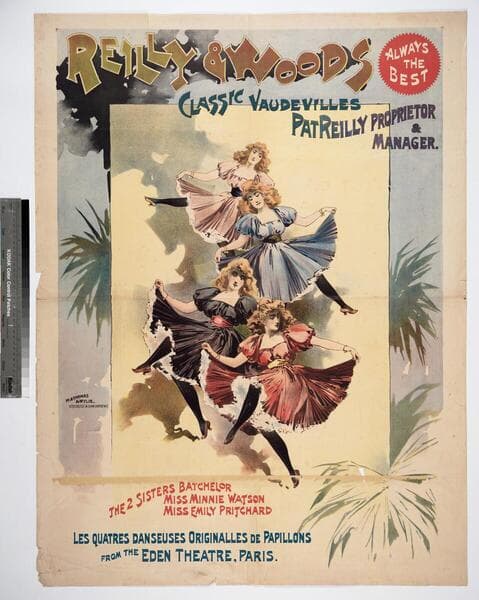
Image of four female can-can dancers kicking their legs and lifting their skirt and petticoat trims; border decorated with palm fronds; the poster advertises a show performed by Reilly & Wood's Classic Vaudeville Company.
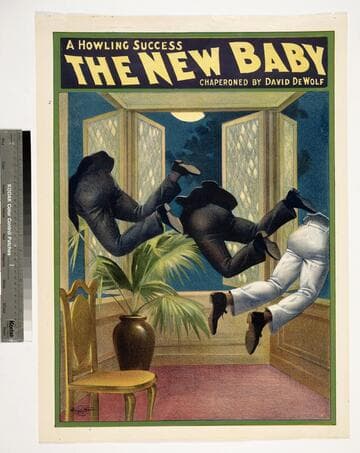
Image of the legs of three men, apparently disconnected from the top halves of their bodies, floating out open windows from a room containing a vase with palm fronds and a chair; the poster advertises the comedy "The New Baby" adapted by English actor and stage manager Arthur Bourchier from the German play "Der Rabenvater" by H. Fischer and Joseph Jarn.
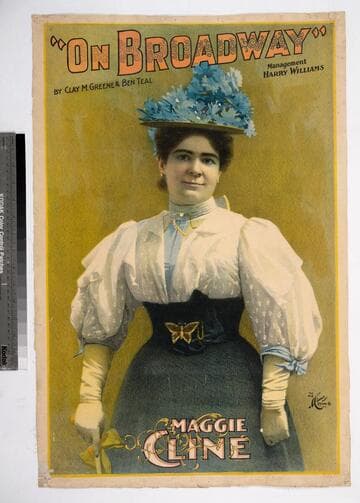
Image of a three-quarter-length portrait American vaudeville singer and actor Maggie Cline in formal dress wearing a hat with blue flowers, gloves, and a belt with a butterfly decoration; the poster advertises the melodrama "On Broadway" written by Clay Greene and Ben Teal.
This collection contains approximately 1,000 printed 19th and early 20th century entertainment broadsides, playbills, and related advertisements, and forms a subset within the Jay T. Last Collection of Entertainment. These items advertise theatrical performances including plays, variety entertainment such as minstrel, burlesque, and vaudeville shows, and optical displays such as dioramas, living statues, and tableaus. Over 250 theaters primarily from the Northeastern United States are represented in the collection, though there are also materials from theaters in the Midwestern, Southern, and Western United States, and approximately 26 items from Canada, Ireland, England, and Scotland. The materials range in size from approximately 9 1/2 x 6 inches to 42 1/2 x 14 inches and consist of single-sheet unfolded advertisements for theatrical productions that were intended to be distributed by hand, posted on walls, fences, or in windows, or sold to playgoers entering the theater. Among the names given to these types of advertisements, according to their size and mode of distribution, are broadsides, dodgers, handbills, hangers, playbills, posters, and show bills.
This collection contains approximately 1,000 printed 19th and early 20th century entertainment broadsides, playbills, and related advertisements, and forms a subset within the Jay T. Last Collection of Entertainment. These items advertise theatrical performances including plays, variety entertainment such as minstrel, burlesque, and vaudeville shows, and optical displays such as dioramas, living statues, and tableaus. Over 250 theaters primarily from the Northeastern United States are represented in the collection, though there are also materials from theaters in the Midwestern, Southern, and Western United States, and approximately 26 items from Canada, Ireland, England, and Scotland. The materials range in size from approximately 9 1/2 x 6 inches to 42 1/2 x 14 inches and consist of single-sheet unfolded advertisements for theatrical productions that were intended to be distributed by hand, posted on walls, fences, or in windows, or sold to playgoers entering the theater. Among the names given to these types of advertisements, according to their size and mode of distribution, are broadsides, dodgers, handbills, hangers, playbills, posters, and show bills.
This collection contains approximately 1,000 printed 19th and early 20th century entertainment broadsides, playbills, and related advertisements, and forms a subset within the Jay T. Last Collection of Entertainment. These items advertise theatrical performances including plays, variety entertainment such as minstrel, burlesque, and vaudeville shows, and optical displays such as dioramas, living statues, and tableaus. Over 250 theaters primarily from the Northeastern United States are represented in the collection, though there are also materials from theaters in the Midwestern, Southern, and Western United States, and approximately 26 items from Canada, Ireland, England, and Scotland. The materials range in size from approximately 9 1/2 x 6 inches to 42 1/2 x 14 inches and consist of single-sheet unfolded advertisements for theatrical productions that were intended to be distributed by hand, posted on walls, fences, or in windows, or sold to playgoers entering the theater. Among the names given to these types of advertisements, according to their size and mode of distribution, are broadsides, dodgers, handbills, hangers, playbills, posters, and show bills.
This collection contains approximately 1,000 printed 19th and early 20th century entertainment broadsides, playbills, and related advertisements, and forms a subset within the Jay T. Last Collection of Entertainment. These items advertise theatrical performances including plays, variety entertainment such as minstrel, burlesque, and vaudeville shows, and optical displays such as dioramas, living statues, and tableaus. Over 250 theaters primarily from the Northeastern United States are represented in the collection, though there are also materials from theaters in the Midwestern, Southern, and Western United States, and approximately 26 items from Canada, Ireland, England, and Scotland. The materials range in size from approximately 9 1/2 x 6 inches to 42 1/2 x 14 inches and consist of single-sheet unfolded advertisements for theatrical productions that were intended to be distributed by hand, posted on walls, fences, or in windows, or sold to playgoers entering the theater. Among the names given to these types of advertisements, according to their size and mode of distribution, are broadsides, dodgers, handbills, hangers, playbills, posters, and show bills.