Manuscripts
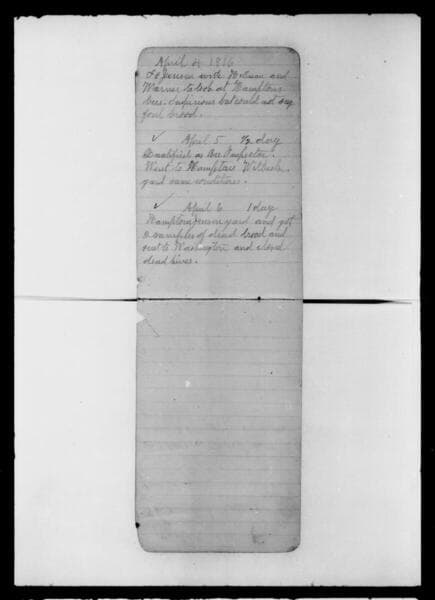
Honey record book [microform]: 1916
You might also be interested in
![Autobiography and diaries of Joab Collier [microform] : 1874-1905](/_next/image?url=https%3A%2F%2Frail.huntington.org%2FIIIF3%2FImage%2F22APN4DW6EPQ%2Ffull%2F%5E360%2C%2F0%2Fdefault.jpg&w=750&q=75)
Autobiography and diaries of Joab Collier [microform] : 1874-1905
Manuscripts
Microfilm of Joab Collier's autobiography, written in about 1905, and two diaries covering 1874-1875. In the autobiography Collier recounts his father's death in a coal mine in 1856, living with his mother on her earnings from a cotton factory, moving to Yorkshire to work in a wool factory after the cotton factory was closed during the American Civil War, attending parish school in Newton (he left at age 13 to work in the factory full time, and describes his work schedule there), starting for the United States in 1869 and arriving in Utah in 1870, working on the railroad in Draper in 1871, returning to school and working herding sheep in 1873, living with Dr. R.M. Boyers and his family, meeting Theodocia at a dance, briefly attending Brigham Young Academy, various livelihoods including agricultural work and sheep herding, and of beginning to raise bees in the 1880s. He also describes specific memories such as the wedding of Prince Albert of Wales in 1863 and trying to pay back a $36 loan his mother took out on arriving in Utah. The 1874 journal was kept while Collier was living with Dr. Boyers, and the entries focus on his work in a store, going to dances, buying livestock and picking up coal, and attending religious meetings. The 1875 journal focuses on Collier's social activities, including his courtship of Theodocia. Some portions of the diary were written in the Deseret alphabet.
MSS MFilm 00182
Image not available
Diary of Joab Daniel Collier [microform] : 1899
Manuscripts
Microfilm of a diary written by Joab Daniel Collier in Vernal, Utah, in 1899. The diary was kept while Collier was attending Uintah State Academy, and primarily follows his school activities.
MSS MFilm 00179
![Autobiograhy and family record of James Bywater [microform] : c.1903-1939](/_next/image?url=https%3A%2F%2Frail.huntington.org%2FIIIF3%2FImage%2F22APN45ETETE%2Ffull%2F%5E360%2C%2F0%2Fdefault.jpg&w=750&q=75)
Autobiograhy and family record of James Bywater [microform] : c.1903-1939
Manuscripts
Microfilm of the autobiography of James Bywater and related family records. The first pages of the volume contain a list of genealogies and ordinances for "The Dead" (including dates and places of births, baptisms, deaths, endowments, etc.) that appears to have been kept through 1936, a sealing record of marriages, a Bywater family record and genealogy through about 1939, and a copy of the program from the Centennial Anniversary of James Bywater in 1925. The autobiography was written by Bywater at Brigham City in 1903. In it he describes his childhood in England, his conversion to Mormonism, his travels to and from England and the United States, his journey to Utah, his life in Brigham City, his missions to England in 1873 and 1893, his polygamy trials in 1874, 1889, and 1891 and stays in the penitentiary, and the death of his wife Hannah in 1906. The last few pages of the journal were written by one of Bywater's children after his death in 1909.
MSS MFilm 00121
![Record book "A" of the Box Elder County Mining District [microform] : 1880](/_next/image?url=https%3A%2F%2Frail.huntington.org%2FIIIF3%2FImage%2F22APN45EH28Y%2Ffull%2F%5E360%2C%2F0%2Fdefault.jpg&w=750&q=75)
Record book "A" of the Box Elder County Mining District [microform] : 1880
Manuscripts
Microfilm of Book "A" of the Box Elder Mining District records, beginning with the By-Laws of the Box Elder Mining District adopted August 7, 1880, and signed by Committee secretary and chairman F.J.P. Pascoe. The book also includes minutes from a meeting of the Box Elder Mining District held at Brigham City on August 26, 1880, and notices of location for various mines, including the Highland Mine and extensions, the Yellow Jacket Mine and extensions, the King Fisher Mine, the Sunny Side Mine, the Great Western Tunnel Mine, the Nabob Mine, the Elizabeth Mine, the Louisa Mine, the Arabella Mine, the American Mine, the Uintrah Mine, the Lake View Mine, the Excelsior Mine, the Keystone Mine, the Henrietta Mine, the Star Metal Mine, the Locators Storm Cloud Mine, and the Box Elder Quarry.
MSS MFilm 00120
![The family record book and autobiography of William Leany [microform] : c.1891](/_next/image?url=https%3A%2F%2Frail.huntington.org%2FIIIF3%2FImage%2F22APN4SLZ5IS%2Ffull%2F%5E360%2C%2F0%2Fdefault.jpg&w=750&q=75)
The family record book and autobiography of William Leany [microform] : c.1891
Manuscripts
Microfilm of the Family Record of William Leany (filled in printed family history book, published in Salt Lake City in 1877). The first twelve pages consist of genealogical information. The rest of the volume contains Leany's autobiography, begun January 1, 1888. Leany begins with more genealogical and family history (including the Revolutionary War service of his relatives), and then recounts his early life in Kentucky. His family left tailoring to begin raisin tobacco, and, according to Leany, "thereby sold ourselves to the merchants." During his childhood in Kentucky Leany "toiled under all the disadvantages of frontier life," and he and his twin brother Isaac traveled to Missouri in 1836. While on the way they converted to the Church of Jesus Christ of Latter-day Saints (Leany writes that his father belonged to no specific church, his mother was a "Republican Baptist," and his stepmother a "Hell Redemptionist"). Debts and various health issues kept Leany from traveling to Nauvoo until 1843, and in the meantime he was present when Isaac was shot during the Haun's Mill Massacre in 1838 (Isaac survived). After finally arriving in Illinois, Leany describes hearing Joseph Smith preach and deciding to go west to Utah in 1846. In 1850 he was part of the company sent to Little Salt Lake and settled near what is now Parowan. He describes troubles with the Walkers Band of Ute Indians and his later moves to Cedar City and finally Harrisburg. William Leany's account ends with a letter to his "Dear Children and Grandchildren," written at Harrisburg on May 5, 1891. In it Leany describes his spiritual beliefs and what he believes to be the religious and temporal obligations of his descendants. The final pages of the film contain a brief autobiography entitled Struggles of an 1847 Pioneer by I.C. Leany. Leany gives an in-depth account of Isaac Leany's experiences at Haun's Mill and describes traveling to Utah with Edward Hunter's company in 1847.
MSS MFilm 00036
![Autobiography of David Lewis [microform]: 1854](/_next/image?url=https%3A%2F%2Frail.huntington.org%2FIIIF3%2FImage%2F22APN4DZYJ36%2Ffull%2F%5E360%2C%2F0%2Fdefault.jpg&w=750&q=75)
Autobiography of David Lewis [microform]: 1854
Manuscripts
Microfilm of the autobiography of David Lewis, written in 1854. The front page includes an unidentified photograph. The text begins with an account of Lewis' birth and childhood in Kentucky, including his family history (with physical descriptions of family members), his family's agricultural pursuits, his knife fights with his brothers, and his working at spinning cotton from the age of 12. Most of the manuscript focuses on the expulsion of the Mormons from Missouri and the events of the Haun's Mill Massacre, during which David's brother Benjamin Lewis was killed. Lewis thoroughly describes the event and its aftermath, including a latter meeting with James Campbell. He also writes of being captured by Missouri soldiers and interrogated about whether he was a Danite. Lewis also describes traveling to Illinois in 1838-1839, returning to Kentucky in 1839, and finally ending up back in Illinois in 1840. The account ends with a brief mention of the death of Joseph Smith. It also includes a patriarchal blessing for Lewis from 1839. The next portion of the volume begins with clippings from the Vernal Express on Sinley Lewis Sr. (1931). It is followed by a biography of David Lewis' son Siney Lewis Sr. (1848-1928) written by his daughter-in-law Crystal P. Lewis. It describes his birth in Council Bluffs, his father's work as a cooper, the death of his mother's father, who left her enough money to emigrate to Utah along with "one negro slave called Jerry" (who spent the rest of his life with the family), their journey to Utah in 1850, Siney's school days, and his leading emigrants to Utah in 1866 with a company of "bull whackers" (teamsters).
MSS MFilm 00157