Manuscripts
Daily: 10 A.M.–5 P.M.
Closed on Tuesdays
1151 Oxford Road
San Marino, CA 91108

Image not available
Manuscripts
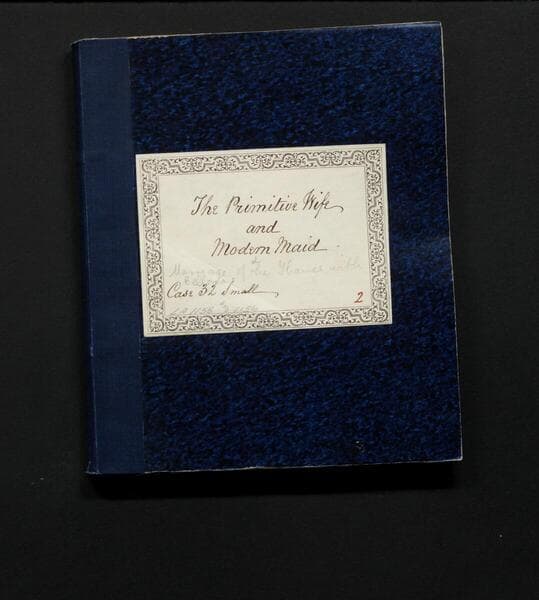
No application. Prod. (as Wives as They Were and Maids as They Are) C.G., Mar. 4, 1797. MS: dated Feb. 10; cast. (Bound with LA 1156.) Comp. Wives as They Were, etc., 1797 (K-D 255): slight differences.
LA 1155
Image not available
Manuscripts
The collection consists of the personal, estate, legal, and business correspondence of a Herefordshire gentry family with strong ties to the London legal world and with some slight connection to their more important relative James Brydges, 1st Duke of Chandos. The first letter in the collection (26 Oct 1719) is written by William Brydges (1663-1736) to his brother Francis Brydges with regards to setting up a meeting between the two. The next forty letters are written by William Brydges (1681-1764) to his father Francis Brydges. In these letters, William displays traits of a member of the British upper-class. Whether it's by entertaining guests with a harp, mentioning an inclination to be "gentlemen-like", receiving invitations to dine and socialize with local lords, or being the second cousin of James Brydges 1st Duke of Chandos, William is not ashamed of his gentility. His title, Esquire of Tibberton (or Tyberton) in Herefordshire, reflects that as well. Although his work as a lawyer requires him to live in London during this time, he is still obligated to settle matters in Tibberton. The issue that is mentioned the most within this set of letters centers on the tithe dispute of Tibberton Parish. In the early 1700s, there were serious difficulties faced by the established church as the failure of the Anglican Church to meet the needs of its constituents all throughout Britain laid the groundwork for the rise of Methodism and other non-conformist sects- particularly associated with towns. In Tibberton, William and Francis Brydges have a difficult time getting the local citizens to pay for the repair of the collapsed chancel and tower of Tibberton Parish Church. In the case of the Tibberton church, neither the Dean and Chapter of the diocese nor the townspeople agreed to repair these damaged areas. According to William in one of his letters to Francis (17 Oct 1719), he states that the Dean and Chapter want parishioners to pay for the repair of the chancel but nobody is willing to pay. This disorganization leads to William and Francis demanding money from the person who collects the tithes of Tibberton parish, Mr. Tom Jones, in order to pay for the repairs themselves. Seeing as Francis and his father Marshall were both clerks of the church, their involvement in this case appears fitting. A further example of William's dedication to the church lies in his search for records indicating the administrative status of Tibberton and its adjoining church with the name "Madley". When the ownership of the church comes into question, William travels to the augmentation office at Westminster to prove that Tibberton is its own distinct parish. It is not known whether these issues get resolved, but what can be told from these letters is that William found documents proving Tibberton's distinct existence from Madley; the damaged chancel was removed by the end of 1719 (though not yet replaced with a new one); and due to both Tom Jones' refusal to pay his share and inaction from others involved with the church, William and Francis do not resolve the ecclesiastical conflict of law among all sides of this affair. Along with Tibberton, real estate matters are the most mentioned subject within William's letters to his father. These matters deal with William, his father-in-law Andrew Card (1653-1732) who served the Duke of Chandos as a lawyer, and Francis purchasing and selling estates within the towns of Bosbury, Hereford, Bristol, Moreton, Shirkway, and Upleadon. Some of William's cousins play a role in these affairs as well; including Will Vaughn who informs William of his intention to purchase the Brampton estate in Hereford, and Tom Brydges who is selling the Brampton estate in the first place. Another involvement of Tom brought up in these letters involves a complex and strenuous financial affair wherein Tom purchases the life annuity of Andrew Card's widowed sister "Aunt Holmes". The next sixteen letters are written from Joseph Hardwick (fourteen letters) and Stephen Reeves (two letters) to Francis Brydges from 1719 to 1720. Hardwick and Reeves are separate tradesmen hired by Francis to assist in the repairing of the church at Tibberton, but Hardwick also discusses land prices and other business affairs in his writings to Francis. The last three letters are written from notable architect John Wood (1705?-1754) from 1729 to 1731 to William Brydges concerning his estate purchase in Bristol. They consist of architectural suggestions for the estate- thus proving Wood's loyalty to the Brydges family after designing the Duke of Chandos' estate in Bath a few years earlier. From the day to day occurrences illustrated in these primary sources, the Brydges' way of life can be deciphered. The first thing to notice is that business for William, Francis, and Andrew Card is essentially localized. All of the estate affairs (except for Bristol being 40 miles from Hereford) occur in locations that are not only in Herefordshire but also extremely close within the county as well. The fact that there was no effective transport due to poorly maintained roads and a lack of modernized technology in this pre-Industrial Revolution era meant that business could be handled more easily when it was close by. Another thing to note is how often William talked about his family to his father. Seeing as how there was no other means of communication except for talking in person, William felt obligated to inform his father in every single letter that he wrote during this time how his immediate family fared. He constantly mentioned his daughter Elizabeth and nieces Mary and Elizabeth Unett because he shared a close relationship with all of them. Unfortunately, sickness was prevalent among this time due to the instances of Elizabeth "Betty" Unett contracting smallpox, Francis acquiring gout for a brief stint, and Andrew Card suffering from an illness that prevented him from traveling for a whole year and forced him to resign his post as treasurer of Gray's Inn in London in June 1719. William also wrote about politics- mentioning that his uncle William Brydges (1663-1736) lost a by-election at Wells, Somerset on December 14th, 1719; and also giving an account (letter of 26 Sept 1719) of working out a deal with Lord Chandos regarding the British East India Company and an outside agent, meanwhile providing hints towards a warm relationship he shared with his second cousin. The relationship between William, his father-in-law, and his biological father Francis is built on tremendous interaction and trust. Though other family members and various affiliates come to William for legal and financial advice, William constantly mentions throughout his letters to Francis that he relies on Card's counsel before he follows through with these affairs as well. William also trusts Francis enough to let him know everything that is occurring in his life during this time- so much so that the most repeated statement among these letters is: "I entirely submit my thoughts to you [Francis]". This statement demonstrates that people actually come to both William and Francis for legal and financial advice, and at the end of the day the father decides what is best. Thus we observe the family dynamic of the Brydges family in this collection.
mssHM 75705-75763
Image not available
Manuscripts
The heart of the collection is the correspondence between Wallace Stevens and his family, scholars, poets, editors, business associates and friends. All of the correspondence (except that relating to genealogy) has been fully catalogued in the Manuscripts Catalogue. Although there is some correspondence of minor importance, such as friends' greetings while Stevens was convalescing in 1955, most of it has an interest from either a biographical or poetical viewpoint. Many of the letters from Stevens were published by his daughter in Letters of Wallace Stevens, ed. Holly Stevens, 1966. But still unpublished is the other side of the correspondence--to Stevens--amounting to about 2,500 pieces. The bulk of Stevens' letters are carbon copies, with the exception of his letters to Barbara S. Church, Wilson E. Taylor, and Elsie Viola (Moll) Stevens. Stevens began to keep carbon copies regularly only after the early 1940s, so his letters from the earlier period are scarce in the collection. A brief notice of the kinds of correspondence in the collection is given below: Family Letters The most significant family figure represented in the correspondence is Stevens' wife, Elsie Viola (Moll) Stevens (1886–1963). Her real name was Elsie Viola Kachel, but when her mother remarried, Elsie took on the surname Moll. Most of the correspondence is from Stevens to Elsie, 1907 (before their engagement) to 1935. (271 pieces; WAS 1776-2047). The principal letters from Elsie are to her stepfather and mother, Lehman W. and Ida Bright (Smith) Kachel Moll and to her half-sister, Dorothy La Rue (Moll) Weidner. Additional family correspondents include: Elizabeth (Stevens) MacFarland (1885-1943): Wallace Stevens' elder sister. Daughter: Jane (MacFarland) Stone Wilson. Garrett Barcalow Stevens a (1848-1911): Wallace Stevens' father. Garrett Barcalow Stevens b (1877-1937): Wallace Stevens' elder brother. Wife: Sarah Shelley (Stayman) Stevens. Holly Bright Stevens (1924-1992): Daughter of Wallace and Elsie Stevens. First married name: Hanchak (son: Peter Reed Hanchak). Second married name: Stephenson. Her maiden name is used throughout the collection. John Bergen Stevens a (1880-1940): Wallace Stevens' younger brother. Son: John Bergen Stevens b. Wife: Anna May Stevens. Daughter: Eleanor (Stevens) Sauer. Husband: John C. Sauer. Margaretha Catharine (Zeller) Stevens (1848-1912): Wallace Stevens' mother. Mary Catharine Stevens (1889-1919): Wallace Stevens' younger sister, killed in France during World War I. Literary Correspondents The crux of the collection deals with Wallace Stevens' poetry; a majority of the correspondence falls into this category. The following list deals only with some of the correspondents, including those who were important in their own right or important for the quality of the correspondence. The list is by no means complete. Many of the editors of journals, critics and publishers that figure in the collection are not on the following list but may be found alphabetically in the Manuscript Catalogue in the Library. All letters in the list are addressed to or written by Stevens. Note: Marguerite G. Flynn, whose name figures in some of the correspondence, was Stevens' secretary and stenographer. She personally answered some of Stevens' letters, especially in 1955 when Stevens was hospitalized. Letters written by her are catalogued under her name, not Stevens'. Henry Hall Church: 102 pieces, 1939-[1947]. (WAS 3366-3467). Stevens to HHC: 94 pieces, 1939-1947, mostly carbons. (WAS 3468-3561). Barbara S. Church: 112 pieces, 1942-1955. (WAS 3563-3674). Stevens to BSC: 148 letters, 1 942-1955, mostly originals. (WAS 3678-3825). The Church-Stevens correspondence is undoubtedly the most important (and numerous) in the collection. Henry Church and Stevens were both interested in French literature and, during the war years when the Churches were unable to spend half the year in their home at Ville d'Avray, France, Stevens saw the Churches frequently and became close friends with them, so that in his correspondence with both Henry and Barbara Church, he frequently and honestly speaks of his personal and literary life. Edward Estlin Cummings: 4 letters, 1944-1950. (WAS 1-4). Stevens to EEC: 2 carbons, 1947-1950.(WAS 5-6). Harry Duncan (of the Cummington Press): 61 letters, 1943-1951. (WAS 555-615). Stevens to HD: 9 carbons, 1945-1950. (WAS 616-624). Katharine Frazier (of the Cummington Press): 19 letters, 1941-1943. (WAS 647-665). Robert Lee Frost: 1 A.L.S. (and photograph), July 28, 1935. (WAS 365). Victor Karl Hammer: 32 letters, 1946-1952. (WAS 776-807). Stevens to VKH: 11 carbons, 1948-1951. (WAS 808-818). Alfred A. Knopf: 64 letters, 1920-1955. (WAS 3084-3147). Stevens to AAK: 44 carbons, 1930-1955. (WAS 3148-3191). The following four individuals are the major associates with Alfred A. Knopf Inc. in the correspondence: William Cole: 10 letters, 1951-1955. (WAS 3044-3053). Stevens to WC: 9 carbons, 1951-1955. (WAS 3054-3062). Sidney R. Jacobs: 9 letters, 1950-1954. (WAS 3063-3071). Stevens to SRJ: 12 carbons, 1950-1954. (WAS 3072-3083). William A. Koshland: 11 letters, 1950-1954. (WAS 3198-3208). Stevens to WAK: 10 carbons, 1950-1955. (WAS 3209-3218). Herbert Weinstock: 74 pieces, 1946-1955. (WAS 3219-3292). Stevens to HW: 66 carbons, 1946-1955. (WAS 3293-3358). Archibald MacLeish: 2 letters, 1925-[1948]. (WAS 1063-1064). Stevens to AM: 1 carbon, Aug. 23, 1948. (WAS 1065). Harriet Monroe: 10 letters, 1914-1935. (WAS 28-37). Marianne Craig Moore: 27 letters, 1926-1955. (WAS 41-67). Samuel French Morse: 7 letters, 1953-1955. (WAS 1266-1272). Stevens to SFM: 3 carbons, 1954-1955. (WAS 1273-1275). Renato Poggioli: 30 letters, 1947-1954. (WAS 286-315). Stevens to RP: 23 carbons, 1947-1954. (WAS 316-338). Mary Bernetta Quinn: 12 letters, 1948-1955. (WAS 2621-2632). Stevens to MBQ: 3 carbons, 1948-1954. (WAS 2633-2635). Hi Simons: 28 pieces, 1937-1945.(WAS 78-105). Stevens to HS: 35 carbons, 1937-1945.(WAS 106-140). Allen John Orley Tate: 45 pieces, 1941-1949. (WAS 2340-2384). Stevens to AJOT: 21 carbons, 1941-1949. (WAS 2385-2405). Thornton Niven Wilder: 1 A.L.S., Sep. 12, 1951. (WAS 2524). Stevens to TNW: 1 carbon, Oct. 19, 1951. (WAS 2525). William Carlos Williams: 13 letters, 1916-1953. (WAS 11-23). Foreign Correspondence Although Stevens never travelled abroad (other than to Havana, Cuba), he was always interested to read about foreign places and to correspond with foreigners. Some of the most engaging correspondence is with foreign writers, whose letters with Stevens are among the finest in the collection for the insights they give into Stevens the man and the poet. Notable correspondents include: Rosamond (Bates) Cary: 6 letters, 1931-1936. (WAS 2071-2076). Stevens to RBC: 6 carbons, 1935-1936. (WAS 2077-2082). Cary was an American living in Otaru, Japan. Stevens asked her to select a number of Japanese toys and traditional items as gifts for Elsie and Holly Stevens. Peter H. Lee: 13 letters, 1951-1955.(WAS 1030-1042). Stevens to PHL: 8 carbons, 1954-1955.(WAS 1043-1050). Lee was a Korean poet. Robert McAlmon: 13 letters, [1921-1924]. (WAS 1150-1162). McAlmon, an American writer living and writing in Europe, wrote some extremely good letters about James Joyce and other literary figures in the 1920s. Thomas MacGreevy: 39 letters, 1948-1955. (WAS 141-158; 161-180). Stevens to TM: 17 carbons, 1948-1955. (WAS 181-197). MacGreevy was appointed Director of the National Gallery of Ireland in 1950. The MacGreevy-Stevens correspondence brings out Stevens' interest in painting and the other arts. José Rodriguez-Feo: 51 letters, 1944-1954. (WAS 1588-1638). Stevens to JR-F: 9 carbons, 1948-1955. (WAS 1639-1647). Warm letters from and to Rodriguez-Feo, a young Cuban poet, many concerning the meaning of Stevens' poetry. Leonard Van Geyzel: 15 letters, 1938-1954. (WAS 2450-2464). Stevens to LVG: 18 carbons and 1 L.S., 1937-1954. (WAS 2470-2488). Van Geyzel was an Englishman working on a tea plantation in Ceylon who read widely in modern literature. Interesting correspondence regarding Stevens' literary and political (World War II) views. Anatole Vidal: 20 letters, 1935-1940, in French. (WAS 2650-2669). Vidal was the Parisian bookseller who, like his daughter Paule Vidal after his death, provided Stevens with French books and magazines and purchased for Stevens original paintings by contemporary French artists, including Auberjonois, Maurice Brianchon, Roger Callois and Tal Coat. The Anatole and Paule Vidal correspondence is of the utmost importance in defining Stevens' attitudes toward modern art and literature. Paule Vidal: 80 letters, 1945-1955,in French. (WAS 2806-2885). Stevens to PV: 110 carbons, 1945-1955. (WAS 2886-2995). Paule Vidal took over her father's bookshop in Paris after his death in the early 1940s and continued the correspondence with Stevens. In addition, there is correspondence regarding tea. Stevens was a connoisseur of fine foods and enjoyed sending away for tea in particular. These letters with the Associated Tea Syndicate (WAS 1170-1176) and the Ceylon Tea Plantation Company (WAS 1346-1349), 1935-1938, give some idea of his personal habits. Business Associates The collection does not contain letters from the files of the Hartford Accident and Indemnity Company. The following correspondents were business associates as well as friends: C.L. Daughtry: 7 pieces, 1943-[1955].(WAS 492-498). Stevens to CLD: 40 pieces, 1931-1955, mostly originals. (WAS 499-538). Arthur Gray Powell (known as "Judge Powell"): 6 letters, 1940-1950. (WAS 1477-1482). Wilson E. Taylor: 12 letters, [1939?]-1955, including 5 carbons. (WAS 3837-3848). Stevens to WET: 96 letters, 1933-1955, originals. (WAS 3849-3944).
Image not available
Manuscripts
The following notes on the Turner papers were compiled after only a three-month examination of those papers. Hence they make no pretense of completeness or accuracy. They are compiled only to serve as a general guide to later users of the papers.The following outline, or index, of the sections of this report that follow may make its use easier:1: Correspondence and DocumentsFrederick Jackson Turner's correspondence, together with certain important documents, has been expertly arranged in a series of flat boxes, each bearing a number, date, and appropriate descriptive designation. Within each box the letters to and from Turner, or the documents, have been placed in folders, each of which bears a descriptive title and date. Arrangement within each box in chronological.The correspondence an document boxes may be conveniently divided into several categories:General correspondence during Turner's life.This is contained in Boxes 1 through 47. Included are letters written by and to Turner between the time of his boyhood and his death on March 14, 1932. Three letters from Woodrow Wilson are present, see descriptions for Boxes 3 and 9. General correspondence, 1932-1956. This is contained in Boxes 48 through 52. Many of the letters in these boxes relate to the efforts of the Huntington Library to assemble the Turner correspondence, to the publication of his posthumous books, etc. A large number are extremely valuable for an understanding of Turner, for they were written by friends and former students who frequently reminisced at length on his virtues. Form of citation: TU Box 48, Correspondence, Apr.-June 10, 1932.Biographical and Autobiographical Material. This is contained in Box 53, a large flat box. Contained in this box are diplomas received by Turner, certificates of membership in learned societies, honorary degrees, and the like. Box 62 also has biographical and genealogical data.Manuscripts and Documents. These are in Boxes 54 through 57, covering the years 1877 to 1932. Materials have been placed in blue folders, each labeled and dated, and arranged in chronological order. The boxes contain some of Turner's earliest historical writings, notes for lectures and seminars, drafts of essays, etc., clippings, and other personal data. For of citation: TU Box 54, Manuscripts & Documents, 1877-1900.The Turner-Hooper correspondence. This is contained in eight boxes, the first seven of which are devoted to letters between Turner and Mrs. William Hooper (Mrs. Alice Forbes Perkins Hooper). Mrs. Hooper, a daughter of Charles Elliott Perkins, president of the Burlington Railroad, and wife of William Hooper of a prominent New England family, became acquainted with Turner when he first moved to Harvard University in 1910. She played a leading financial role in establishing the Harvard Commission on Western History under his guidance. These initial contacts led to a lasting friendship, which endured to the time of Turner's death. Hence this is a unique correspondence, in which he discusses his political beliefs, his writing, his teaching, his reading, and the ordinary events of the day with a frankness that he displayed to few others. The correspondence is essential for biographical purposes, and reveals Turner at his witty best. The eighth box in the series contains letters between Mrs. Hooper and Max Farrand concerning the disposition of the letters after Turner's death. Her comments on Turner's character in these letters are revealing. Form of citation: TU-H Box 1, Turner-Hooper Correspondence, 1910-1912. Also in Turner-Hooper Correspondencs, Boxes A-D: correspondence from other people.Turner Family letters. These are now in Boxes A-K.2: Manuscript VolumesIncluded in the Turner papers are a number of items of importance which have been separately preserved and catalogued. Notes on the contents of each of these volumes follow. Citation is to: TU Volume 1, etc.1. TU Vol. 1, Red Book. This contains letters from students and friends written to Turner a the time he left the University of Wisconsin to go to Harvard. They were solicited by one of his former students, Professor James Alton James. Mounted in a red-colored book, they are normally in the form of holograph letters. Folders in the correspondence boxes refer to each of these letters.2. TU Vol. II, Blue Book. When Turner retired from Harvard, his friends and former students held a dinner in his honor. This was arranged by his students in his seminar for 1923-1924. Letters and telegrams written by friends and former students who could not attend have been arranged in a blue-covered book inscribed: "Frederick Jackson Turner May 24, 1924." In the book also is an envelope holding newspaper clippings dealing with his retirement.3. TU Vol. III (1 & 2), Commonplace Book. These consist of two paper-bound notebooks in which Turner jotted down his thoughts, quotations that appealed to him, rough drafts of orations, and miscellaneous items during the period 1883-1887 when he was a student and graduate student at the University of Wisconsin. This is a valuable collection of materials which indicate his interests and the evolution of his historical concepts.4. TU Vol. IV, A. J. Turner, History of Portage. A volume prepared by Andrew Jackson Turner, Frederick J. Turner's father, entitled: "A History of Portage, Wisconsin: A Talk to the local Women's Club." Typescript, 12 pp., fol. c.1900, bound in hard covers.5. TU Vol. V, Letters of Condolence. Fifty-two letters of condolence and appreciation addressed to Mrs. Frederick Jackson Turner between March 15, 1932 and November 22, 1932. Chronologically arranged in a portfolio, entitled: "Letters of Condolence and Appreciation Addressed to Caroline Mae (Sherwood) Turner, on the death of Her Husband, March 14, 1932."6. TU Vol. VI, Collection of Syllabuses. These include both printed and manuscript syllabuses for period c. 1893 to 1909 on: English history (probably prepared by Professor Allen), The Colonization of North America, and The History of the West. Collected in hard-cover folder labeled: "Collection of Syllabuses: [c.1893-1909].7. TU Vol. VII, Bibliography of United States History. Manuscript bibliography of United States history, 1865-1910, prepared by Turner for his section of the Channing, Hart and Turner, Guide. Additions and corrections have been made in Turner's hand, and by others.8. TU Vol. VIII, Dictionary of American Biography. Turner was a leading instigator in the publication of the Dictionary of American Biography under the sponsorship of the American Council of Learned Societies. This bound volume, collected by Turner, contains most of his correspondence in connection with the project.9. TU Vol. IX, Town and Gown Club. A facsimile of a book entitled "Golden Anniversary Town and Gown, 1878-1928." The Town and Gown Club was an active organization in Madison, Wisconsin, to which Turner belonged. This book contains its records and history during his years of membership. His name is listed, but there are no comments or speeches by him recorded.10. TU Vol. X, Diary and Correspondence Relating to Children. This volume contains several telegrams and letters received by the Turners at the time of the birth of their first daughter, Dorothy Kinsey Turner, on September 1, 1890. It also contains two diaries that Turner kept to record the day-by-day or week-by-week development of his children. The first, describing Dorothy Kinsley Turner, covers the period September 1, 1890 to September 1893. The second, a briefer document, is a diary of Allen Jackson Turner, June 26, 1892 to October, 1892. Handwritten on cheap paper mostly by Mrs. Turner.11. TU Vol. XI, Journal of Camping Trip. A diary kept by Mrs. Frederick Jackson Turner during the summer of 1908 when the Turners camped with Mr. and Mrs. C. R. Van Hise, apparently in the Lake Superior country. Mr. Van Hise was president of the University of Wisconsin. Handwritten in pencil on small sheets of paper.12. TU Vol. XII, Household Account Book. Notebook containing the household accounts, with notes of expenditures, of Mrs. Frederick Jackson Turner, Cambridge, Massachusetts, for rent, food, etc. Covers parts of 1921 and 1922. Written in pen in Mrs. Turner's hand.13. TU Vols. XIII-XVIII, Student Notebooks. Common notebooks kept by Turner when he was a student at the University of Wisconsin. One bears notation: "Prof. Allen Hist. of U.S. Fred. J. Turner, Feb. 17, 1883." The remainder are undated, but presumably of the same period, and probably represent reading and lecture notes compiled in Professor Allen's course or later during Turner's graduate school career at Madison. Two notebooks marked "Am. History I 1492-1763," and "American History II 1763-1789," cover the colonial period. Three more on the "Period of the Republic" deal with aspects of that story: 1) Foreign Relations to 1820, 2) Political history to the Civil War, and 3) The Slavery Controversy to 1876. A final notebook covers the Civil War period, with heavy emphasis on battles.14. TU Vol. XIX, Retiring Allowance Correspondence. Eighteen letters bound in a folder by Turner concerning his allowance on retirement. Included is the letter appointing him to his first teaching post in American history.15. TU Vol. XX, References on the History of the West. Three copies of the Turner and Merk, List of References on the History of the West (1920 and 1922), heavily annotated by Turner.3: File Drawers 1-22These previously consisted of one bank of eighteen wooden, typewriter-size file drawers and four steel file drawers, numbered consecutively from one to twenty-two; now housed in 91 upright holinger boxes, numbered 1-22 and subdivided in consecutive letters. They contain the wide variety of materials accumulated by Professor Turner during his lifetime of reading American history: reading notes, occasional lecture notes, student papers, clippings from newspapers and magazines, maps that he prepared or found useful, offprints, magazine articles, and sections of books torn apart to e inserted at appropriate spots. Reference should be made to: TU File Drawer No. 1A, 1B, etc.A rough and tentative list of the contents of the various drawers follows:File Drawers 1 through 9. These contain materials noted above dealing with the period from early Colonial times to 1850. Contents of the separate drawers are as follows:File Drawer No. 1. New England, 1492-1659; Middle Colonies, 1492-1659, South, 1492-1659, the West, 1492-1659; New England, 1660-1689; Middle Colonies, 1660-1689.File Drawer No. 2. South, 1660-1689; General, 1690-1763; Middle Atlantic, 1690-1763; South, 1690-1763; New England, 1690-1763.File Drawer No. 3. South, 1690-1763; West, 1690-1763; Far West, 1690-1763; General, 1761-1782; New England, 1764-1782; Middle Atlantic, 1764-1782.File Drawer No. 4. West, 1764-1782; General, 1783-1788; New England, 1783-1788; Middle Atlantic, 1783-1788; West, 1783-1788.File Drawer No. 5. General, 1789-1818.File Drawer No. 6. General, 1789-1818 continued.File Drawer No. 7. New England, 1789-1818; Middle Atlantic, 1789-1818; South, 1789-1818; West, 1789-1818; General, 1819-1829; New England, 1819-1829.File Drawer No. 8. Middle Atlantic, 1819-1829; South, 1818-1829; Middle West, 1819-1829; Far West, 1818-1829; General, 1830-1850.File Drawer No. 9. General, 1830-1850, continued.File drawer No. 10. This drawer, which is seemingly out of sequence, was found to contain far more useful material than the earlier drawers. Principally important are the lecture notes and completed lectures, especially those for the History of Liberty series given at Harvard University shortly after World War I. In these Turner reviewed many of his ideas concerning the nature of American society and its political institutions, often dwelling on his frontier and sectionalism themes in doing so. The drawer also contains notes for his lectures on political map studies, as well as a large number of maps that he apparently used for illustrative purposes while lecturing. The reading notes interspersed among these materials are largely for the 1830-1850 period.File Drawers 11 and 12. In these Professor Turner returned to his chronological sequence, as follows:File Drawer No. 11. New England, 1830-1850; Middle Atlantic, 1830-1850; South, 1830-1820; Middle West, 1830-1850; Far West, 1830-1850; General, 1851-1865.File Drawer No. 12. New England, 1851-1865; Middle Atlantic, 1851-1865; South, 1851-1865; Middle West, 1851-1865; Far West, 1851-1865.File Drawer No. 13. This, too, is seemingly out of place, a position probably explained by the fact that its contents were little used, and hence were relegated to the lowest level. It contains nothing but the research notes accumulated by Turner for his never-completed biography of George Rogers Clark.File Drawer No. 14. This drawer, and File Drawer No. 15, are the two most important for any student of Turner's historical concepts. Drawer No. 14 was apparently that occasionally referred to by Turner in his correspondence as the "Sectionalism" drawer; Drawer No. 15 he also sometimes designated as the "Frontier" drawer. The division, however, is by no means exact, and both drawers contain extremely valuable material on both subjects. In this drawer are the drafts, in various stages of completion, of several of his articles on sectionalism, notes and manuscripts of speeches, fragments of writing on the section, and the like. The materials have been placed in folders and many of them labeled.File Drawer No. 15. The contents of this drawer are even more important than those of Drawer No. 14 for a study of Turner as historian. It contains drafts of several of his articles, a number of speeches, essays in various stages of composition, and a wide range of biographical materials. Most of the items have been placed in folders, and labeled, many in the handwriting of Fulmer Mood. Any student with limited time available would do well to begin with this drawer, proceed to File Drawer No. 14 and to File Drawer 10, and then spend such time as remained on the other drawers in this bank.File Drawers 16 through 21. In these drawers Professor Turner filed the results of his reading and research on the period since 1866. They contain the usual items: reading notes, offprints, segments of books, articles, magazine clippings, maps, student notes, student papers, and an unusually large number of newspaper clippings, kept by Turner in his avid reading of contemporary events. Virtually the only material prepared by Turner in these drawers is his reading notes, and the drafts, usually first or second, of the sections that he prepared for the Channing, Hart and Turner Guide. There is little of interest on his frontier or sectional concepts, but the drawers do illustrate his catholic tastes, and his wide reading. Occasional research notes are buried midst the clippings, together with maps and charts that he probably used in teaching. The material emphasized in individual drawers is as follows:File Drawer No. 16. General, 1866 to present. File Drawer No. 17. General, 1866 to present. File Drawer No. 18. General, 1866 to present. File Drawer No. 19. General, 1866 to present.File Drawer No. 20. New England, 1866 to present; Middle Atlantic, 1866 to present; South, 1866 to present; Middle West, 1866 to present. The bulk to the contents are in the latter category. At rear a few miscellaneous items, including skyscraper book.File Drawer No. 21. The West, 1866 to present. In this drawer materials are arranged topically, under railroads, mining, cattlemen, agrarian movements, and the like. Many of the books and articles have been annotated or underlined by Turner, with his usual red pencil. At the rear of the drawer are several folders marked "Miscellany" which contain a variety of reading notes, bibliography, etc., dealing with an earlier period.File Drawer No. 22. In this drawer are the lecture notes apparently used by Professor Turner during his last teaching days at Harvard. The first portion contains notes for a course that begins about 1860 and continues through Reconstruction; the latter portion contains his notes for the second half of History 39, spring semester, 1924. These cover the period 1880 to 1920. The notes for each lecture are usually in rough form, with tables, maps and charts drawn by Turner to use as illustrative material, and the like. In only a few instances are the lectures written out in complete form.4: File Drawers A-LThese previously consisted of one bank of twelve steel file drawers, typewriter paper size, numbered consecutively A through L; now housed in 45 upright holinger boxes, numbered A-L and subdivided in consecutive numbers. They contain (with one exception noted below) the materials used by Professor Turner in writing his last book, The United States, 1830-1850. Included are, in most instances, his reading notes, outlines and fragments in Turner's hand, student theses, seminar reports, rough drafts of maps, charts, and elaborate tables and statistical data on which the maps were based. Rough drafts of the various parts of chapters are also to be found in some of the drawers.A rough and tentative listing of the contents of the various drawers follows: (Cited as TU File Drawer A1, A2... etc.)File Drawer A. [In folders at the front of the drawer are the correspondence between the Huntington Library and Henry Holt & Co. concerning the publishing of the book, and the accounts of Merrill H. Crissey, Professor Turner's secretary.] *All Holt correspondence has been placed in TU Box 63.* Then follow drafts of the chapters, usually typed carbons heavily corrected in Turner's hand. Drafts of the introduction and some other parts of chapters are in Turner's hand. Each chapter is accompanied by a series of notes and memoranda by the editors, which admirably illustrate the problems of posthumous publication. File Drawer B. This contains the rough data and Turner's notes for political developments during the period covered by the book. The large quantities of statistical data gathered by Professor Turner as the basis for his analysis of elections and for the maps of elections and congressional votes provide admirable evidence of the factual basis for each of his generalizations. This evidence was too voluminous to be shown in footnotes.File Drawer C. The material contained in this drawer deals largely with the public issues of the Jackson-Tyler administrations: nullification, the tariff, the bank war, the independent treasury, foreign relations, etc. Included are many copies of documents from archives in the United States and Europe, in addition to the usual reading notes, seminar reports, offprints, etc.File Drawer D. Included in this drawer are materials for the later political history of the period 1830-1850. Reading notes, maps, seminar reports, offprints, documents, etc. are supplemented by a few of Turner's rough-draft chapters extending through the Polk Administration. The rear of the drawer contains materials not yet reduced to written form when death intervened, extending the story to 1850.File Drawer E. In this drawer are various drafts of the manuscripts for the Lowell Institute Lectures that Turner delivered in Boston in 1918 on "The United States and its Sections, 1830-1850." Because many pages of the lectures were later removed to be incorporated in "the" book, most of the lectures are not complete. Enough of them remain to indicate the scope and interpretation of the subject.File Drawer F. This is devoted to materials for the chapter of the North Central States, 1830-1850. In contains a draft of the chapter, as well as the usual notes, maps, reading materials, etc. Specific items such as the effect of glaciation, population movements, the cost of moving west, and the like, illustrate again the staggering amount of evidence that underlay each generalization in the final draft.File Drawer G. This is also devoted exclusively to materials on the North Central States, with notes, memos, and manuscript drafts on such topics a agriculture, transportation, business, banking,and the land system. These are a number of preliminary drafts in Turner's hand of sections on canals, and other small parts of the whole.File Drawer H. In this drawer are comparable materials dealing with the political and cultural history of the North Central States, 1830-1850.File Drawer I. This drawer contains reading notes and similar materials for the first five chapters of the book: the introduction, the United States in 1830, and the discussions of New England, the Middle Atlantic states, and the South Atlantic states. In each case various drafts of the chapters or fragments of chapters are filed with the other notes.File Drawer J. In this are comparable materials for the chapters on the South Central states and for Texas and the Far West. There are no drafts of chapters included, but fragments of drafts are tucked in with the other materials.File Drawer K. This is devoted to materials on the Far West that formed a basis for the latter part of the Texas and Far West chapter. The usual reading notes, theses, pamphlets, offprints, etc. deal with such subjects as Indians, trade, settlement of Oregon, etc.File Drawer L. Largely compiled after Turner's death, and having little relation to the other materials in this bank of drawers, this drawer deals largely with the preparation posthumously of Turner's book of essays on Sections in American History. Included is the correspondence between the editors and Henry Holt & Co., the publishers, a folder of permissions from prior publishers of the materials, copies of each of the original essays sent to the publishers to be reproduced, and a variety of materials on sectionalism that have no connection with the book: many maps by Turner, one manuscript on sectionalism, jottings by Turner on the subject, offprints, articles, and similar materials on the subject.5. Contents of 3 x 5 FilesThe following brief notes on the contents of the drawers are based only on a hurried examination, and are tentative. They are designed only to provide some introduction to a 778 rather complex note-taking system. Citation: 3 x 5 File Drawer No. 1.Drawer No. 1. Internal evidence (handwriting, a few scattered dates, etc.) suggests that this drawer was compiled and used in the 1890's and to about 1904. It contains bibliographical notes and brief reading notes on the social and economic history of the United States, and was perhaps compiled in connection with Professor Turner's course on that subject, given at the University of Wisconsin. A number of notes suggest the type of reading that he was doing at the time of the preparation of the "Frontier" essay. At the rear of the drawer is a section on "Immigration" apparently of the same period. This was possible collected when he was preparing the articles on immigration for the Chicago Record-Herald, August-October, 1901.Drawer No. 2. This drawer was also probably compiled during Turner's early teaching career. Material has been added later, however, distinguished by a later handwriting and differing paper types. Most of the cards contain bibliographical or reading notes, with the emphasis on sovereignty and nationalism. The Revolutionary Period receives most attention, but early social compacts are included as well as some later periods. Probably these notes were connected with Turner's course on American Constitutional History, given at Wisconsin.Drawer No. 3. A calendar prepared by Turner of three collections of manuscripts in the Library of Congress: the James Monroe, John Quincy Adams, and Albert Gallatin papers. Individual cards, arranged chronologically, describe each manuscript item.Drawer No. 4. A similar compilation and abstracting of the papers of James Barbour, Rufus King, and George Clinton, with a chronological arrangement employed under the heading of each individual. The latter portion of this drawer also contains a series of bibliography cards on American newspapers, and others on American public figures in the period 1820-1850.Drawer No. 5. This drawer contains a bibliography for the period 1820-1830. Arrangement is topical, with headings under "Gazetteers," "Newspapers," etc.Drawer No. 6. A chronological file of the period 1820-1830. Cards are arranged by year, and sometimes even by month within the yearly division. Most of the cards contain brief notes on research, dealing with all of the public issues of the day. (Note: for the probable use of this material by Turner in his writing, see note on his methodology, below, immediately after the description of Drawer No. 21).Drawer No. 7. This drawer contains research and bibliographical notes for the period 1820-1830, as does Drawer No. 6. Those in this drawer are, for the most part, arranged by subject, and deal largely with social, economic, and political events during the decade.Drawer No. 8. In this drawer Turner has arranged his biographical notes on which he based his essay on "The Children of the Pioneers." The first card in the box has a brief note in Turner's hand suggesting the method that he was to follow. The drawer is especially interesting in revealing the staggering amount of detailed work that underlay his statements.Drawer No. 9. Internal evidence suggests that this drawer, and those that follow, were for the most part arranged by Turner in his Harvard period. This drawer contains bibliographical material and brief research notes on the period from the Civil War to the 1880's, largely during the Grant and Hayes Administrations. Within each presidential administration, material is arranged under topical headings: "labor," "tariff," etc.Drawer No. 10. The contents of this drawer are comparable to those for Drawer No. 9, but for the period of the Harrison and Cleveland Administrations. Bibliographical information and brief reading notes are arranged topically.Drawer No. 11. Bibliographical and reading notes, arranged topically, for the period since 1900.Drawer No. 12. This contains a variety of material, largely bibliographic. Included, moving from the front to the rear of the drawer, are: a topical bibliography for the period 1865-1910, a bibliography on economic history, largely in this period, a bibliography on immigration and racial groups, apparently compiled later than that in Drawer No. 1; a small packet of cards held by a clip containing notes that appear to be related to Turner's early research and thought on sectionalism; and a miscellaneous bibliography dealing largely with the period 1865-1900.Note: The remaining drawers in the file were those used by Turner in writing his United States, 1830-1850. Their purpose will be made clear only after reading the following note on Turner's methodology and writing techniques. This was sent by Merrill H. Crissey, his secretary, to Avery Craven, on July 5, 1932, and is in TU Box 49, Correspondence, June 11-Dec., 1933:"Throughout the dictated portion of the book (including all the chapters on Presidential Administrations), the procedure, in the case of each chapter, was, first, to make a chronological card file of the raw material. Earlier researches had yielded a mass of notes, partly on cards (3" x 5", white), partly on paper. The former were at once put into a pasteboard-box file, by date; the latter were transferred to cards, which likewise went into the file. Additional cards were then prepared; material for these came from both secondary works (general histories and biographies --for a skeleton of events --and special studies deemed valuable for a particular phase of the narrative) and sources (principally the writings of political leaders, the debates in Congress, and contemporary journals). Guide cards, in color, were used for the years and months. Subject tabs (improved from gummed manila paper) were affixed to note cards bearing on topics or events of chief importance. This arrangement of notes made it easy to bring together material on any outstanding subject an d facilitated correlations. The file of notes was supplemented by sectional tabulations of Presidential-election votes and important votes in Congress."Crissey goes on to explain that Turner dictated from these notes, with the first draft recorded in triple-space; the resulting manuscript was then corrected and revised in several more versions.The following listing of the contents of drawers used in the compilation of this book uses the words employed by Turner in labeling each of the cardboard boxes from which the notes were transferred to the metal file cases:Drawer No. 13. "Correlation 1827-35."Drawer No. 14. "Campaign 1836 and Topics."Drawer No. 15. "1836 by States."Drawer No. 16. "1837."Drawer No. 17. "1838, 1839, 1840."Drawer No. 18. "1841-1843."Drawer No. 19. "Administration of James K. Polk, 1845-1849." In addition to the research notes referred to in Mr. Crissey's note above, the drawers of this series contain occasional small maps drawn by Turner, usually of congressional votes.6: Black Boxes Nos. 1-14The materials in these fourteen black boxes were apparently arranged by Merrill H. Crissey, Professor Turner's secretary, either before or after Turner's death. They consist of offprints, clippings from magazines and newspapers, pamphlets, small booklets, and an occasional student paper. Many of the items have been heavily underlined or annotated by Turner, and are valuable in indicating the nature of his historical reading and thinking. The items are numbered throughout, in Crissey's hand, from 1 to 298; the numbers that follow the drawer numbers below refer to this classification. Suggested form of citation: TU Black Box No. 1 (1-25), Item 1.Box No. 1 (1-25). Material dealing with the origin and outbreak of the Civil War. In some instances heavily annotated and with side comments by Turner.Box No. 2 (26-40). Continuation of materials on the Civil War. In addition to the usual offprints, clippings, pamphlets, etc., this box contains three student papers prepared in Turner's courses.Box No. 3 (41-64). A continuation of Civil War materials, with emphasis on military events. one student paper, from Turner's Harvard period, is included.Box No. 4 (65-83). Largely magazine clippings, but with a few additional items, dealing with the military history of the Civil War. Greatest emphasis is on the Battle of Gettysburg.Box No. 5 (84-100). A continuation of materials on the military history of the Civil War, with later battles emphasized.Box No. 6 (101-110). Materials dealing with diplomatic aspects of the Civil War.Box No. 7 (111-138). Reprints, pamphlets, clippings and the like concerning the early phases of Reconstruction, and particularly the administration of Andrew Johnson.Box No. 8 (139-159). A continuation of materials of reconstruction, with some also on the purchase of Alaska.Box No. 9 (160-168). Miscellaneous materials, having little relationship to contents of earlier boxes. Two items deserve special mention. One is a series of pages clipped from the 1890 census report containing the well-known passage on the closing of the frontier, underlined by Turner. The other is an 1891 advance sheet on the 1890 census, dealing with the spread of population between 1790-1890. (Items 163 and 164).Box No. 10 (169-206). Pamphlets, magazine articles, and newspaper clippings on technological developments and especially on the depletion of natural resources in relation to growing population needs. Source materials for Clark University address.Box No. 11 (207-228). Materials dealing with political history after Reconstruction, and emphasizing the Progressive Period. The last items are on labor and immigration history and policies for the period.Box No. 12 (229-249). Materials on labor are continued from the last box; this box also contains items on the South in the twentieth century. Newspaper clippings are more numerous than in many earlier boxes.Box No. 13 (250-274). Beginning with a few items on the South, this box also contains some materials on the Pacific Northwest and the northern Great Plains. A few items deal with foreign policy in the twentieth century.Box No. 14 (275-298). Clippings predominate in this box, on politics in the 1880s and 1920s.7: MiscellaneousThe following items are included in the collection of Turner papers:Maps. Maps drawn or used by Turner are in two filing-case size drawers. These include many political maps of others of a like nature used to illustrate his sectionalism concept. Note: In addition to the maps in these two drawers, hundreds of others are scattered through the large file drawers containing his research and reading notes.Student Thesis. One large file drawer contains a number of theses prepared in Turner's classes and seminars. These have been arranged alphabetically and labeled by Merrill H. Crissey, Mr. Turner's secretary. They have also been dated where this is possible. Note: Many other theses, term papers, and seminar reports prepared in Professor Turner's classes are scattered through File Drawers 1-22 and A-L.Lantern Slides. The lantern slides used by Turner in his teaching and lectures. Many of the slides are of political maps, elections, congressional votes, etc., prepared by Turner. Also includes 7 wooden boxes that slides were originally housed in.Ephemera. Miscellaneous materials having only a remote connection to Turner's career as teacher or scholar have been assembled in a flat cardboard box labeled "Ephemera." Included are many of the advertisements and similar material received through the mails after his death.8: Index cards These index cards consist of typewritten and handwritten notes regarding Turner and Western history.
mssWAS
mssTU