Manuscripts
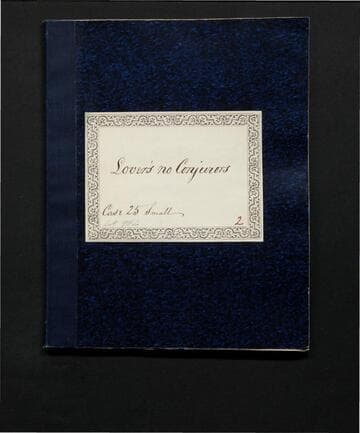
The Privateer

You might also be interested in
Image not available
Map of the City of Vallejo, terminus of the Napa Valley, Sonoma Valley and California Pacific Railroad / Surveyed by E. H. Rowe, C.E
Rare Books
This map has many hand written notes. Notable across the top, "No City or town was ever laid off with better or wider or more regular streets." The verso contains a letter in the same hand to "Brother William" started on August 14, 1871 and continued on August 27th of the same year, giving particulars about Vallejo and investment opportunities available there. Submap; Showing lot arrangement at the junction of two surveying systems. Prime meridian: GM. Relief: no. Graphic Scale: Feet. Projection: Plane. Printing Process: Lithography. Verso Text: Letter to Brother William, 1871.
235195
Image not available
Fadeout : a Dave Brandstetter novel
Rare Books
"Five decades after its original landmark publication, Joseph Hansen's 'Fadeout' is as fresh and important as ever. Preceded only by a handful of gay protagonists in crime fiction, Hansen's Dave Brandstetter, a ruggedly handsome World War II vet with a quick wit, a faultless moral compass, and endless confidence, broke the mold and won over a large reading audience, a feat previously considered impossible for queer fiction. Set in the mid-1960s, 'Fadeout' centers on the disappearance of a Southern California radio personality named Fox Olson. A failed writer, Olson finally found success as a beloved folk singer and wholesome country raconteur with a growing national audience. The community is therefore shocked when Olson's car is found wrecked, having been driven off a bridge and swept away in a fast-moving arroyo on a rainy night. A life insurance claim is filed by Olson's widow and the company holding the policy sends their best man to investigate. The problem is that Olson's body was never found. Not in the car. Not farther down the river. As Dave Brandstetter begins his investigation, he quickly finds that none of it adds up"--From back cover.
642324
Image not available
Jonas Bardsley and Hannah Bardsley letter to family
Manuscripts
Letter sent from Jonas and Hannah Bardsley in Cincinnati, Ohio, to relatives in England shortly after the Bardsleys had arrived in the United States in 1844. Jonas writes to his parents that after landing in Philadelphia and failing to find work in New England or Cleveland, the family traveled to the "western country" and settled in Cincinnati. They had previously worked on a steamboat (Jonas as a fireman, Hannah as a chambermaid, and their son George as a cabin boy) and had traveled up the Red River "three hundred miles higher than any boat ever went before." They passed through the settlements of Choctaw, Cherokee, and other Indian tribes before their steamship was wrecked "2,500 miles above New Orleans." They traveled back down the river in canoes, and camped out along the river among "thousands of...crocodiles, alligators, bloodsuckers, vampires, and other dangerous water reptiles" and in the woods with bears and wolves, although Jonas chiefly complains about the mosquitoes and sand flies. At one point George came down with bilious fever, and Jonas writes that they ultimately spent most of their steamboat wages in getting home. Following the steamboat incident, Jonas determined that "I will be my own master as long as I stay in this country." He writes to his brother John of trying to repay a debt he owes him, although "it is desperate hard to work to get hold of money in this part of the country." Still, Jonas wrote to his brother George that provisions are cheap and "a man with a family is much better off here than in England," although the lack of "amusement" made it less appealing to single men. In a section to his sister Esther, Jonas notes that Hannah "has got many of the Yankee ways" and has become restless since "she has never been able to muster a baby since she left England." He concludes that his son George is sending them a walking stick and tea ground he got in trade from the Choctaw Indians in Texas. The letter is on a printed letterhead with an engraved image of Cincinnati.
mssHM 80135
Image not available
James Hervey Simpson letter to Josiah Simpson
Manuscripts
An autograph, signed letter from James Hervey Simpson to his brother Dr. Josiah Simpson, with envelope. The letter was written three weeks before the 1864 election and Simpson is responding to his brother's concern that it is "injudicious" for him to become involved in presidential politics. Simpson had contributed a long letter to the anti-McClellan pamphlet "Gen'l McClellan's Record. His Sympathy with the South," (1864) a publication attributed to Edgar Conkling. The letter is accompanied by two items which quote Simpson's views on McClellan: a copy of this 1864 pamphlet, with edits by Simpson, and a newspaper clipping from the "Cincinnati Daily Times" with Simpson's letter to the editor (November 12, 1864).
mssHM 84054
Image not available
Arrest warrants and records of interrogation of slaves accused of arson
Manuscripts
On February 23, 1832, a group of slaves belonging to Moses Dickey Kilpatrick (1790-1855), Daniel Webb, Samuel Lecky, and other slave owners of Rowan County were discovered to planning coordinated arson attacks. According to the testimony, Jack, "a negro slave the property of Daniel Webb," was "talking about the patrollers he saith they had been riding and that any man would raise his hand before he would suffer death and that would have to be a stop put to them (the patrollers), and that any terms that Daniel or any of them would let him know he would go and burn big Samuel Leckey's barn." He also was reported as saying that "he wanted to burn Lecky's barn because Lecky had struck Jack's wife at home." Another slave, Daniel persuaded other slaves "to burn Dicky Kilpatrick's barn, and to carry coals in a horn" and "Abe a negro belonging to Margaret Irwin was to burn James Kerrs barn." On March 3, 1832, the Rowan County court issued arrest warrants for the slaves involved. (One of the judges, Abel Graham (1787-1844), was brother-in-law of Moses D. Kilpatrick.) The group includes the warrants and the records of interrogations of accused slaves Jack, Daniel, Newton, Alfred and Will.
mssHM 83163-83166