Manuscripts
Daily: 10 A.M.–5 P.M.
Closed on Tuesdays
1151 Oxford Road
San Marino, CA 91108

Image not available
Manuscripts
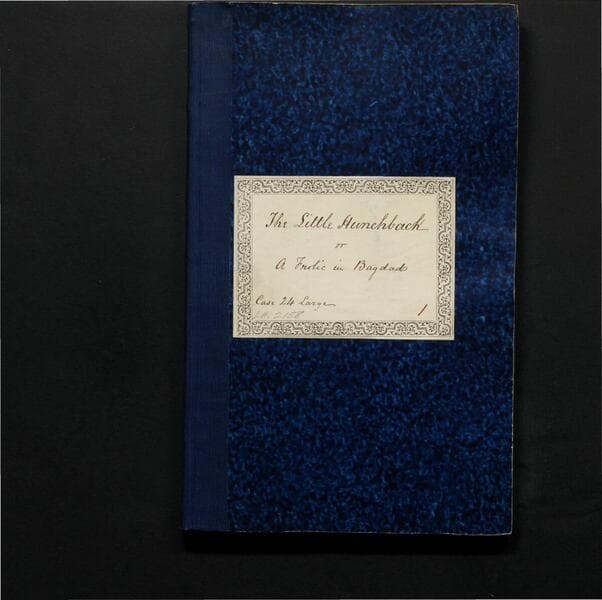
The collection consists of official copies of plays submitted for licensing between 1737 and 1824. Most of copies were written by professional copyists. Approximately 95 of the plays submitted were printed texts, either whole or partial. These have been cataloged individually and may be searched in the online catalog.
LA 2158
Image not available
Manuscripts
Contains loose matted photographs from plays and many portraits of actors and actresses, some in performance; most are from the Midsummer Drama Festival of 1937. Photographs by Jerry Eaton include: Nude with Pineapple (seven photos); Juarez and Maximilian (five photographs and one posterboard with cutouts); Night over Taos (four photos); Montezuma (two photos); and one photo of Morris Ankrum as Pablo Montoya in an unidentified play. Photographs by Peter Piper include: Mlle. Richert in Rose of the Rancho (one photo); Girl of the Golden West (two photos by Piper and two by unidentified photographers); a photo of Charlie Prickett and unidentified man, captioned Nose! Nose! Nose! (A Million Times Nose!) (1938); and Miracle of the Swallows (two photos). Photographs by C. K. Eaton include: Ethan Frome (five photos). Also includes several unidentified photographs and several depictions of set and costume design.
mssPlayhouse
Image not available
Manuscripts
This collection contains the papers of British-American writer Christopher Isherwood, chiefly dating from the 1920s to the 1980s. This part of the collection consists of scripts, literary manuscripts, correspondence, photographs, ephemera, audio-visual material, and Isherwood's library, the archive is an exceptionally rich resource for research on Isherwood, as well as W.H. Auden, Stephen Spender and others. Subjects documented in the collection include homosexuality and gay rights, pacifism, and Vedanta. The Christopher Isherwood Papers were cataloged over a span of 10 years and multiple acquisitions, resulting in a collection organized by accretion, with each new acquisition added on in sequence at the end of the collection, rather than interspersed with similar or related materials. Therefore, each separate acquisition must be searched in order to locate all of the relevant manuscripts or correspondence by a particular author. Similarly, the collection was cataloged by multiple catalogers, so styles, levels of detail and format vary throughout the collection and finding aid. Scripts (Boxes 1-9) The majority of scripts are by Isherwood, and there are quite a few collaborative efforts, e.g., Below the Equator and Jacob's Hands with Aldous Huxley; and Frankenstein, A Meeting By the River and other titles with Don Bachardy. There are also drafts of the early Auden-Isherwood collaborations The Dog Beneath the Skin and The Enemies of a Bishop. Literary Manuscripts (Boxes 10-84) The archive includes manuscripts for most of Isherwood's works. The largest exception is the manuscripts for The Berlin Stories, which are not present. High points include multiple drafts for A Single Man, The World in the Evening, Down There On a Visit, Christopher and His Kind, A Meeting By the River, The Memorial, and My Guru and His Disciple. Isherwood's "Writing Notebook" (CI 1158) is very rich, containing long series of notes on the writing of The World in the Evening and Down There On a Visit. For example, he spent seven years working and re- working The World in the Evening, a process that included many conversations about the novel with his friends Dodie Smith and Alec Beesley. The "Writing Notebook" includes accounts of those conversations, in addition to notes reflecting his own thoughts about writing the novel. An extensive series of notes for lecture that Isherwood presented at universities in southern California contains highly important information on Isherwood's views on literature, Vedanta, and his own place in 20th-century letters. Isherwood and W.H. Auden enjoyed a deep, life-long friendship and, beginning in their youth, they exchanged thoughts about literature and their reactions to one another's writings. Isherwood exerted a profound effect on Auden's poems, suggesting alterations on many occasions. Because of Isherwood and Auden's close literary interaction, Auden gave many poems to Isherwood. These verses, some unpublished, are in the Isherwood Papers, along with an extraordinary notebook containing drafts of early Auden poetry (some unpublished). Of special note is the journal that Isherwood and Auden kept jointly on their trip to Asia in 1938, later published as Diary of a Trip to Asia. Correspondence (Boxes 10-84) The collection is rich in letters to Isherwood, most notably from W.H. Auden and Stephen Spender. The Auden letters are superb and, together with poetry manuscripts, form a body of original material that is equaled only by the manuscripts held in the Berg Collection at the New York Public Library. The letters from Stephen Spender are excellent and form a long body of communication about literary and editorial matters, both his own and Isherwood's. Spender sold Isherwood's letters to the Bancroft Library, so the two halves of the correspondence are housed in northern and southern California. A superb series of letters from E.M. Forster bespeaks the closeness of his friendship with Isherwood, as well as his position as mentor to the younger writer, who greatly admired the older writer. In addition to literary and social matters, Forster's letters include descriptions of the effects of bombing on England during World War Two. Most notably, several letters address Forster's request that Isherwood oversee publication of Maurice after Forster's death. Correspondence from other major literary figures includes letters by Truman Capote, Somerset Maugham, J.D. Salinger, Gore Vidal and Tennessee Williams. An extensive series of letters from dance impresario Lincoln Kirstein fully and wittily document his time in the military, stationed in Germany during World War Two. The longest set of letters by Isherwood is the series to his mother Kathleen Bradshaw-Isherwood, which are long and filled with important information about his activities and his thoughts. These letters have been published: Colletta, Lisa, ed., Kathleen and Christopher: Christopher Isherwood's Letters to His Mother (Minneapolis: University of Minnesota Press, 2005). Apart from this series, Part I of the collection contains relatively few letters by Isherwood. Diaries (Box 85) This box of five volumes includes trips to Greece (1933) and South America (1947-1948), a volume of ideas for stories, and daily diaries (1935-1938 and 1979). Please note: this box of diaries does not have any restrictions of access or use. Addenda (Boxes 86-90) The Addenda material came to the Library in 2000 and was cataloged over the next several years. It consists, mainly, of literary correspondence, interviews and manuscripts by W.H. Auden, Don Bachardy, Ray Bradbury, Christopher Isherwood, Ken Maley, Stephen Spender, and Edward Upward. The Isherwood manuscripts include drafts of Christopher and His Kind, Down There on a Visit and The World in the Evening. Photographs (Boxes 91-114) There are about 1,800 photographs in Part I of the collection, chiefly depicting Christopher Isherwood and Don Bachardy. The majority of the photographs are the work of professional photographers and therefore under copyright, so researchers wishing to publish or make use of them must seek the appropriate permission. Ephemera (Boxes 115-122) Among the ephemera are flyers and publicity for the Auden-Isherwood collaborations, for productions of Cabaret, and for stagings of adaptations of Isherwood's novels. There are also Isherwood's datebooks and address books, published interviews, clippings by and about Isherwood, about his writings, and about others, and miscellaneous printed material. There is also important material that documents homosexuality and the gay rights movement. Audiovisual Material (Boxes 123-135) The audiovisual material contains 3, 5 and 7" magnetic tapes, audiocassettes, VHS and Betamax tapes and three films. The magnetic tapes include Christopher Isherwood conferences, interviews, lectures and speeches; also included, among others, are Don Bachardy, Swami Prabhavananda, Dylan Thomas, and Edward Upward. Many of the tapes also have CD preservation copies and these are noted in the finding aid The audiocassettes include dramatizations of Christopher Isherwood's works, interviews and lectures, as well as a few other authors, including Edward Upward. A limited number of audiocassettes have CD preservation copies and these are noted in the finding aid. The VHS, Betamax tapes and films include interviews with Christopher Isherwood and Don Bachardy on the BBC and Dick Cavett television show, as well as an interview by Ariana Huffington; the tapes have DVD preservation copies and these are noted in the finding aid. The three films are still in process and are not available. Sealed Diaries and Scholar's Papers (Boxes 136-138) The eight daily diary volumes (1939-1970) are sealed until Jan. 1, 2030. The scholar's material includes essays, correspondence and photocopies; the material is sealed until 30 years after the date of each item.
Image not available
Manuscripts
This collection contains of the business records of the Merrymount Press and the related papers of its founder Daniel Berkeley Updike (1860-1941). The bulk of the collection consists of financial volumes; correspondence with customers, publishers, illustrators, craftsmen, and suppliers; bills; estimates; and scrapbooks with specimens of work. While the majority of the correspondence is comprised of letters, there are occasionally proofs, specimens, and cloth, paper, fabric samples, etc., found with the correspondence. The records reflect Updike's involvement with printing across the United States and in Europe, though much of his work was produced for clients in Massachusetts, Rhode Island, and New York City. Some of the correspondence reflects Updike's personal interests including Rhode Island history and churches and charitable work with poor children as well as prison inmates. Correspondence, 1893-1906 Incoming correspondence for 1893 to 1906 is arranged chronologically in boxes and there is currently no name index. Consequently, a researcher searching for correspondence by a specific individual or company needs to look in all folders within an applicable date range. Copies of outgoing correspondence are held in chronological letter books (Volumes 1-31), each with a front alphabetical index. There is also one letter book containing miscellaneous personal correspondence of Updike dating from December 1903-January 1907 (Volume 32). Much of the correspondence in Volume 32 relates to Updike's involvement in various plans to develop a press for Harvard University. Correspondence, 1907-1952 For 1906-1952, original incoming letters, carbon copies of outgoing correspondence, bills, and estimates are grouped in correspondent files arranged according to the year in which the first communication was received by the Press. This filing system was created to work with an alphabetical card catalog (Boxes 321-322) that contains correspondent names, addresses, and group numbers. In some cases the cards also have cross references to related groups. The origin of this organizational schema remains unclear, but its idiosyncrasies impact the ability to find material. There are over 2000 entities assigned individual group numbers in this system. The group numbers were presumably assigned before the material was transferred to the Huntington Library in 1958, and the group numbers were written in blue pencil at the top of each piece of paper along with a sequential item number. (Note: in some cases, items were misfiled or sequential item numbers were incorrectly assigned; consequently the blue handwritten numbers may not be entirely accurate.) This finding aid provides the group number, correspondent name, and the date range of included documents. It does not provide an indication of piece count, and it should be noted that a file may contain only letter or it may contain hundreds of pieces. In addition, the group name typically reflects the main correspondent represented in the file, but in some cases there is related correspondence with other individuals, companies, or organizations. Most of the entities represented are customers of the Press, but numbers were also assigned for individuals and companies doing business with the Merrymount Press or its owner Daniel Updike (such as the Edison Electric Company, tax offices, and investment firms); or for individuals with whom Updike had personal communication. Updike, Bianchi, and Bianchi's son Daniel Berkeley Bianchi also have correspondence files that provides information about the activities of the business. Daniel Bianchi (Group 2214) worked as a representative for the Press in New York beginning in the late 1930s, as did Vrest Orton in 1934-1935 (Group 2176), and their files provide reports of meetings with customers. While most groups are named for individuals or organizations, some materials are filed by type including: Group 125 (Boxes 75-76): Updike, Daniel B. Personal miscellaneous correspondence Group 246 (Box 95): Miscellaneous Business Papers, 1906-1917 Group 549 (Boxes 126-128): Applications for employment Group 737 (Boxes 144-145): Foreign booksellers Group 847 (Boxes 152-153): Miscellaneous correspondence, 1907-1919 arranged alphabetically Group 847 (Boxes 154-160): Miscellaneous correspondence, 1920-1929 arranged alphabetically Group 847 (Boxes 161-172): Miscellaneous correspondence, 1930-1948 arranged alphabetically Group 1089 (Box 217): Religious Documents Printed by the Merrymount Press, 1908 Group 2275 (Box 318): Victory Tax, ca. 1943-1949 (includes W-2 withholding receipts for employees) Note: Groups are also referred to as folders on the physical boxes. Financial volumes The financial volumes include day-books, journals, cash books, invoice books, sales books, ledgers, and job books (Volumes 33-141). In addition there are books of copies of receipts generated by the Merrymount Press to customers (Volumes 197-200), as well as volumes recording cash receipts/disbursements related to the estate and trust of Edward Perry Warren (Volume 201-203). Updike was a trustee of the Warren trust, and these volumes are complemented by files found in the correspondence series. There is also what appears to be a personal cash book for Updike, 1902-1903 (Volume 205) Specimen books The collection also includes an extensive set of scrapbooks of minor printing done by the Press containing specimens of small jobs such as bookplates, envelopes, pamphlets, and programs (Volumes 142-180). There is also a scrapbook of small advertising jobs produced by Houghton-Mifflin Co. while D. B. Updike worked for them in the 1880s and early 1890s (Volume 184). In addition there are scrapbooks of minor printing, design examples, and type specimens maintained by the Press (Volumes 185-196). Additional materials The collection also contains other materials created by or owned by the Merrymount Press. This includes 30 publishing dummies, mostly for books printed by the Pres (Volumes 206-234), including The Book of Common Prayer; decorative and marbled endpaper samples (Box 327); two volumes containing clipped press notices from newspapers about the Press (Volumes 235-236); some publications/articles about Updike and the Press (Box 328); and 17 catalogs, chiefly bookseller sales catalogs, which are primarily related to printing and typography (most of these catalogs contain the Merrymount Press bookplate). There are also miscellaneous typescript manuscripts (Boxes 325-326) consisting of: "Memoirs of Mary Baker Eddy" by Adam H. Dickey [typescript manuscript with pencil corrections and annotations], 1927; a translation from the German of Music Printing with movable type in the 16th century. Leipzig, 1892 [typescript manuscript]; "Humanistic Script" (Chapter III) by Stanley Morison [typescript manuscript]; and "Printing Types" manuscript and notes by D. B. Updike, 1937.
mssCI
mssMerrymount