Manuscripts
The New Play Criticiz'd; or, The Plague of Envy (The Suspicious Husband Criticized; or, The Plague of Envy)

You might also be interested in
Image not available
The New Play Criticiz'd; or, The Plague of Envy. [The Suspicious Husband Criticized; or, The Plague of Envy.] Farce, 1 act. Charles Macklin
Manuscripts
The collection consists of official copies of plays submitted for licensing between 1737 and 1824. Most of copies were written by professional copyists. Approximately 95 of the plays submitted were printed texts, either whole or partial. These have been cataloged individually and may be searched in the online catalog.
LA 64
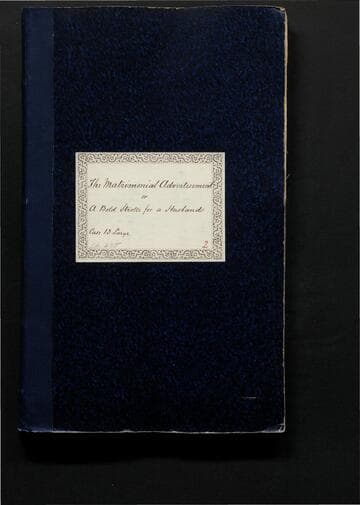
The Matrimonial Advertisement; or, A Bold Stroke for A Husband
Manuscripts
Produced as 'The Advertisement; or, A Bold Stroke for a Husband' on August 9th. Manuscript copy containing a number of corrections and a prologue. A wealthy widow desires a new husband.
mssLA 435
Image not available
The Advertisement; or, A New Way to Get a Husband. Farce, 2 acts. James Fennell
Manuscripts
No application. [1791?] MS: several pages canceled. J.P.C. in B.D.: 'The Advertisement or a new way to get a Husband' a farce in 2 acts was licensed on March 3d. 1791 and according to Larpents accounts played for the benefit of Lee Lewis-Larpents Copy contains some curious erasures of passages against dramatic despotism-
LA 924
Image not available
John Larpent Plays
Manuscripts
This collection consists of official manuscript copies of plays submitted for licensing between 1737 and 1824 that were in the possession of John Larpent, the examiner of plays, at the time of his death in 1824. These copies were later owned by John Payne Collier before being purchased by the Bridgewater House Library. The collection includes 2,399 identified plays as well as an additional 104 unidentified pieces including addresses, prologues, epilogues, etc. These copies of plays, generally, were clearly written by professional copyists attached to the theaters, though some are partly, or entirely, in the authors' handwriting. Most copies are accompanied by a formal application for license to perform, signed by the manager of the theater. The name of the author only rarely appears upon the play, except on title-pages of printed copies, submitted instead of manuscripts. Presumably, all new plays performed between June 24, 1737, and January 18, 1824, were licensed as the law required, but Larpent's collection is not entirely complete. The most conspicuous of the plays not now in the Huntington's collection (e.g., The Clandestine Marriage and The School for Scandal) are also not listed in the manuscript Alphabetical Catalogue with Notes of Theatrical representations &ca Submitted for Licensing From The Year 1737, to the Year 1787 inclusive in the handwriting of Larpent and of his second wife (now held by the New York Public Library). Their omission in Larpent's list suggest that these plays were removed from the Examiners' papers before Larpent took office. Others appear to have been either returned to the managers or given away by Larpent or by Collier. Note though that the Alphabetical Catalogue is incomplete and lacks a large number of titles held in this collection. A manuscript catalogue, Larpent dramatic manuscripts catalogue, 1737-1824 (call number: EL 26/B/11), was presumably made under Collier's direction, and it sometimes conveys information not found upon the copy itself, though the catalogue is incomplete and at times inaccurate. Originally, the manuscripts were bound in a rough whity-brown paper covers, upon which the Examiner often made notes. Before Larpent took office, the mark of an "X" on the paper cover seems to have indicated that the play had been examined; but Larpent usually entered the name of the theater submitting the play and a date, presumably when Larpent licensed the play and generally a day or two after the date of the application. Sometimes, though, the date is considerably after the first performance. On some copies, the marks of the Examiners indicate objectionable passages, and most suppressed plays bear endorsements stating that the license was not granted. While Collier had access to the collection, he inscribed many of the copies with notes, most of them partly in shorthand, recording his opinions on matters such as authorship, handwriting, or date. Though many of these notes are correct, others are mistaken or unintelligible. The fact that these plays are official copies sent to the office of the Examiner by the managers of the theaters, not the authors, places them in a different category from that of most literary texts. Their relation on the one hand to the acted version and on the other to the published work raises complicated problems that can be solved only individually. What liberties actors took with the text after it had been approved, one cannot say, but it seems likely that in general the licensed text was presented on the stage. The printed play, however, was generally set from copy provided by the author; and in it he had the opportunity to restore what the manager had eliminated, or to revise the piece in the light of its reception. The Larpent text, thus, may represent a state of composition either later or earlier than the first acted version. An examination of the manuscripts will show that the Examiner's copy seldom conforms entirely to the published text.
mssLA 1-2503
Image not available
[Akins, Zoë, 1886-1958]. "These Critics:" [essay], A. MS. (23 p.), ([ca. 1921?]), [New York (N.Y.)]
Manuscripts
The collection consists of the personal and business papers of Zoë Akins (1886-1958). It includes correspondence with various literary, theatrical and motion picture figures of the first half of the twentieth century. There are also manuscripts of novels, plays, poems, short stories, outlines for plays, and articles. There is also correspondence related to her husband, Hugo Rumbold (d. 1932), and the Rumbold family. The collection also contains various photographs, manuscripts by others, and various business papers (including agreements, accounts, contracts, copyrights, and receipts). Correspondents represented in the collection include: Aline Barnsdall, Ethel Barrymore, Carlo Beuf, Billie Burke, Willa Cather, George Cukor, Patterson Greene, Sir Gerald Grove, William Harris, Carl Hovey, Jobyna Howland, Orrick Johns, George S. Kaufman, Alice Kauser, Sonya Levien, Anita Loos, Amy Lowell, W. Somerset Maugham, H.L. Mencken, Harry Moses, Kay Nielsen, George O'Neil, Max Pfeffer, Rosamond Pinchot, Una Pope-Hennessey, William Marion Reedy, Lady Etheldred Rumbold, Sir Horace Rumbold, Hugo Rumbold, David Selznick, Edward Sheldon, Sara Teasdale, Harriet Ware, Edith Wharton, John Hall Wheelock.
ZA 533.
Image not available
American Play Company. 22 letters and 2 telegrams to Zoë Akins, 1886-1958, (1933, Mar.- 1954), New York (N.Y.)
Manuscripts
The collection consists of the personal and business papers of Zoë Akins (1886-1958). It includes correspondence with various literary, theatrical and motion picture figures of the first half of the twentieth century. There are also manuscripts of novels, plays, poems, short stories, outlines for plays, and articles. There is also correspondence related to her husband, Hugo Rumbold (d. 1932), and the Rumbold family. The collection also contains various photographs, manuscripts by others, and various business papers (including agreements, accounts, contracts, copyrights, and receipts). Correspondents represented in the collection include: Aline Barnsdall, Ethel Barrymore, Carlo Beuf, Billie Burke, Willa Cather, George Cukor, Patterson Greene, Sir Gerald Grove, William Harris, Carl Hovey, Jobyna Howland, Orrick Johns, George S. Kaufman, Alice Kauser, Sonya Levien, Anita Loos, Amy Lowell, W. Somerset Maugham, H.L. Mencken, Harry Moses, Kay Nielsen, George O'Neil, Max Pfeffer, Rosamond Pinchot, Una Pope-Hennessey, William Marion Reedy, Lady Etheldred Rumbold, Sir Horace Rumbold, Hugo Rumbold, David Selznick, Edward Sheldon, Sara Teasdale, Harriet Ware, Edith Wharton, John Hall Wheelock.
ZA 2597-2620.